Map of Germany showing where the Fusi arms are recorded
The Fusi arms were recorded in Nuremberg, c. 1765.
This is where the arms were entered in the register. Families often moved to other parts of the country, so the same name can turn up in more than one region.
The body that granted and recorded arms in Germany in this period.
Francis I, Holy Roman Emperor
Sovereign of the period
Francis I, Holy Roman Emperor
1745–1765
Reigning in Germany when the Fusi arms are first recorded.
How Arms Worked in Germany
In the Holy Roman Empire, coats of arms were often granted to individuals by the Emperor or his representatives. These arms were then passed down through the generations to all legitimate descendants of the original holder. Younger branches of a family usually kept the same shield design without needing to change it, as the arms belonged to the entire lineage.
Granting authority
The Holy Roman Emperor held the sole power to grant new coats of arms throughout his vast imperial territories.
How they got arms
Families typically obtained their coats of arms through a formal imperial grant or by proving their noble status to the authorities.
Where arms were recorded
These grants were officially recorded in the Imperial Chancery registers, which began keeping formal records of such honors during the Middle Ages.
The family's standing
Recorded among the armigerous families of Germany.
Origin & History of the Fusi Family in Germany
The Fusi family name has roots that reach into the heart of the Holy Roman Empire, with documented evidence placing members of the family in the imperial city of Nuremberg by 1765. During this period, Nuremberg served as a major center for trade and skilled craftsmanship, attracting families who were often involved in specialized guilds or mercantile networks. The name itself is believed to be a variation of the Italian word "fuso," which means spindle, suggesting that the earliest ancestors may have been associated with the textile industry or tool making. As the family established their presence in Germany, they likely integrated into the urban middle class, contributing to the city’s reputation for precision engineering and artistic production. By settling in such a prominent hub, the Fusi family became part of the complex social fabric of eighteenth-century Germany, where they navigated the shifting economic landscape of the Enlightenment era.
Meaning of the Fusi family crest colors & symbols
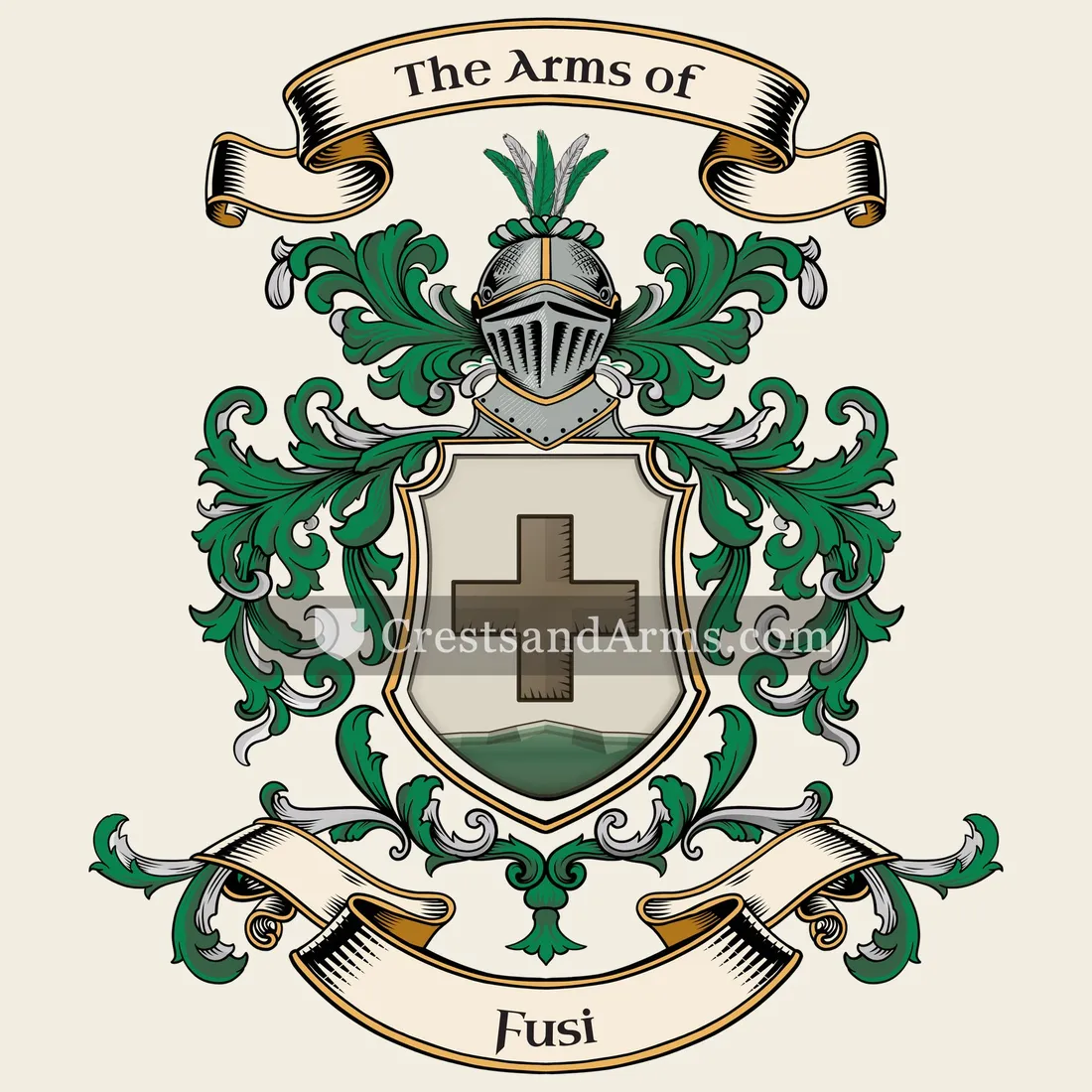
Symbols on this shield
cross symbolChristian faith and service
mountThe ground held, and steadfastness upon it
Colours
Silver (Argent)Means: Peace and sincerity
Green (Vert)Means: Hope
Historical info
Source
J. B. Rietstap, Armorial Général, Gouda: G. B. van Goor Zonen, 1884–87
Blazon (the actual original written record)
“D'arg. à une croix latine, couleur de bois, le pied fendu, soutenu d'un tertre de sin. C.: la croix. L. d'arg. et d'azur.”
SwitzerlandBâle, c. 1745
Digital archive packCoat of arms PNG, gold border print PDF, vector SVG and the certificate of authenticity. Sent to your email in minutes.
Map of Switzerland showing where the Fusi arms are recorded
The Fusi arms were recorded in Bâle, c. 1745.
This is where the arms were entered in the register. Families often moved to other parts of the country, so the same name can turn up in more than one region.
The body that granted and recorded arms in Switzerland in this period.
How Arms Worked in Switzerland
In Switzerland, coats of arms were not restricted to the nobility and were often adopted by common citizens and families. These symbols were passed down through generations to show family identity. When branches of a family grew, they often changed small details of the design to distinguish their own line from the original group.
Granting authority
Cantonal and civic authorities managed the use of coats of arms within their specific regions and local jurisdictions.
How they got arms
Families typically assumed their own coats of arms based on local custom rather than receiving them from a central monarch.
Where arms were recorded
Arms were recorded in various cantonal and civic registers starting from the fourteenth century throughout the Swiss region.
The family's standing
Recorded among the armigerous families of Switzerland.
Origin & History of the Fusi Family in Switzerland
The history of the Fusi family in Switzerland is deeply rooted in the urban landscape of Basel, where records confirm their presence by at least 1745. During the eighteenth century, Basel served as a major center for trade and intellectual exchange, providing a stable environment for families to establish themselves within the local guild and merchant systems. The name itself is of Italian origin, likely derived from the word for a spindle, which suggests that early ancestors may have been involved in the textile or silk industries that were vital to the Swiss economy at the time. As these individuals settled in the city, they integrated into the social fabric of the region, transitioning from transient workers or traders into established residents. This migration pattern reflects the broader movement of families across the Alps, who sought new opportunities in the prosperous cities of the Swiss Confederation. By maintaining their identity while adapting to the local culture of Basel, the Fusi family became a small but enduring part of the city’s long history of craftsmanship and commerce.
Fusi Meaning & Related Branches
Root word
Fuss
German word for foot or a person with a distinctive gait.
This name
FusiA topographic or occupational surname referring to someone living near a foot of a hill.
also spelled
Fus
Fusss
Fusse
Documented Sources
J. B. Rietstap, Armorial Général, Gouda: G. B. van Goor Zonen, 1884–87
Stadtarchiv Nürnberg, Bürgerbücher der Reichsstadt Nürnberg, 1765
Bahlow, Hans, Deutsches Namenlexikon: Familien- und Vornamen nach Ursprung und Sinn erklärt, 1967
Digital archive packCoat of arms PNG, gold border print PDF, vector SVG and the certificate of authenticity. Sent to your email in minutes.


 legStrength and swiftness
 legStrength and swiftness
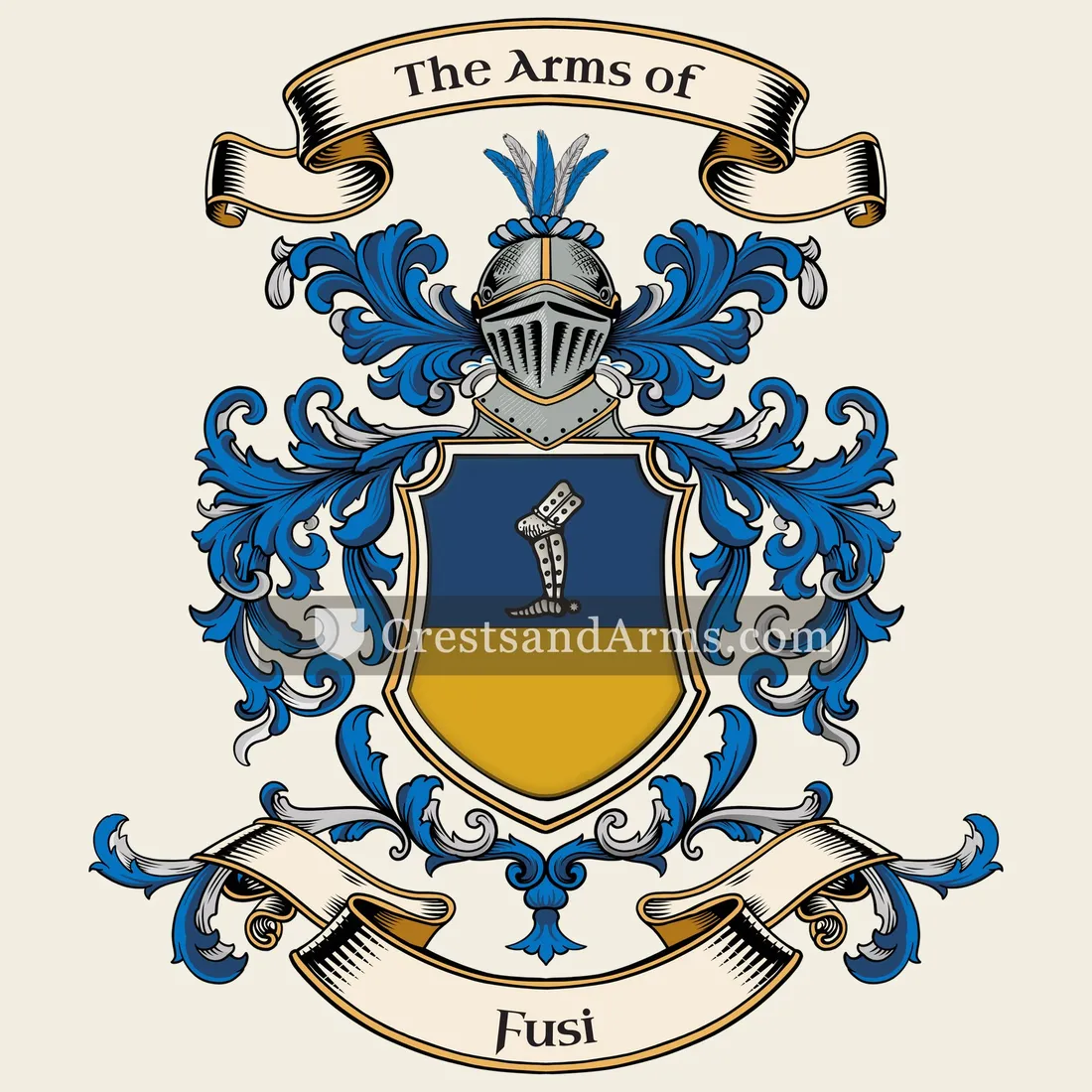


 cross symbolChristian faith and service
 mountThe ground held, and steadfastness upon it