Map of Germany showing where the Fuss arms are recorded
The Fuss arms were recorded in Nuremberg, c. 1765.
This is where the arms were entered in the register. Families often moved to other parts of the country, so the same name can turn up in more than one region.
The body that granted and recorded arms in Germany in this period.
Francis I, Holy Roman Emperor
Sovereign of the period
Francis I, Holy Roman Emperor
1745–1765
Reigning in Germany when the Fuss arms are first recorded.
How Arms Worked in Germany
In the Holy Roman Empire, coats of arms were often granted to individuals by the Emperor or his representatives. These arms were then passed down through the generations to all legitimate descendants of the original holder. Younger branches of a family usually kept the same shield design without needing to change it, as the arms belonged to the entire lineage.
Granting authority
The Holy Roman Emperor held the sole power to grant new coats of arms throughout his vast imperial territories.
How they got arms
Families typically obtained their coats of arms through a formal imperial grant or by proving their noble status to the authorities.
Where arms were recorded
These grants were officially recorded in the Imperial Chancery registers, which began keeping formal records of such honors during the Middle Ages.
The family's standing
Recorded among the armigerous families of Germany.
Origin & History of the Fuss Family in Germany
The surname Fuss originated in Germany as a descriptive nickname, likely referring to a person’s physical stature or their way of walking. During the Middle Ages, many German families adopted names based on specific traits, and the word *Fuss*, meaning foot, was a common way to identify someone who was known for being a fast runner or a frequent traveler. By the time members of the family were documented in Nuremberg in 1765, the name had become a stable hereditary surname passed down through generations. Nuremberg was a major center for trade and craftsmanship during the eighteenth century, suggesting that early ancestors likely worked as skilled artisans or merchants within the city walls. These families contributed to the local economy and social fabric of the region, living as established citizens during a time of significant growth and cultural development in Bavaria.
Coat of Arms & Family Crest Details
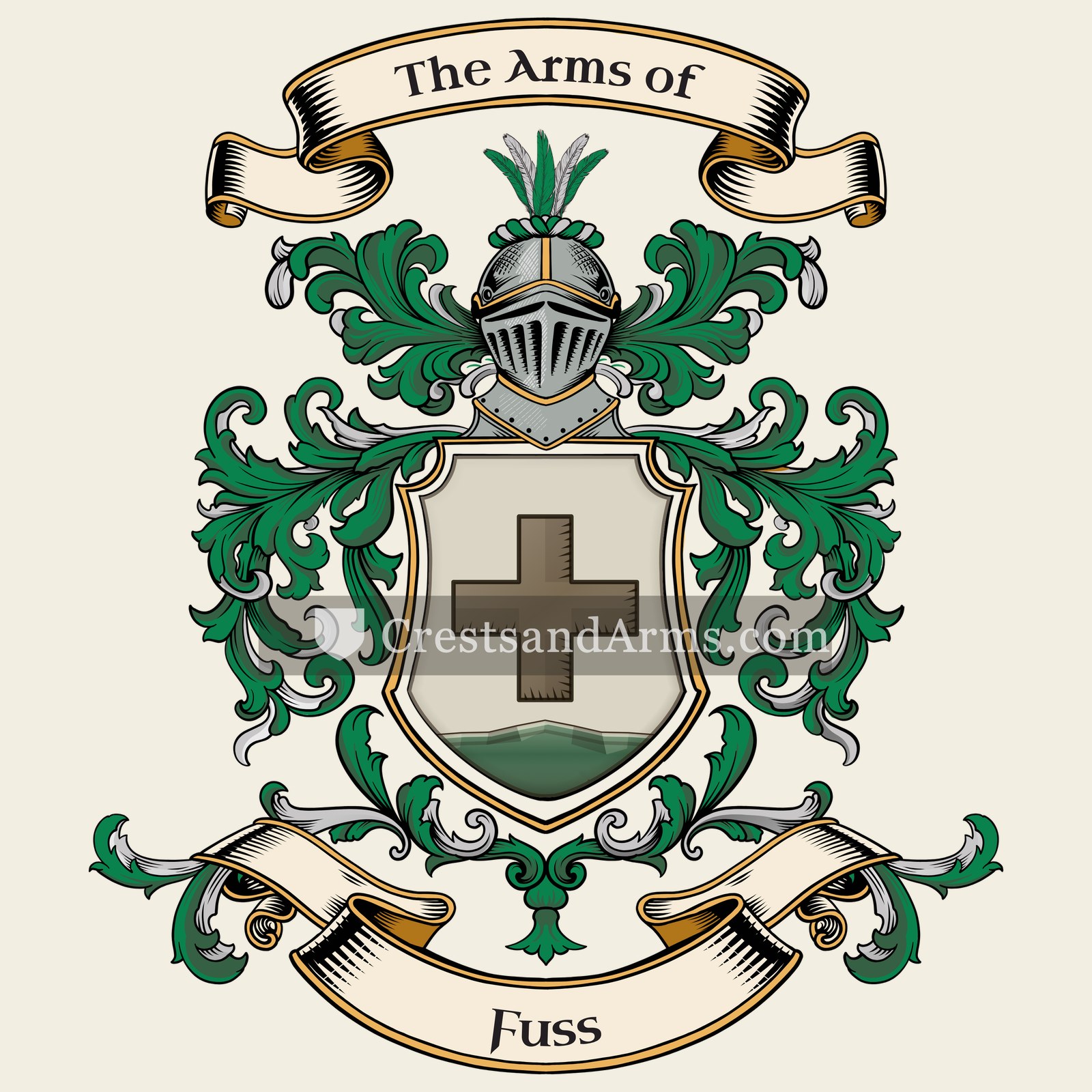
Symbols on this shield
cross symbolChristian faith and service
mountThe ground held, and steadfastness upon it
Colours
Silver (Argent)Means: Peace and sincerity
Green (Vert)Means: Hope
Historical info
Source
J. B. Rietstap, Armorial Général, Gouda: G. B. van Goor Zonen, 1884–87
Blazon (the actual original written record)
“D'arg. à une croix latine, couleur de bois, le pied fendu, soutenu d'un tertre de sin. C.: la croix. L. d'arg. et d'azur.”
SwitzerlandBâle, c. 1745
Digital archive packCoat of arms PNG, gold border print PDF, vector SVG and the certificate of authenticity. Sent to your email in minutes.
Map of Switzerland showing where the Fuss arms are recorded
The Fuss arms were recorded in Bâle, c. 1745.
This is where the arms were entered in the register. Families often moved to other parts of the country, so the same name can turn up in more than one region.
The body that granted and recorded arms in Switzerland in this period.
How Arms Worked in Switzerland
In Switzerland, coats of arms were not restricted to the nobility and were often adopted by common citizens and families. These symbols were passed down through generations to show family identity. When branches of a family grew, they often changed small details of the design to distinguish their own line from the original group.
Granting authority
Cantonal and civic authorities managed the use of coats of arms within their specific regions and local jurisdictions.
How they got arms
Families typically assumed their own coats of arms based on local custom rather than receiving them from a central monarch.
Where arms were recorded
Arms were recorded in various cantonal and civic registers starting from the fourteenth century throughout the Swiss region.
The family's standing
Recorded among the armigerous families of Switzerland.
Origin & History of the Fuss Family in Switzerland
The family name Fuss has deep roots in the Swiss region, with historical records confirming the presence of the family in the city of Bâle by 1745. In the German language, the word "Fuss" translates to "foot," which suggests that the name likely originated as a descriptive nickname for an ancestor. During the Middle Ages, it was common for people to receive surnames based on physical traits, a long journey they had taken, or a specific way they walked. By the mid-18th century, the Fuss family had established themselves within the urban environment of Bâle, which was a major center for trade and intellectual life at the time. As residents of this influential city, members of the family were part of a society that valued craftsmanship and civic participation. Over the following generations, the family became a part of the local fabric, contributing to the growth and history of the region through their daily work and community involvement.
Fuss Meaning & Related Branches
Root word
Fuss
Middle High German word for foot or a measurement of length.
This name
FussA topographic name for someone living near a landmark or a nickname for a person with large feet.
also spelled
Fus
Fusss
Fusse
Documented Sources
J. B. Rietstap, Armorial Général, Gouda: G. B. van Goor Zonen, 1884–87
Bahlow, Hans, Deutsches Namenlexikon: Familien- und Vornamen nach Ursprung und Sinn erklärt, 1967
Heintze, Albert, Die deutschen Familiennamen: geschichtlich, geographisch, sprachlich, 1903
Stadtarchiv Nürnberg, Bürgerbücher der Reichsstadt Nürnberg, 1765
Digital archive packCoat of arms PNG, gold border print PDF, vector SVG and the certificate of authenticity. Sent to your email in minutes.


 legStrength and swiftness
 legStrength and swiftness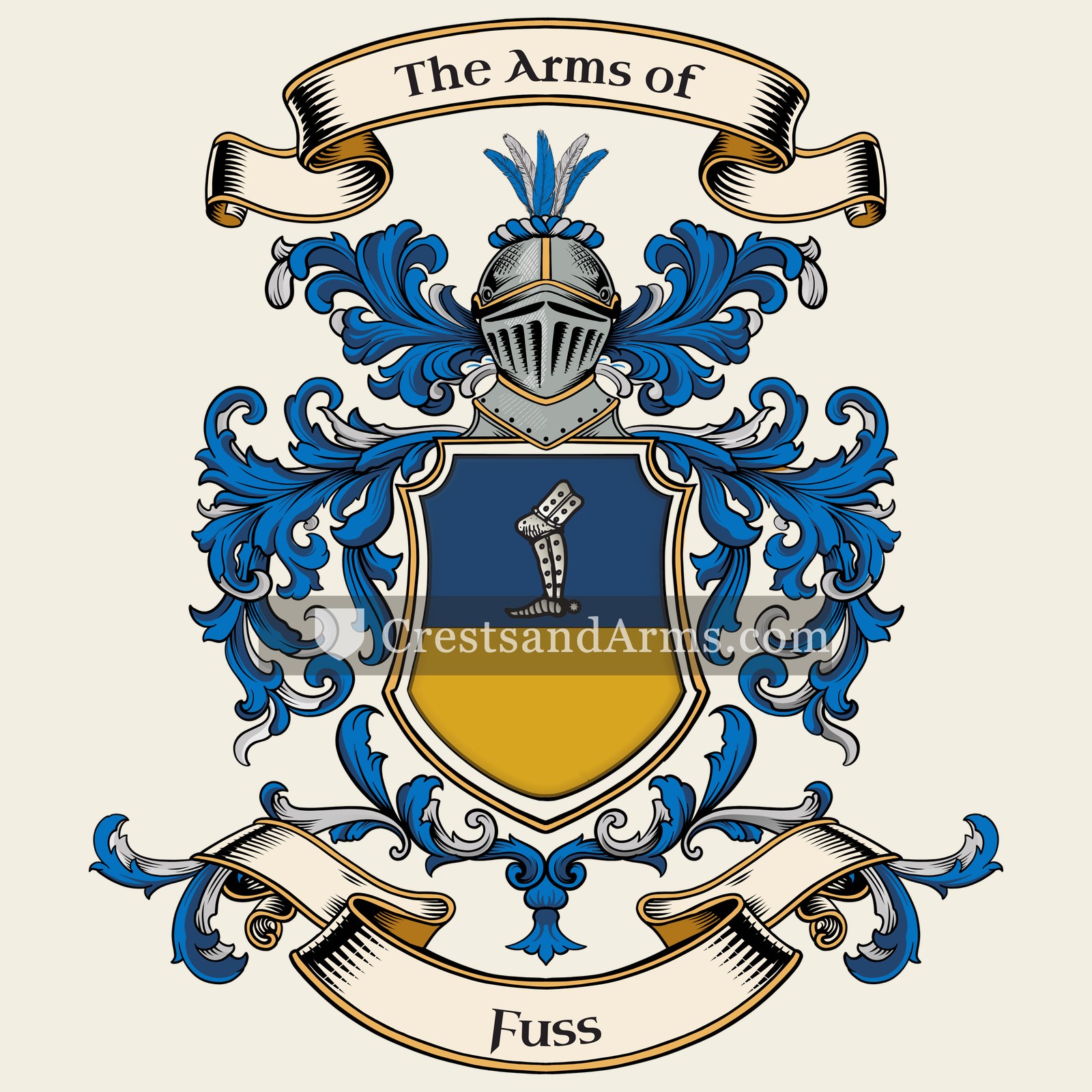


 cross symbolChristian faith and service
 mountThe ground held, and steadfastness upon it