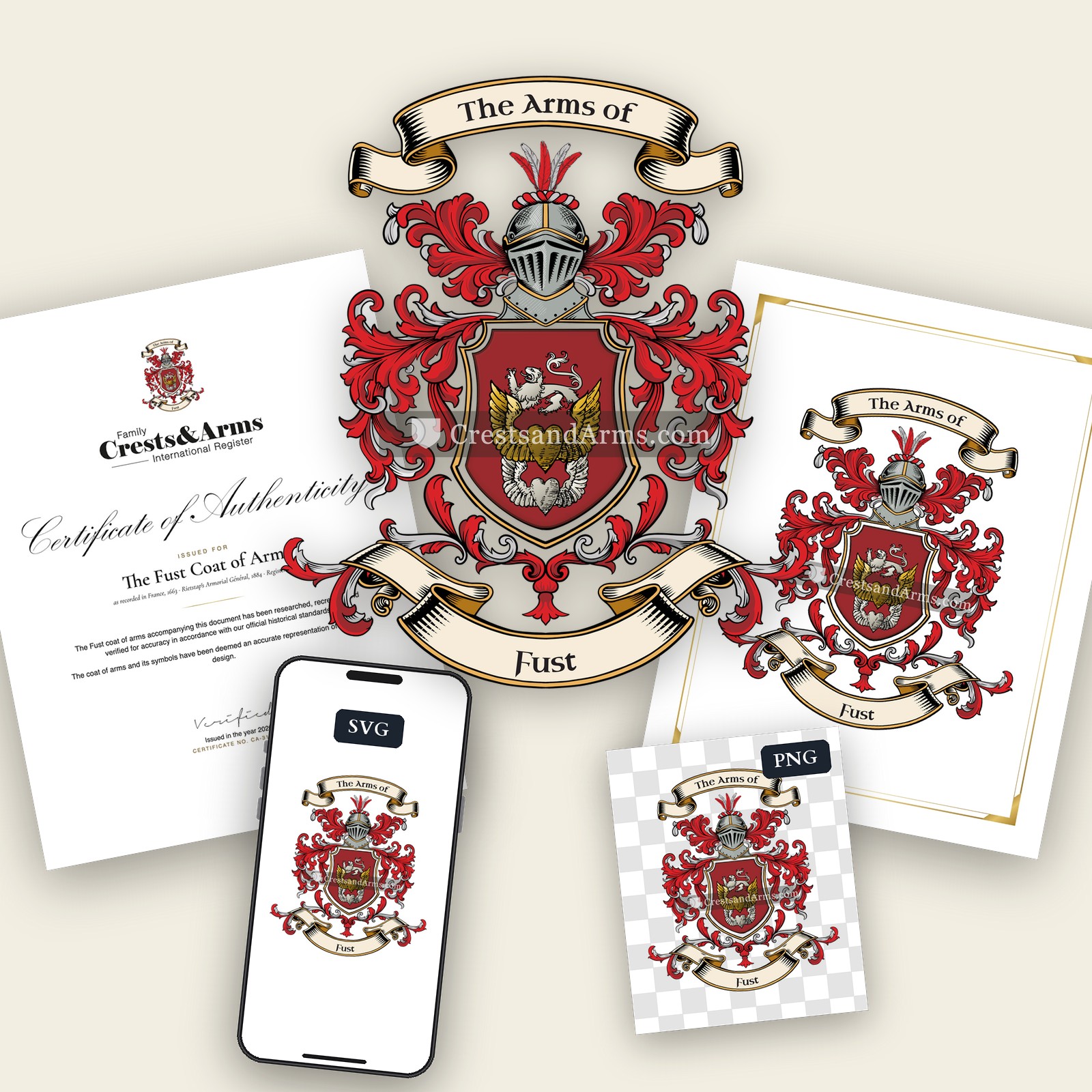
Map of France showing where the Fust arms are recorded
The Fust arms were recorded in Champagne, c. 1663.
Champagne made its money at its great trade fairs, where merchants from across Europe met. Wealth of that kind bought land, and land brought arms, so the region carries a lot of names.
This is where the arms were entered in the register. Families often moved to other parts of the country, so the same name can turn up in more than one region.
The body that granted and recorded arms in France in this period.
Louis XIV of France
Sovereign of the period
Louis XIV of France
1643–1715
Reigning in France when the Fust arms are first recorded.
How Arms Worked in France
In France, a coat of arms was a mark of honor that passed down through the male line to all legitimate descendants. Families often used the same shield without changes to show their shared heritage. If a branch wanted to stand out, they could add a small mark to their shield to show their specific place in the family tree.
Granting authority
The Juge d'armes de France acted as the official authority that regulated and verified coats of arms across the country.
How they got arms
Families typically inherited their arms from ancestors, though they could also receive them through royal grants or by proving their noble status.
Where arms were recorded
Coats of arms were officially recorded in the Armorial Général de France, which began its main collection in the year 1696.
The family's standing
Recorded among the armigerous families of Champagne.
Origin & History of the Fust Family in France
The family name Fust has deep roots in the Champagne region of France, where records confirm their presence as early as 1663. During the seventeenth century, this area was a vital center for agriculture and trade, placing the family in a landscape defined by rolling vineyards and bustling market towns. Families living in Champagne at this time often held roles tied to the land or local administration, which helped them establish a lasting footprint in their community. While the name is sometimes associated with later migrations to other parts of Europe, its early history is firmly anchored in the social and economic life of the French countryside. By maintaining consistent ties to their home province, the Fust family participated in the regional traditions and historical shifts that defined Champagne during the reign of King Louis XIV.
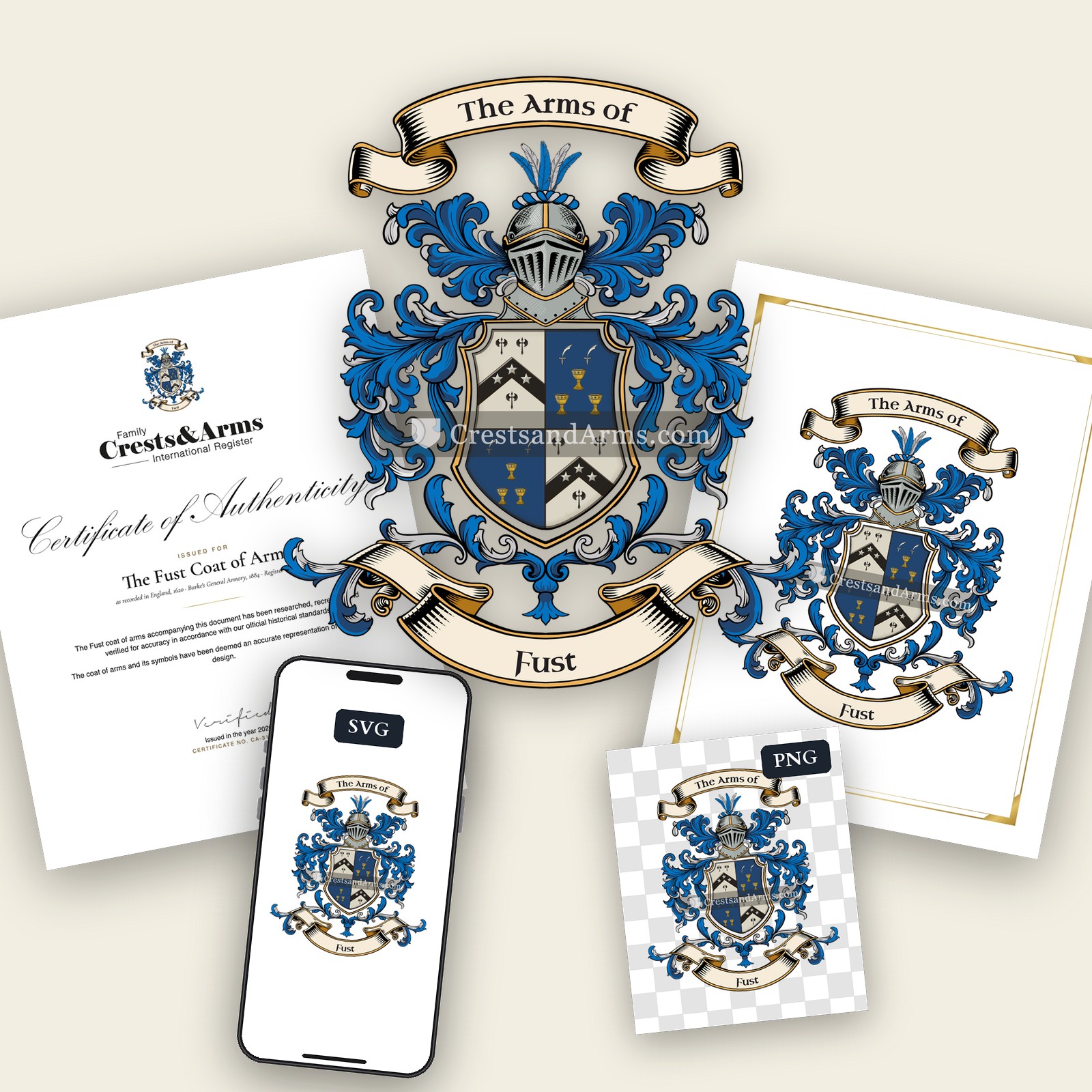
Coat of Arms & Family Crest Details
Symbols on this shield
chevronProtection, and faithful service completed
axeThe execution of military duty
mulletThe third son, and a divine quality from above
swordJustice, and military honour
cupFaith, office, and a trust discharged
Colours
Silver (Argent)Means: Peace and sincerity
Blue (Azure)Means: Loyalty and truth
Black (Sable)Means: Constancy
Gold (Or)Means: Generosity
Historical info
Source
Sir Bernard Burke, The General Armory of England, Scotland, Ireland and Wales, London: Harrison & Sons, 1884
Blazon (the actual original written record)
“Quarterly, 1st and 4th, ar. on a chev. betw. three woodbills erect sa. as many mullets pierced of the field, for FUST; 2nd and 3rd, az. two swords erect chevronways, points meeting ar. pommels and hilts or, betw. three covered cups of the last, for JENNER”
KentKent, c. 1620
Digital archive packCoat of arms PNG, gold border print PDF, vector SVG and the certificate of authenticity. Sent to your email in minutes.
Map of England showing where the Fust arms are recorded
The Fust arms were recorded in Kent, c. 1620.
Kent sits between London and the short crossing to Europe, and the trade passing through made it wealthy. Merchant families bought land with that money, and it was landowners who took coats of arms.
This is where the arms were entered in the register. Families often moved to other parts of the country, so the same name can turn up in more than one region.
The body that granted and recorded arms in England in this period.
James VI and I
Sovereign of the period
James VI and I
1603–1625
Reigning in France when the Fust arms are first recorded.
How Arms Worked in England
English heraldry allowed arms to be shared by all legitimate descendants of the original owner. These symbols were treated as personal property that moved through the generations to all children. While the eldest son kept the original design, other family members could use the same shield without needing to change it or register their own unique versions.
Granting authority
The College of Arms in London has regulated the use of coats of arms throughout England and Wales since 1484.
How they got arms
Families typically obtained their coats of arms through a formal grant from the Crown or by proving their ancient right to them.
Where arms were recorded
All official coats of arms are recorded in the registers kept at the College of Arms, which date back to the fifteenth century.
The family's standing
Recorded among the armigerous families of Kent.
Origin & History of the Fust Family in England
The Fust family name has roots that stretch back into the early seventeenth century in the county of Kent. By 1620, records confirm that members of the family were established within this region, which was a hub for trade and agriculture in England. The name itself is thought to have Germanic origins, potentially derived from a word meaning a fist or a strong grasp, which may have originally served as a descriptive nickname for an ancestor. As the family settled into English life, they became part of the local social fabric, often appearing in parish registers and legal documents that tracked property ownership and community standing. Their presence in Kent suggests they were likely involved in the active economic life of the southeast, contributing to the development of the local area during a time of significant social change.
Fust Meaning & Related Branches
Root word
fustis
A Latin term referring to a club, staff, or cudgel.
This name
FustAn occupational name for a maker of wooden staves, clubs, or barrels.
also spelled
Fuste
Fustt
Fustte
Related arms
Voestsame arms
Documented Sources
J. B. Rietstap, Armorial Général, Gouda: G. B. van Goor Zonen, 1884–87
Archives départementales de la Marne, Registres paroissiaux et d'état civil
Boutier, Jean, Les noms de famille en France, 2002
Dauzat, Albert, Dictionnaire étymologique des noms et prénoms de France, 1951
Digital archive packCoat of arms PNG, gold border print PDF, vector SVG and the certificate of authenticity. Sent to your email in minutes.


 heartSincerity, charity and true affection
 lionCourage, strength and royalty
 heartSincerity, charity and true affection
 lionCourage, strength and royalty


 chevronProtection, and faithful service completed
 axeThe execution of military duty
 mulletThe third son, and a divine quality from above
 swordJustice, and military honour
 cupFaith, office, and a trust discharged