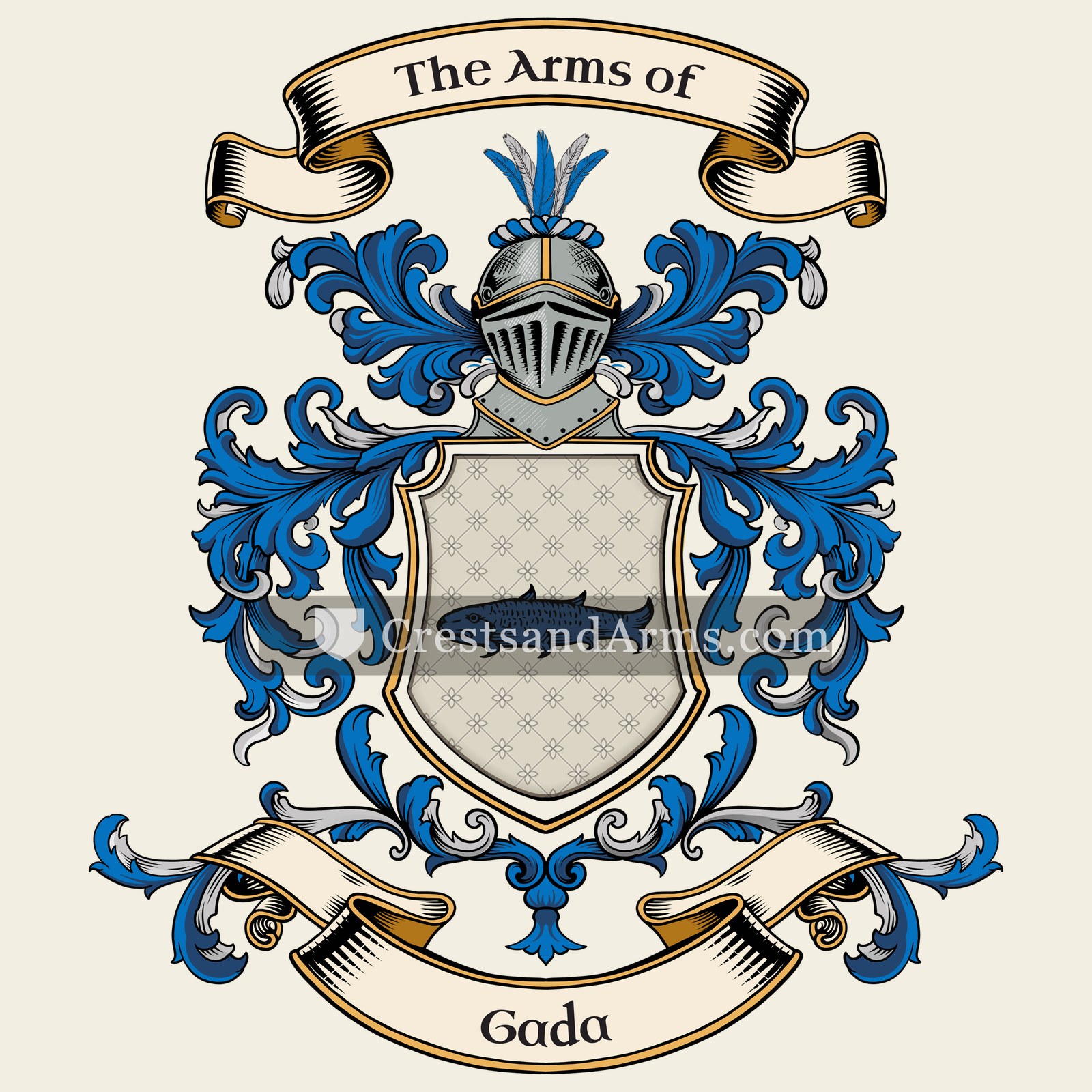
A record of documented arms, meaning and origin, researched for the Gada family of Sweden.
Reg. 1660 · Swedish, G–I
Coat of Arms & Family Crest Details
Symbols on this shield
fishA true and generous mind, and Christian faith
Colours
Silver (Argent)Means: Peace and sincerity
Blue (Azure)Means: Loyalty and truth
Historical info
Source
J. B. Rietstap, Armorial Général, Gouda: G. B. van Goor Zonen, 1884–87
Blazon (the actual original written record)
“D'arg. à un poisson d'azur, posé en bande. Cq. cour. C.: un poisson d'azur, posé en pal; entre deux prob., coupées alt. d'arg. et d'azur.”
Swedenc. 1705
Where the Gada Arms Were Recorded
Stockholm
Map of Sweden showing where the Gada arms are recorded
The Gada arms were recorded in Sweden, c. 1705.
Arms such as these were typically recorded in Stockholm.
Stockholm held the Swedish court and the House of Nobility, where every noble family's arms were entered and kept. Families ennobled for service registered there, which is why so many are recorded around the city.
This is where the arms were entered in the register. Families often moved to other parts of the country, so the same name can turn up in more than one region.
The body that granted and recorded arms in Sweden in this period.
Carl XII of Sweden
Sovereign of the period
Carl XII of Sweden
1697–1718
Reigning in Sweden when the Gada arms are first recorded.
How Arms Worked in Sweden
In Sweden, a coat of arms belonged to a noble family as a whole rather than just one individual. These arms were passed down through the generations to all legitimate descendants. Younger branches of the family used the same shield without needing to change it. This system ensured that the entire lineage shared the same identity and status under the law.
Granting authority
The Riddarhuset, or House of Nobility, regulated all noble coats of arms in Sweden under royal authority.
How they got arms
Families received their coats of arms through royal grants of nobility which were then officially registered with the House.
Where arms were recorded
Coats of arms were officially recorded in the Swedish House of Nobility register starting in the year 1626.
The family's standing
Recorded among the armigerous families of Sweden.
Origin & History of the Gada Family in Sweden
The history of the Gada family in Sweden is rooted in the urban life of Stockholm during the early eighteenth century. Historical records confirm that members of the family were established residents of the city by 1705. During this period, Stockholm was a growing hub of trade and administration, and families like the Gadas often integrated into the city’s professional and merchant classes. While the name itself may have origins linked to specific locations or occupations common in Northern Europe, its presence in the capital suggests that the family was part of the social fabric of Sweden during a time of significant national transition. By settling in a major center of commerce, these early ancestors helped establish a lasting legacy that persisted through the generations as the family integrated into the broader Swedish society.
Related Branches & Arms
Root word
Gadd
A sharp point, spike, or goad used for driving cattle.
This name
GadaRefers to a sharp-witted person or someone who carries a pointed weapon or tool.
also spelled
Gadd
Gada
Documented Sources
J. B. Rietstap, Armorial Général, Gouda: G. B. van Goor Zonen, 1884–87
Stockholm City Archives, Mantalslängder för Stockholms stad (1705)
Digital archive packCoat of arms PNG, gold border print PDF, vector SVG and the certificate of authenticity. Sent to your email in minutes.


 fishA true and generous mind, and Christian faith
 fishA true and generous mind, and Christian faith