Map of Italy showing where the Gaetani arms are recorded
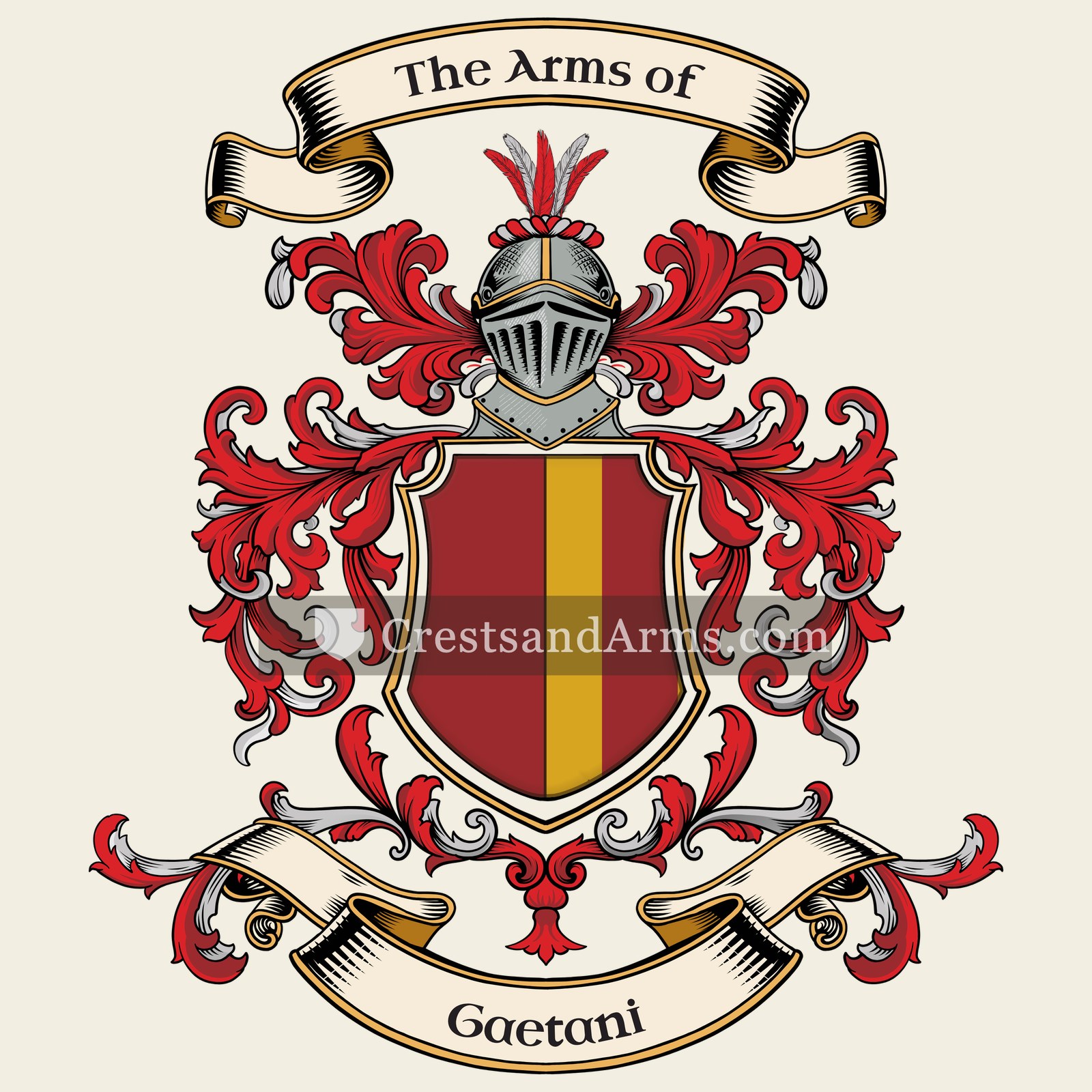
The Gaetani arms were recorded in Florence, c. 1775.
This is where the arms were entered in the register. Families often moved to other parts of the country, so the same name can turn up in more than one region.
The body that granted and recorded arms in Italy in this period.
Alvise Giovanni Mocenigo
Sovereign of the period
Alvise Giovanni Mocenigo
1763–1778
Reigning in Italy when the Gaetani arms are first recorded.
How Arms Worked in Italy
In the Italian states, coats of arms were often used by noble families to show their status and history. These symbols were passed down through the generations to all legitimate male descendants. Younger branches of a family usually kept the original design but sometimes added small changes to distinguish their specific line from the main branch.
Granting authority
Various local rulers and city governments controlled the use of coats of arms across the different Italian states.
How they got arms
Families often assumed their own arms or received them as official grants from local lords, popes, or city councils.
Where arms were recorded
Arms were recorded in local city archives or private family books rather than in one single national register.
The family's standing
Recorded among the armigerous families of Italy.
Origin & History of the Gaetani Family in Italy
The Gaetani family name holds a long and significant place in Italian history, with roots that trace back to the medieval period. While the family established a notable presence in Florence by 1775, their influence originally grew from the region of Gaeta, from which the name is derived. Throughout the centuries, members of the family were deeply involved in the political and religious life of Italy, often serving in high-ranking positions within the church and local government. By the time the family became prominent in Florentine society, they had already built a reputation as a family of substance and civic engagement. Their migration and settlement patterns reflect the broader movement of influential families who sought to expand their reach across the Italian peninsula during the transition into the modern era.
Gaetani Meaning & Related Branches
Root word
Caietanus
A person originating from the ancient Italian city of Caieta.
This name
GaetaniA noble Italian surname derived from the Latin name for a resident of Gaeta.
also spelled
Gaetany
Getani
Gaytani
Related arms
Gaetavariant spelling
Documented Sources
J. B. Rietstap, Armorial Général, Gouda: G. B. van Goor Zonen, 1884–87
Gregorovius, Ferdinand. Geschichte der Stadt Rom im Mittelalter. 1859
Caetani, Gelasio. Domus Caietana. 1920
Archivio di Stato di Firenze, Notarile Antecosimiano
Digital archive packCoat of arms PNG, gold border print PDF, vector SVG and the certificate of authenticity. Sent to your email in minutes.


 paleMilitary strength, and a fortified defence
 paleMilitary strength, and a fortified defence