Map of Russia showing where the Gagarin arms are recorded
The Gagarin arms were recorded in Russia, c. 1784.
Arms such as these were typically recorded in Moscow.
Moscow held the Russian court, and rank there came from service rather than land. Families who served the Tsar were entered in the registers of nobility, and that entry is where their arms are recorded.
This is where the arms were entered in the register. Families often moved to other parts of the country, so the same name can turn up in more than one region.
The body that granted and recorded arms in Russia in this period.
Catherine II of Russia
Sovereign of the period
Catherine II of Russia
1762–1796
Reigning in Russia when the Gagarin arms are first recorded.
How Arms Worked in Russia
Russian heraldry was strictly tied to the nobility and the state service system. Families proved their ancient status or earned new rank to receive an official grant from the Tsar. These symbols were then inherited by all legitimate children of the noble line. If a family lacked proof of their status, they were often excluded from the official records entirely.
Granting authority
The Herald Master's Office acted as the central state body that strictly regulated and verified all noble heraldic symbols.
How they got arms
Families typically received their arms through a formal state grant or by proving their noble status to the government authorities.
Where arms were recorded
All approved coats of arms were officially recorded in the General Armorial of the Noble Families of the Russian Empire starting in 1797.
The family's standing
Recorded among the armigerous families of Russia.
Origin & History of the Gagarin Family in Russia
The Gagarin family name is one of the most distinguished surnames in Russian history, tracing its roots back to the Rurik dynasty that once ruled the country. The name itself is derived from the Russian word "gagara," which refers to a type of loon or diving bird. In the early centuries of their history, the family held significant power as princes who served the Grand Dukes of Moscow. By the time the family was well-established in Moscow in 1784, they had already spent generations serving as high-ranking diplomats, military commanders, and government officials. Their influence was deeply woven into the social and political fabric of the city, allowing them to play a central role in the administration of the Russian Empire during the eighteenth century.
Gagarin Meaning & Related Branches
Root word
gagara
A species of diving bird known as a loon or diver.
This name
GagarinDerived from a nickname for a person resembling a loon bird.
also spelled
Gagarine
Gagaryne
Gagarinz
Documented Sources
J. B. Rietstap, Armorial Général, Gouda: G. B. van Goor Zonen, 1884–87
Dumin, S. V., Dvorianskie rody Rossiiskoi imperii (1993)
Petrov, P. N., Istoriia rodov russkogo dvorianstva (1886)
Russian State Archive of Ancient Acts (RGADA), Fond 1209: Pomestnyi prikaz
Digital archive packCoat of arms PNG, gold border print PDF, vector SVG and the certificate of authenticity. Sent to your email in minutes.


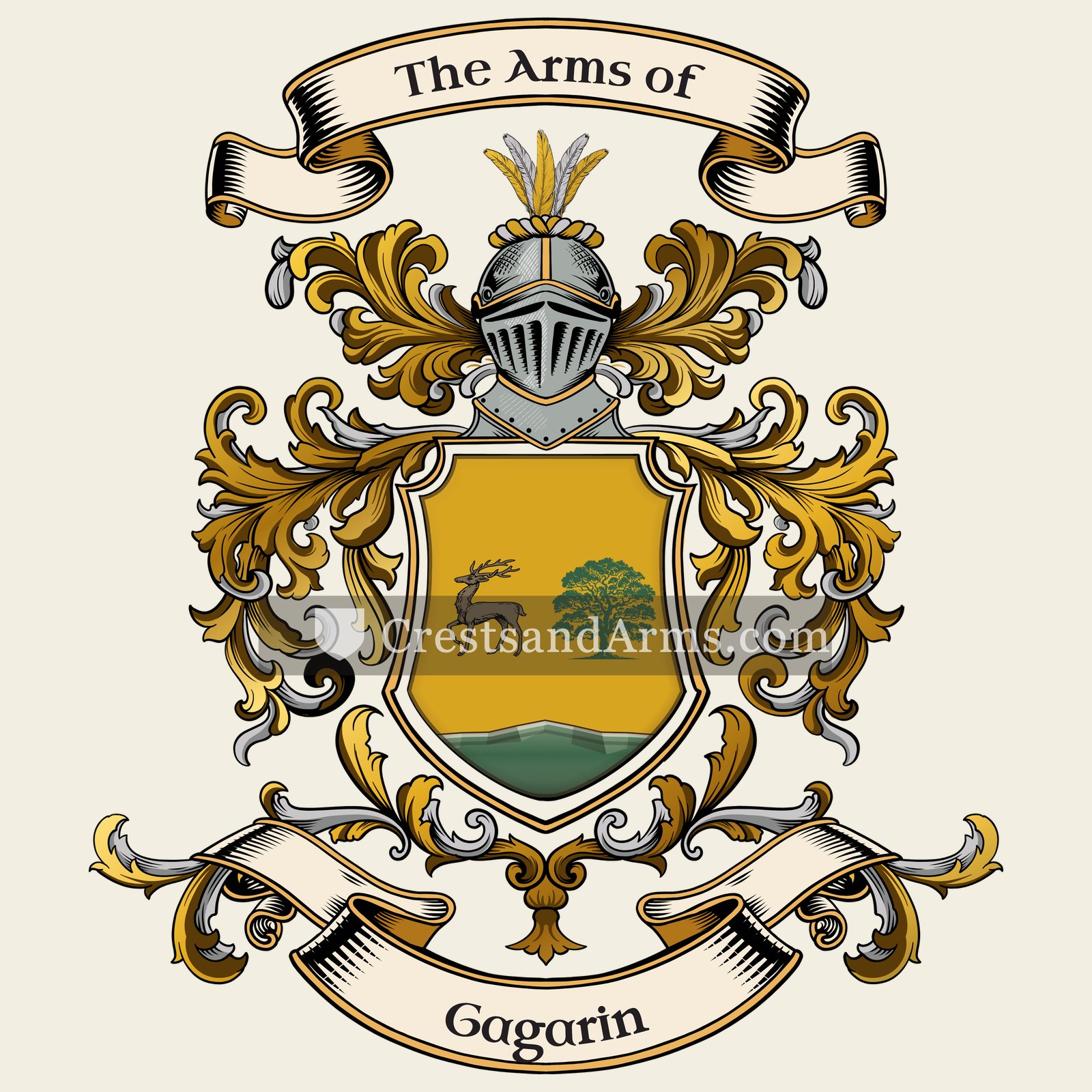
 mountThe ground held, and steadfastness upon it
 stagPeace and harmony, and one who will not fight unprovoked
 treeLife, endurance and deep roots
 mountThe ground held, and steadfastness upon it
 stagPeace and harmony, and one who will not fight unprovoked
 treeLife, endurance and deep roots