Map of Sweden showing where the Gahn arms are recorded
The Gahn arms were recorded in Sweden, c. 1781.
Arms such as these were typically recorded in Stockholm.
Stockholm held the Swedish court and the House of Nobility, where every noble family's arms were entered and kept. Families ennobled for service registered there, which is why so many are recorded around the city.
This is where the arms were entered in the register. Families often moved to other parts of the country, so the same name can turn up in more than one region.
The body that granted and recorded arms in Sweden in this period.
Gustav III of Sweden
Sovereign of the period
Gustav III of Sweden
1771–1792
Reigning in Sweden when the Gahn arms are first recorded.
How Arms Worked in Sweden
In Sweden, a coat of arms belonged to a noble family as a whole rather than just one individual. These arms were passed down through the generations to all legitimate descendants. Younger branches of the family used the same shield without needing to change it. This system ensured that the entire lineage shared the same identity and status under the law.
Granting authority
The Riddarhuset, or House of Nobility, regulated all noble coats of arms in Sweden under royal authority.
How they got arms
Families received their coats of arms through royal grants of nobility which were then officially registered with the House.
Where arms were recorded
Coats of arms were officially recorded in the Swedish House of Nobility register starting in the year 1626.
The family's standing
Recorded among the armigerous families of Sweden.
Origin & History of the Gahn Family in Sweden
The Gahn family name has deep roots in Swedish history, with its origins tied to the professional and intellectual life of the eighteenth century. By 1781, members of the family were well-established in Stockholm, where they began to make significant contributions to science and medicine. The name is often associated with Henrik Gahn, a prominent physician who became a key figure in the Swedish medical community during this era. As the family grew, they became known for their dedication to chemistry and pharmacy, helping to advance public health and scientific knowledge in the capital. Their presence in Stockholm during this time reflects a broader trend of educated families rising to prominence through academic achievement and service to the state.
Gahn Meaning & Related Branches
Root word
Gane
Old Swedish term referring to a gap, opening, or mouth.
This name
GahnA topographical surname likely denoting someone who lived near a mountain pass or gorge.
also spelled
Gahan
Gahane
Related arms
Barclayrecorded with Gahn, same area
Cahun, or Gahnrecorded with Gahn, same area
Zibetrecorded with Gahn, same area
Documented Sources
Sir Bernard Burke, The General Armory of England, Scotland, Ireland and Wales, London: Harrison & Sons, 1884


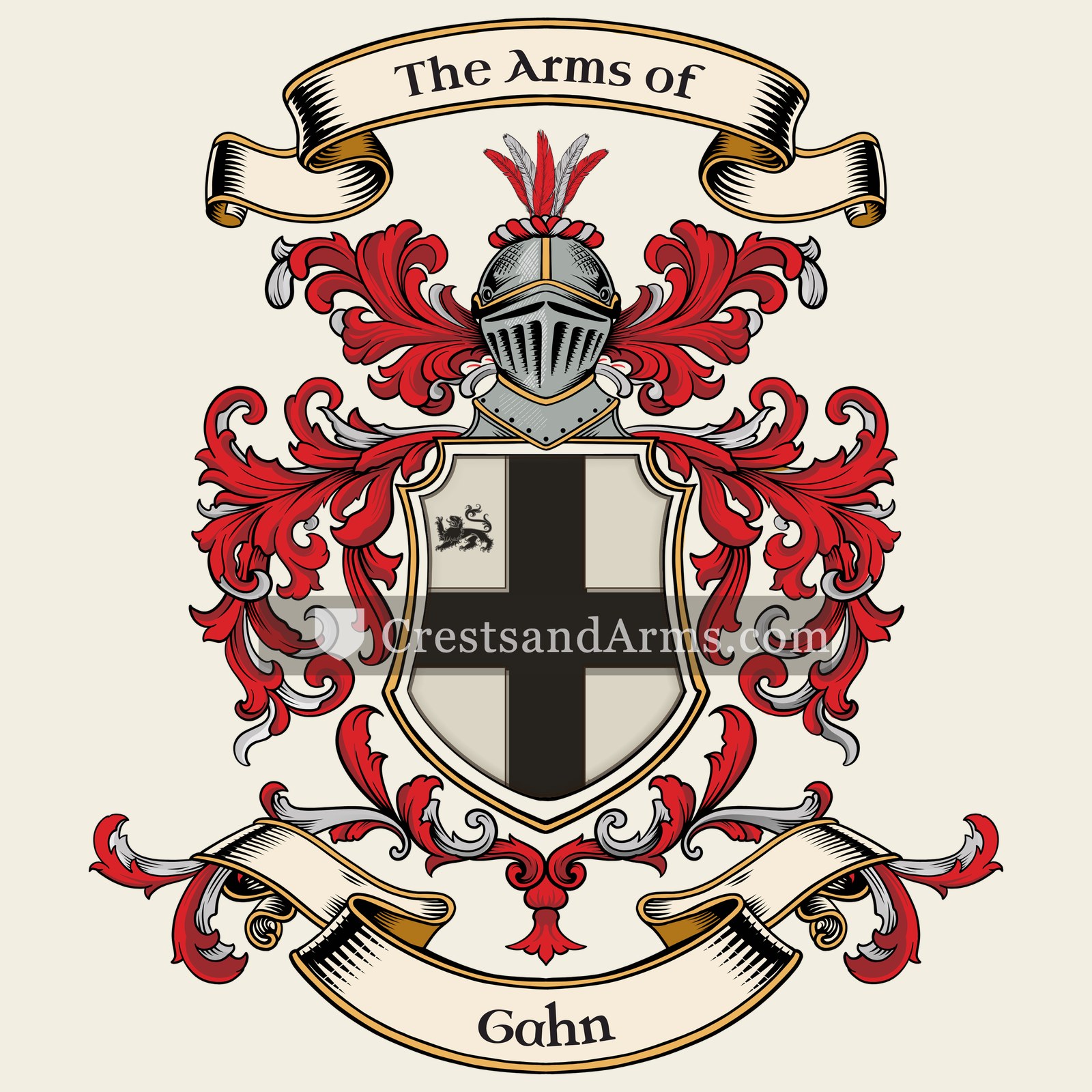
 cross symbolChristian faith and service
 lionCourage, strength and royalty
 cross symbolChristian faith and service
 lionCourage, strength and royalty