Map of England showing where the Gaile arms are recorded
The Gaile arms were recorded in Cornwall, c. 1620.
Cornwall was a county apart, with its own language and its own tight-knit gentry. Tin and the sea made money there, and families who made it bought land, which is what brought arms with it.
This is where the arms were entered in the register. Families often moved to other parts of the country, so the same name can turn up in more than one region.
The body that granted and recorded arms in England in this period.
James VI and I
Sovereign of the period
James VI and I
1603–1625
Reigning in England when the Gaile arms are first recorded.
How Arms Worked in England
English heraldry allowed arms to be shared by all legitimate descendants of the original owner. These symbols were treated as personal property that moved through the generations to all children. While the eldest son kept the original design, other family members could use the same shield without needing to change it or register their own unique versions.
Granting authority
The College of Arms in London has regulated the use of coats of arms throughout England and Wales since 1484.
How they got arms
Families typically obtained their coats of arms through a formal grant from the Crown or by proving their ancient right to them.
Where arms were recorded
All official coats of arms are recorded in the registers kept at the College of Arms, which date back to the fifteenth century.
The family's standing
Recorded among the armigerous families of Cornwall.
Origin & History of the Gaile Family in England
The family name Gaile has deep roots in the rugged landscape of Cornwall, where members of the family were firmly established by the year 1620. During this period, Cornwall was a region defined by its isolation, strong local traditions, and a growing maritime economy. Families like the Gailes often lived in small coastal parishes, where they were likely involved in the essential trades of the era, such as tin mining, farming, or fishing. Because the name appears in local records during the early seventeenth century, it suggests that the family was part of the stable, working population that helped shape the distinct cultural identity of the Cornish peninsula. Over time, the name evolved alongside the local dialect, reflecting the unique history of a family that remained connected to the land and sea for generations.
Gaile Meaning & Related Branches
Root word
Gail
Derived from the Old Norse word geila meaning a ravine or gap.
This name
GaileA topographical surname referring to someone who lived near a narrow passage or ravine.
also spelled
Gaile
Gayle
Gail
Documented Sources
Sir Bernard Burke, The General Armory of England, Scotland, Ireland and Wales, London: Harrison & Sons, 1884
Polsue, Joseph, A Complete Parochial History of the County of Cornwall, 1867


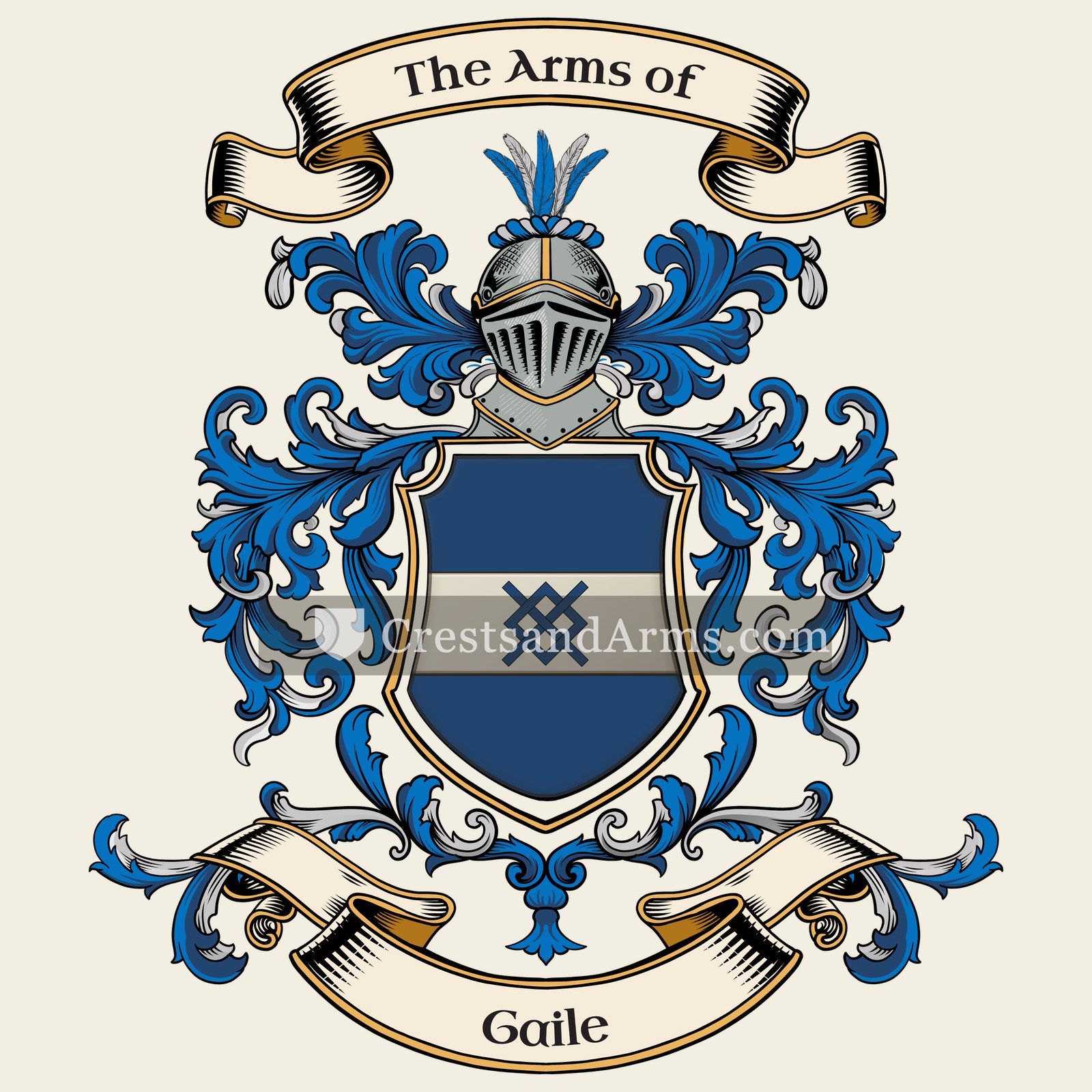
 fessThe military belt, and readiness to serve
 fretPersuasion, and the net that holds
 fessThe military belt, and readiness to serve
 fretPersuasion, and the net that holds