Map of Scotland showing where the Gair arms are recorded
The Gair arms were recorded in Ross, c. 1748.
Ross was Highland country reaching from the North Sea to the Atlantic, held by clan families. Chiefs recorded arms to mark the head of a line and branches recorded their own beneath them.
This is where the arms were entered in the register. Families often moved to other parts of the country, so the same name can turn up in more than one region.
The body that granted and recorded arms in Scotland in this period.
George II of Great Britain
Sovereign of the period
George II of Great Britain
1727–1760
Reigning in Scotland when the Gair arms are first recorded.
How Arms Worked in Scotland
Scottish heraldry is unique because it treats a coat of arms as a piece of personal property protected by law. Only one person can own a specific design at any given time. When a family grows, the head keeps the original shield while other relatives must apply for their own distinct version with slight changes to prove their specific identity.
Granting authority
The Court of the Lord Lyon acts as the official body that regulates and controls all heraldic matters throughout Scotland.
How they got arms
Individuals obtain a legal right to their arms through a formal petition process that confirms their identity and family connection.
Where arms were recorded
All valid coats of arms are officially entered into the Public Register of All Arms and Bearings starting from 1672.
The family's standing
Recorded among the armigerous families of Ross.
Origin & History of the Gair Family in Scotland
The surname Gair is deeply rooted in the rugged landscape of the Scottish Highlands, particularly within the historic county of Ross. While the name is relatively rare, historical records confirm that families bearing this name were well-established in the region by 1748. The name is often associated with the Gaelic word "gearr," which translates to "short" or "cut," suggesting that it may have originally served as a descriptive nickname for an ancestor. During the eighteenth century, families in Ross lived in close-knit communities where they relied on farming and local trade to survive. As members of the Highland population, the Gairs were part of a society defined by strong clan loyalties and a deep connection to the land. Over time, the family expanded from these early roots in Ross, carrying their name and heritage into wider Scottish society.
Gair Meaning & Related Branches
Root word
gearr
A Gaelic adjective meaning short or small in stature.
This name
GairA descriptive nickname for a person of short physical stature.
also spelled
Gayer
Gayerre
Related arms
Gayervariant spelling
Documented Sources
Sir Bernard Burke, The General Armory of England, Scotland, Ireland and Wales, London: Harrison & Sons, 1884
Black, George F., The Surnames of Scotland: Their Origin, Meaning, and History, 1946
National Records of Scotland, Old Parish Registers of Births and Baptisms, 1748
Digital archive packCoat of arms PNG, gold border print PDF, vector SVG and the certificate of authenticity. Sent to your email in minutes.


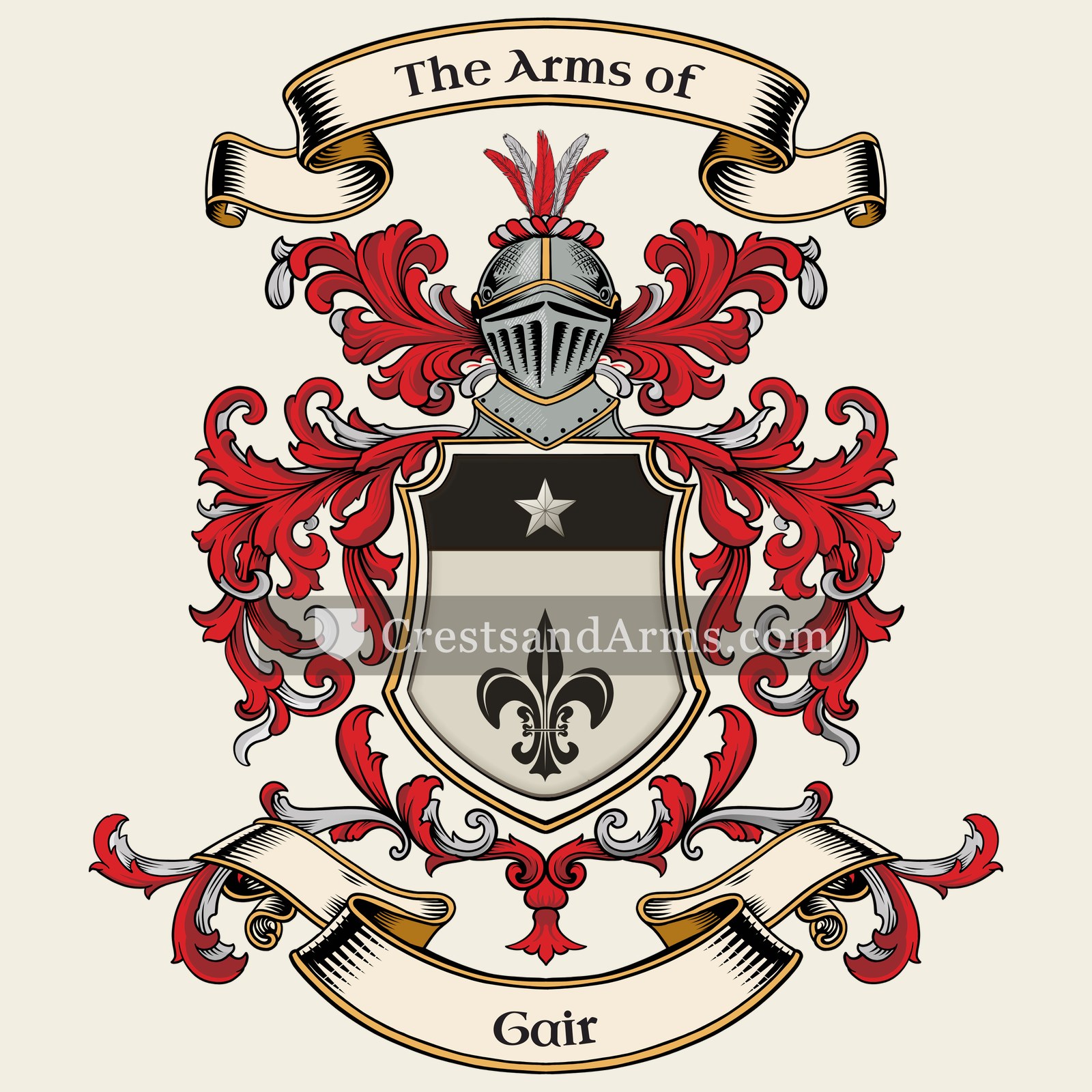
 chiefAuthority, wisdom and dominion
 fleur de lisPurity, light, and the sixth son
 mulletThe third son, and a divine quality from above
 chiefAuthority, wisdom and dominion
 fleur de lisPurity, light, and the sixth son
 mulletThe third son, and a divine quality from above