Map of Germany showing where the Gaisburg arms are recorded
The Gaisburg arms were recorded in Silesia, c. 1821.
Silesia was farming country in the east of the German lands, held in large estates by families who stayed put for generations. Owning land was what entitled a family to arms, so the region fills a good deal of the register.
This is where the arms were entered in the register. Families often moved to other parts of the country, so the same name can turn up in more than one region.
The body that granted and recorded arms in Germany in this period.
Frederick William III of Prussia
Sovereign of the period
Frederick William III of Prussia
1797–1840
Reigning in Germany when the Gaisburg arms are first recorded.
How Arms Worked in Germany
Prussian heraldry was strictly tied to social rank and noble status rather than being a free choice for every citizen. These symbols were treated as permanent family property that moved through the generations to all legitimate heirs. If a family branch wanted to change their design to stand out, they had to apply for official permission to alter their specific version of the shield.
Granting authority
The Prussian Heroldsamt acted as the central state office that managed and strictly controlled all noble titles and coats of arms.
How they got arms
Families usually obtained their arms through formal royal grants or by proving their long-standing noble status to the state authorities.
Where arms were recorded
All official coats of arms were kept in the rolls of the Prussian Heroldsamt, which functioned from 1706 until 1918.
The family's standing
Recorded among the armigerous families of Silesia.
Origin & History of the Gaisburg Family in Germany
The family name Gaisburg is rooted in the historical landscape of the German-speaking regions of Central Europe. By the early 19th century, records confirm that members of the family were well-established in the province of Silesia, which was then a significant territory within the Kingdom of Prussia. The name itself is likely topographic in origin, suggesting that the earliest ancestors lived near a fortified site or a hill associated with goats, as the German word Gais refers to a goat and Burg refers to a castle or stronghold. During the 1820s, families in this region were often tied to the land or local trade, living through a period of great social and industrial transformation. As the family moved through the 19th century, they became part of the complex migration patterns that defined Silesian history, eventually spreading their influence across the broader European continent.
Gaisburg Meaning & Related Branches
Root word
Geis-Burg
A combination of goat or hostage and a fortified place or castle.
This name
GaisburgRefers to a fortified settlement or castle associated with goats or a specific person.
also spelled
Gaisburg
Documented Sources
J. B. Rietstap, Armorial Général, Gouda: G. B. van Goor Zonen, 1884–87
Knie, Johann Georg, Alphabetisch-statistisch-topographische Uebersicht der Dörfer, Flecken, Städte und andern Orte der Königl. Preuß. Provinz Schlesien, 1830
State Archive in Wrocław (Archiwum Państwowe we Wrocławiu), Civil Registration Records of Silesia (Standesamtregister)
Digital archive packCoat of arms PNG, gold border print PDF, vector SVG and the certificate of authenticity. Sent to your email in minutes.


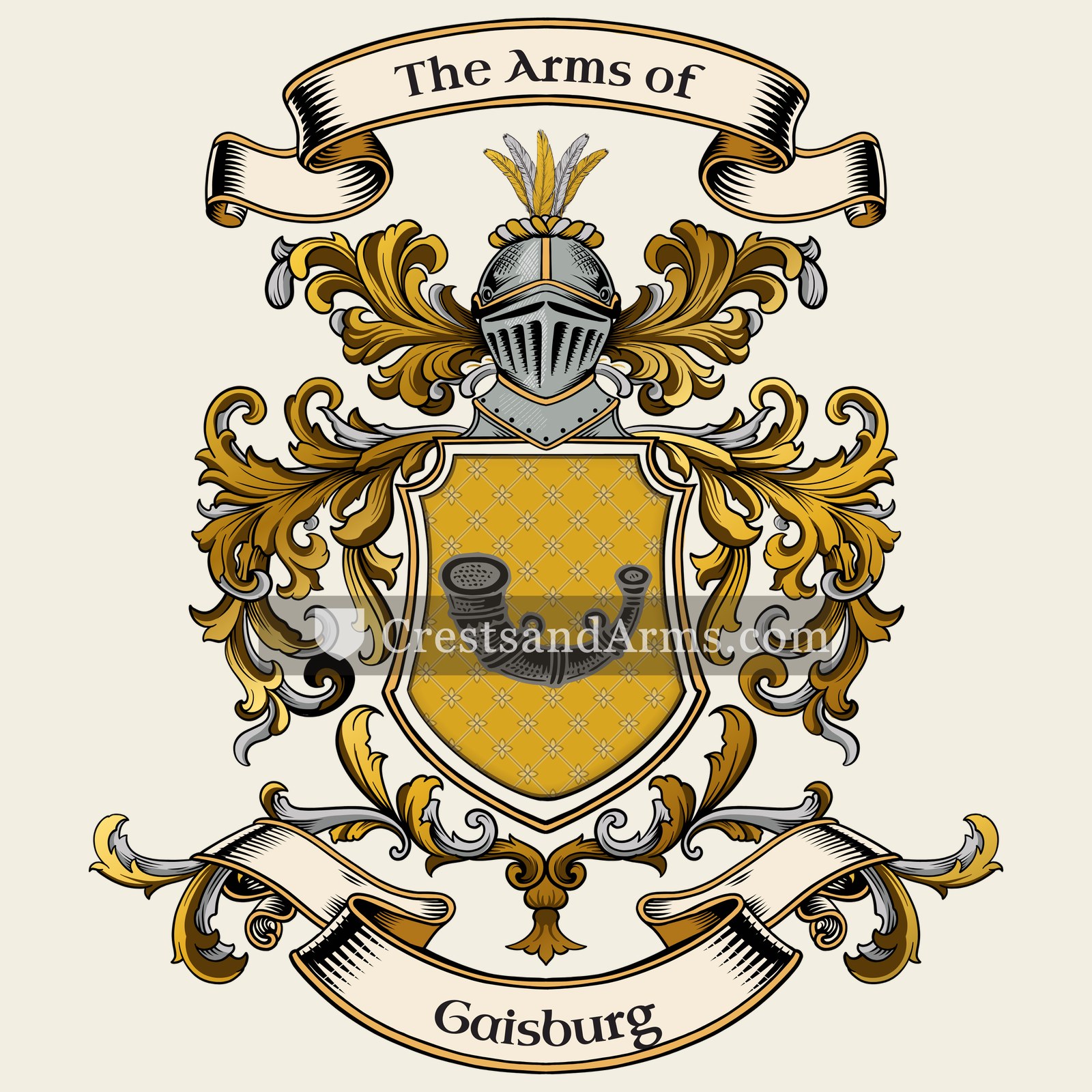
 hunting horn stringedOne who delights in the chase
 hunting horn stringedOne who delights in the chase