Map of Poland showing where the Gala arms are recorded
The Gala arms were recorded in Courland, c. 1772.
Courland was Baltic coast country held in large estates by a small number of families. They kept their land for generations and served as officers abroad, and both landholding and service brought arms with them.
This is where the arms were entered in the register. Families often moved to other parts of the country, so the same name can turn up in more than one region.
Region
Courland
First recorded
1772
Granting Authority for the Gala Arms
Ennoblement by the Sejm
Author: Olek Remesz · CC BY-SA 3.0
The body that granted and recorded arms in Poland in this period.
Stanisław August Poniatowski
Sovereign of the period
Stanisław August Poniatowski
1764–1795
Reigning in Poland when the Gala arms are first recorded.
How Arms Worked in Poland
Polish noble families shared a single coat of arms across many different surnames, creating large clans rather than individual designs. These symbols were held collectively by all members of the clan regardless of their specific family name. When a new family joined the nobility, they were adopted into an existing clan and began using that group's established shield.
Granting authority
The Sejm, which was the Polish parliament, held the power to grant noble status and the right to bear arms.
How they got arms
Families typically received their coat of arms through a formal act of ennoblement granted by the Sejm for distinguished service.
Where arms were recorded
These grants were officially recorded in the Crown Metrica, which served as the central archive for state documents starting in the sixteenth century.
The family's standing
Recorded among the armigerous families of Courland.
Origin & History of the Gala Family in Poland
The family name Gala has deep roots in the historical region of Courland, which is located in modern-day Latvia. By 1772, records confirm that members of the family were already established within this territory. During this period, Courland was a duchy with a complex social structure that blended Baltic German, Polish, and Latvian influences. Families living in this area often navigated a landscape shaped by shifting borders and the influence of the Polish-Lithuanian Commonwealth. The name itself likely evolved from local linguistic traditions, reflecting the diverse cultural environment of the Baltic coast. As the family settled into this region, they became part of a community defined by its agricultural traditions and its position as a crossroads for trade between Eastern and Western Europe.
Related Branches & Arms
Root word
gal
Old Slavic term referring to a loud or boisterous person.
This name
GalaA surname derived from a nickname describing someone who is noisy or talkative.
also spelled
Galaud
Galaue
Galaux
Galo
Gallow
Documented Sources
J. B. Rietstap, Armorial Général, Gouda: G. B. van Goor Zonen, 1884–87
Dunsdorfs, Edgars. Latvijas vēsture 1710–1800. 1973
Latvian State Historical Archives (Latvijas Valsts vēstures arhīvs), Fond 235 (Evangelical Lutheran Church records of Courland)
Digital archive packCoat of arms PNG, gold border print PDF, vector SVG and the certificate of authenticity. Sent to your email in minutes.


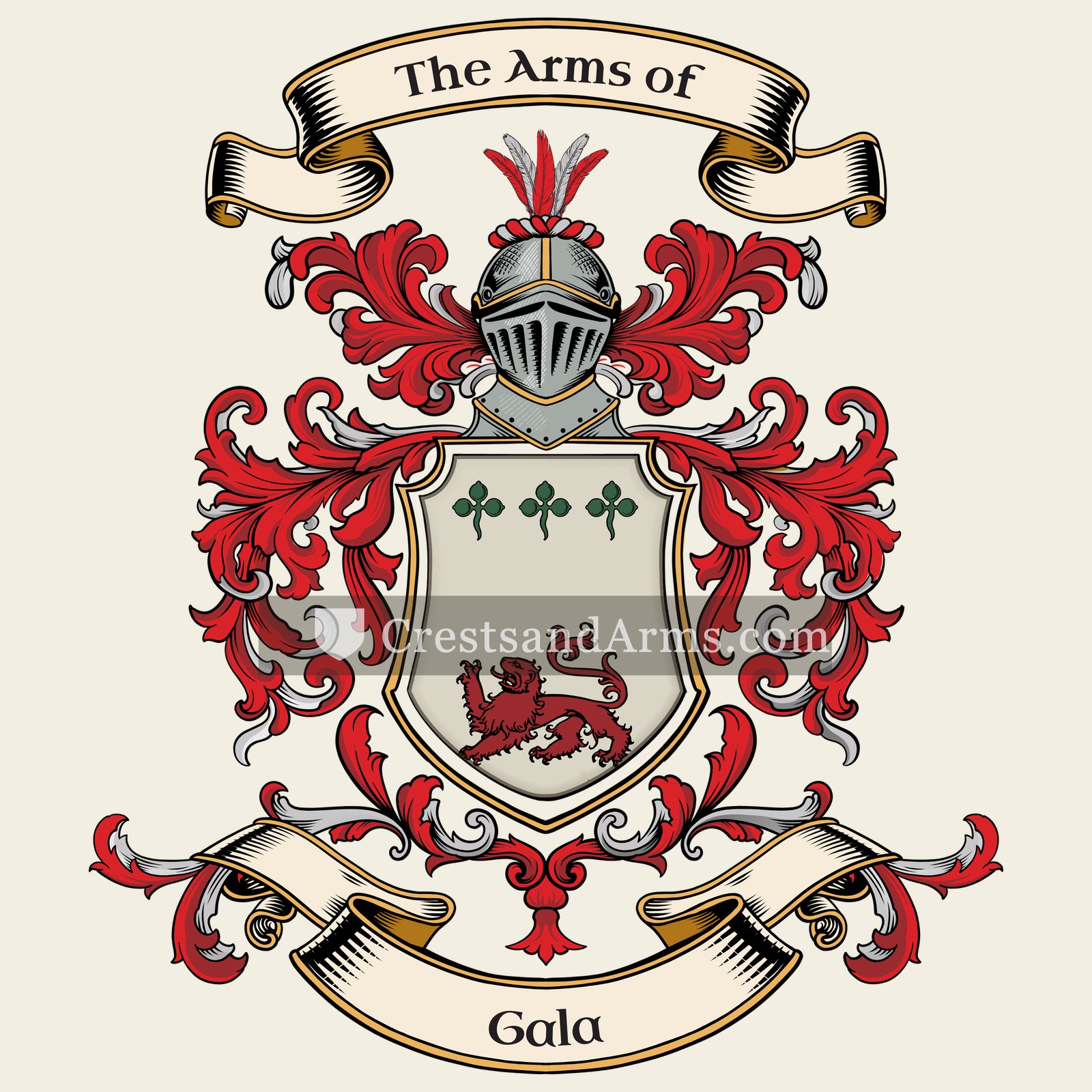
 lionCourage, strength and royalty
 trefoilPerpetuity, and the Trinity
 lionCourage, strength and royalty
 trefoilPerpetuity, and the Trinity