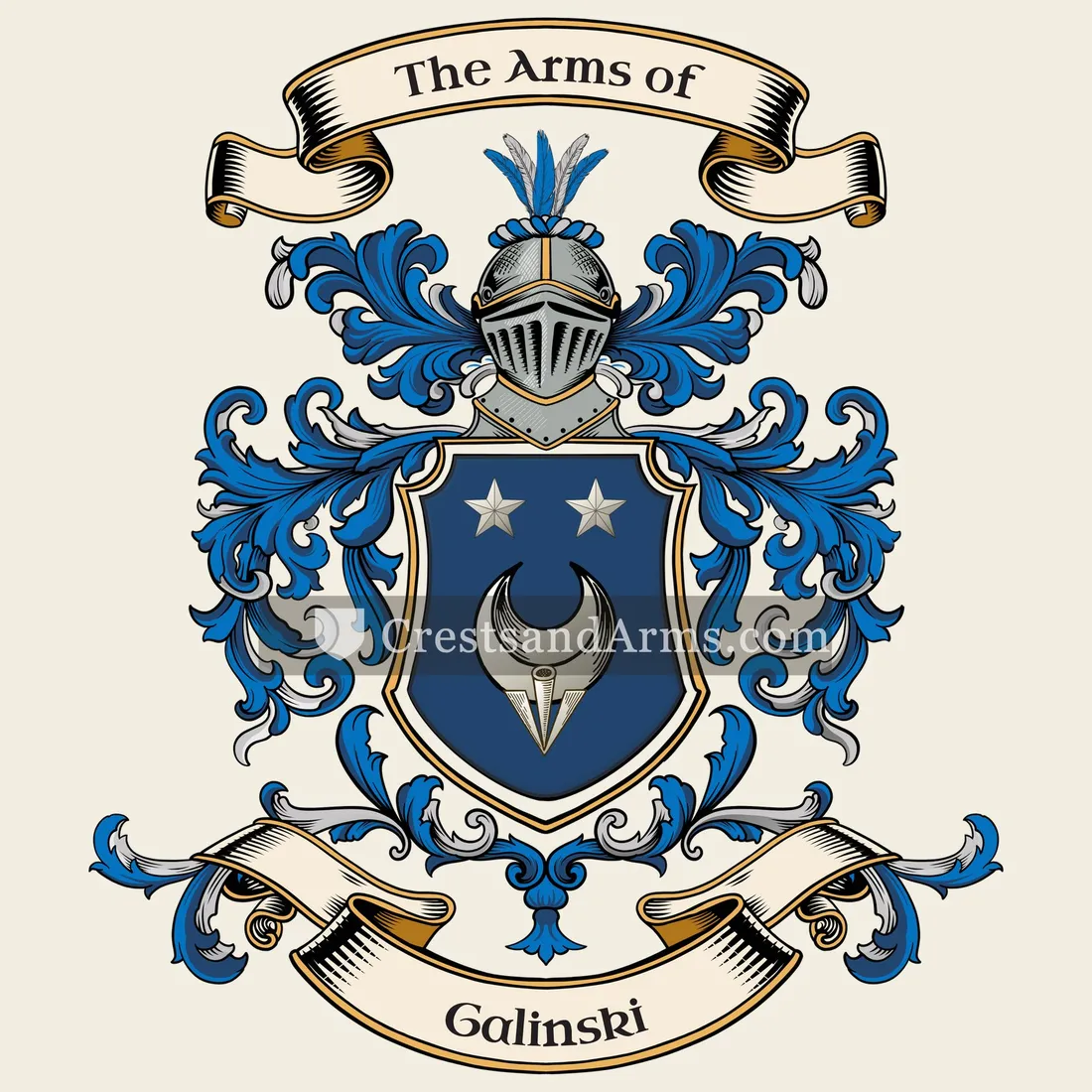
A record of documented arms, meaning and origin, researched for the Galinski family lines. Documented in 2 countries.
Reg. 1225 · Polish, G–I
Meaning of the Galinski family crest colors & symbols
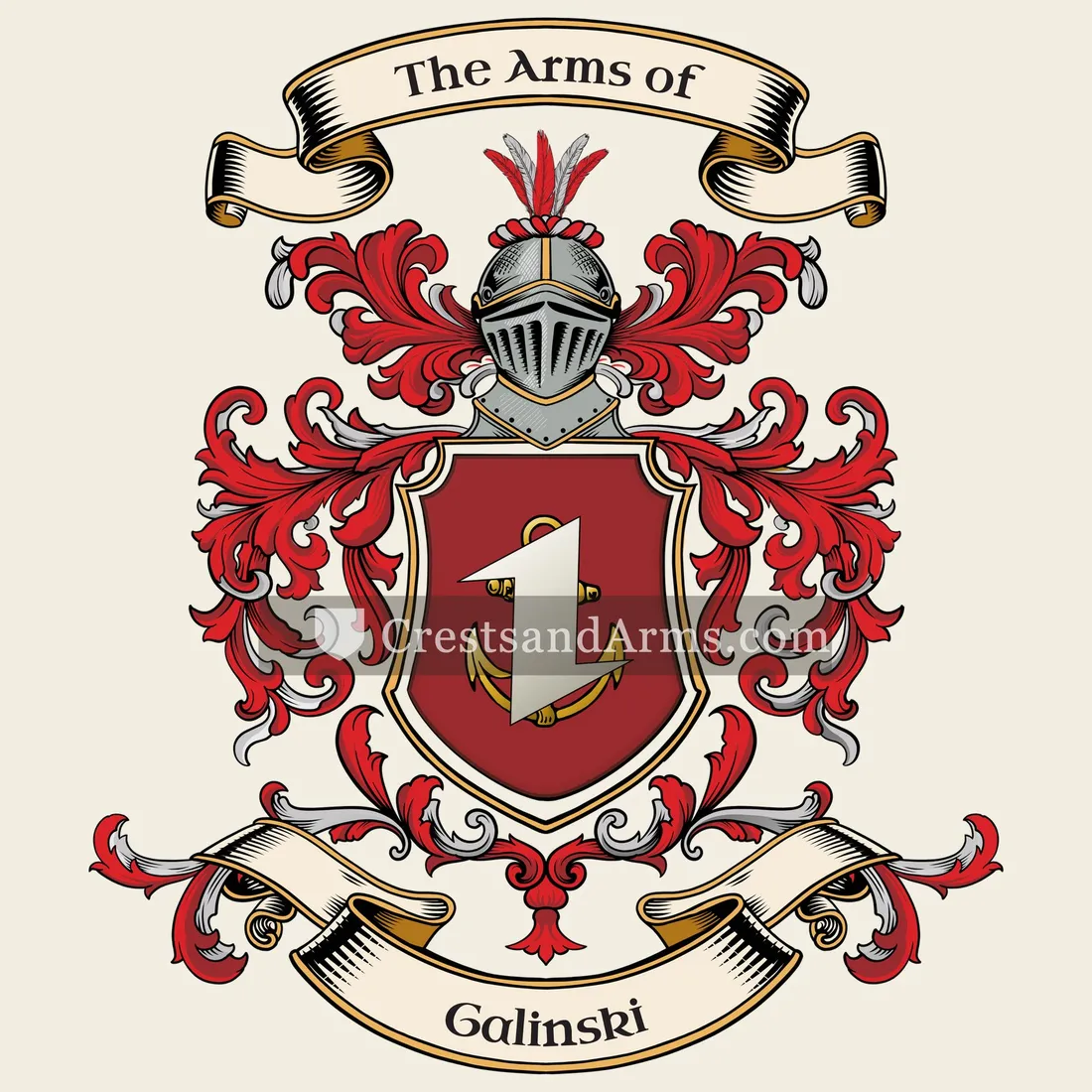
Symbols on this shield
anchorHope, and steadfastness in trouble
cramponFirm hold on what has been gained
Colours
Red (Gules)Means: Military strength
Gold (Or)Means: Generosity
Silver (Argent)Means: Peace and sincerity
Historical info
Source
J. B. Rietstap, Armorial Général, Gouda: G. B. van Goor Zonen, 1884–87
Blazon (the actual original written record)
“De gu. à une ancre renv. d'or, la trabe et l'anneau remplacés par une croix; au crampon d'arg. en forme de fer-à-cheval carré, les bouts en bas, br. sur l'ancre. Cq. cour. C.: cinq pl. d'aut. d'arg.”
Polandc. 1772
Digital archive packCoat of arms PNG, gold border print PDF, vector SVG and the certificate of authenticity. Sent to your email in minutes.
Map of Poland showing where the Galinski arms are recorded
The Galinski arms were recorded in Poland, c. 1772.
Arms such as these were typically recorded in Mazovia.
Mazovia held Warsaw, the Polish court and the assemblies where the szlachta met. Poland's nobles were unusually numerous and every one of them bore arms, and Warsaw is where those arms were argued over and recorded.
This is where the arms were entered in the register. Families often moved to other parts of the country, so the same name can turn up in more than one region.
Region
Mazovia
First recorded
1772
Granting Authority for the Galinski Arms
Ennoblement by the Sejm
Author: Olek Remesz · CC BY-SA 3.0
The body that granted and recorded arms in Poland in this period.
Stanisław August Poniatowski
Sovereign of the period
Stanisław August Poniatowski
1764–1795
Reigning in Poland when the Galinski arms are first recorded.
How Arms Worked in Poland
Polish noble families shared a single coat of arms across many different surnames, creating large clans rather than individual designs. These symbols were held collectively by all members of the clan regardless of their specific family name. When a new family joined the nobility, they were adopted into an existing clan and began using that group's established shield.
Granting authority
The Sejm, which was the Polish parliament, held the power to grant noble status and the right to bear arms.
How they got arms
Families typically received their coat of arms through a formal act of ennoblement granted by the Sejm for distinguished service.
Where arms were recorded
These grants were officially recorded in the Crown Metrica, which served as the central archive for state documents starting in the sixteenth century.
The family's standing
Recorded among the armigerous families of Poland.
Origin & History of the Galinski Family in Poland
The surname Galinski is deeply rooted in the historical landscape of the Mazovia region in central Poland. By the year 1772, records confirm that families bearing this name were well-established within this area, which served as a cultural and political heartland of the Polish-Lithuanian Commonwealth. The name itself is topographic in origin, likely derived from the Polish word "gałąź," meaning branch, or from specific local place names like Galin. Families with this name were typically part of the landed gentry or independent farmers who played an active role in the rural development of the Mazovian plains. During the late 18th century, these individuals lived through a time of great political transition as the region faced the partitions of Poland. Despite these external pressures, the Galinski family maintained a steady presence in local parish registers and land deeds, reflecting a history tied to the soil and the evolving social structures of the Polish countryside.
Meaning of the Galinski family crest colors & symbols
Symbols on this shield
crescentHonour by the sovereign, and the second son
mulletThe third son, and a divine quality from above
arrowReadiness for battle, and affliction endured
Colours
Blue (Azure)Means: Loyalty and truth
Silver (Argent)Means: Peace and sincerity
Historical info
Source
J. B. Rietstap, Armorial Général, Gouda: G. B. van Goor Zonen, 1884–87
Blazon (the actual original written record)
“D'azur à un croiss. figuré versé, acc. en chef de deux étoiles et en p. d'une flèche en pal, la pointe en haut, le tout d'arg. C.: un vol à l'antique, coupé d'arg. sur azur.”
SilesiaSilesia, c. 1765
Digital archive packCoat of arms PNG, gold border print PDF, vector SVG and the certificate of authenticity. Sent to your email in minutes.
Map of Germany showing where the Galinski arms are recorded
The Galinski arms were recorded in Silesia, c. 1765.
Silesia was farming country in the east of the German lands, held in large estates by families who stayed put for generations. Owning land was what entitled a family to arms, so the region fills a good deal of the register.
This is where the arms were entered in the register. Families often moved to other parts of the country, so the same name can turn up in more than one region.
The body that granted and recorded arms in Germany in this period.
Francis I, Holy Roman Emperor
Sovereign of the period
Francis I, Holy Roman Emperor
1745–1765
Reigning in Poland when the Galinski arms are first recorded.
How Arms Worked in Germany
In the Holy Roman Empire, coats of arms were often granted to individuals by the Emperor or his representatives. These arms were then passed down through the generations to all legitimate descendants of the original holder. Younger branches of a family usually kept the same shield design without needing to change it, as the arms belonged to the entire lineage.
Granting authority
The Holy Roman Emperor held the sole power to grant new coats of arms throughout his vast imperial territories.
How they got arms
Families typically obtained their coats of arms through a formal imperial grant or by proving their noble status to the authorities.
Where arms were recorded
These grants were officially recorded in the Imperial Chancery registers, which began keeping formal records of such honors during the Middle Ages.
The family's standing
Recorded among the armigerous families of Silesia.
Origin & History of the Galinski Family in Germany
The surname Galinski traces its roots to the historical region of Silesia, a territory that was once part of the Prussian Kingdom and is now largely located within modern-day Poland. By 1765, records confirm that families bearing this name were well-established in the area. The name itself is derived from the Slavic word "gal," which often referred to a bird or a person with specific physical traits, and it evolved as a locational or descriptive identifier. During the eighteenth century, Silesia served as a cultural crossroads between German and Slavic populations. Families like the Galinskis lived through a time of significant administrative change as the Prussian government sought to standardize record-keeping and taxation across its eastern provinces. This period of transition helped solidify the spelling and usage of the name in official church and state documents, marking the beginning of the family's documented presence in the region.
Galinski Meaning & Related Branches
Root word
gal
A Slavic term referring to a cockerel or rooster.
This name
GalinskiA topographic or habitational name for someone living near a place associated with roosters or poultry.
also spelled
Glinsky
Documented Sources
J. B. Rietstap, Armorial Général, Gouda: G. B. van Goor Zonen, 1884–87
Bieńkowski, Wiesław, Słownik historyczno-geograficzny ziem polskich w średniowieczu, 1982
Kozłowska-Budkowa, Zofia, Rozwój sieci parafialnej w diecezji płockiej, 1974
Archiwum Główne Akt Dawnych w Warszawie, Księgi grodzkie i ziemskie województwa mazowieckiego
Archiwum Państwowe w Warszawie, Akta stanu cywilnego parafii rzymskokatolickich z terenu Mazowsza
Digital archive packCoat of arms PNG, gold border print PDF, vector SVG and the certificate of authenticity. Sent to your email in minutes.


 anchorHope, and steadfastness in trouble
 cramponFirm hold on what has been gained
 anchorHope, and steadfastness in trouble
 cramponFirm hold on what has been gained


 crescentHonour by the sovereign, and the second son
 mulletThe third son, and a divine quality from above
 arrowReadiness for battle, and affliction endured