A record of documented arms, meaning and origin, researched for the Galinsky family lines. Documented in 2 countries.
Reg. 8520 · Polish, G–I
Coat of Arms & Family Crest Details
Symbols on this shield
anchorHope, and steadfastness in trouble
cramponFirm hold on what has been gained
Colours
Red (Gules)Means: Military strength
Gold (Or)Means: Generosity
Silver (Argent)Means: Peace and sincerity
Historical info
Source
J. B. Rietstap, Armorial Général, Gouda: G. B. van Goor Zonen, 1884–87
Blazon (the actual original written record)
“De gu. à une ancre renv. d'or, la trabe et l'anneau remplacés par une croix; au crampon d'arg. en forme de fer-à-cheval carré, les bouts en bas, br. sur l'ancre. Cq. cour. C.: cinq pl. d'aut. d'arg.”
Polandc. 1772
Digital archive packCoat of arms PNG, gold border print PDF, vector SVG and the certificate of authenticity. Sent to your email in minutes.
Map of Poland showing where the Galinsky arms are recorded
The Galinsky arms were recorded in Poland, c. 1772.
Arms such as these were typically recorded in Mazovia.
Mazovia held Warsaw, the Polish court and the assemblies where the szlachta met. Poland's nobles were unusually numerous and every one of them bore arms, and Warsaw is where those arms were argued over and recorded.
This is where the arms were entered in the register. Families often moved to other parts of the country, so the same name can turn up in more than one region.
Region
Mazovia
First recorded
1772
Granting Authority for the Galinsky Arms
Ennoblement by the Sejm
Author: Olek Remesz · CC BY-SA 3.0
The body that granted and recorded arms in Poland in this period.
Stanisław August Poniatowski
Sovereign of the period
Stanisław August Poniatowski
1764–1795
Reigning in Poland when the Galinsky arms are first recorded.
How Arms Worked in Poland
Polish noble families shared a single coat of arms across many different surnames, creating large clans rather than individual designs. These symbols were held collectively by all members of the clan regardless of their specific family name. When a new family joined the nobility, they were adopted into an existing clan and began using that group's established shield.
Granting authority
The Sejm, which was the Polish parliament, held the power to grant noble status and the right to bear arms.
How they got arms
Families typically received their coat of arms through a formal act of ennoblement granted by the Sejm for distinguished service.
Where arms were recorded
These grants were officially recorded in the Crown Metrica, which served as the central archive for state documents starting in the sixteenth century.
The family's standing
Recorded among the armigerous families of Poland.
Origin & History of the Galinsky Family in Poland
The surname Galinsky is a topographic name, meaning it was originally derived from the geography of the land where a family lived. In the Polish language, the root word "gal" or "gałąź" often relates to branches or wooded areas, suggesting that the earliest ancestors likely settled near a specific forest or a village named Galin or Galiny. By 1772, records confirm that the family was well-established in the Mazovia region, a historical province in east-central Poland known for its dense forests and central role in Polish statehood. During this era, families in Mazovia were often tied to the land through agricultural work or service to local nobility. As the family grew, the name evolved to reflect their identity as people from these specific Mazovian settlements. This history highlights how the Galinsky name served as a permanent link between the family and the landscape of their ancestral home.
Coat of Arms & Family Crest Details
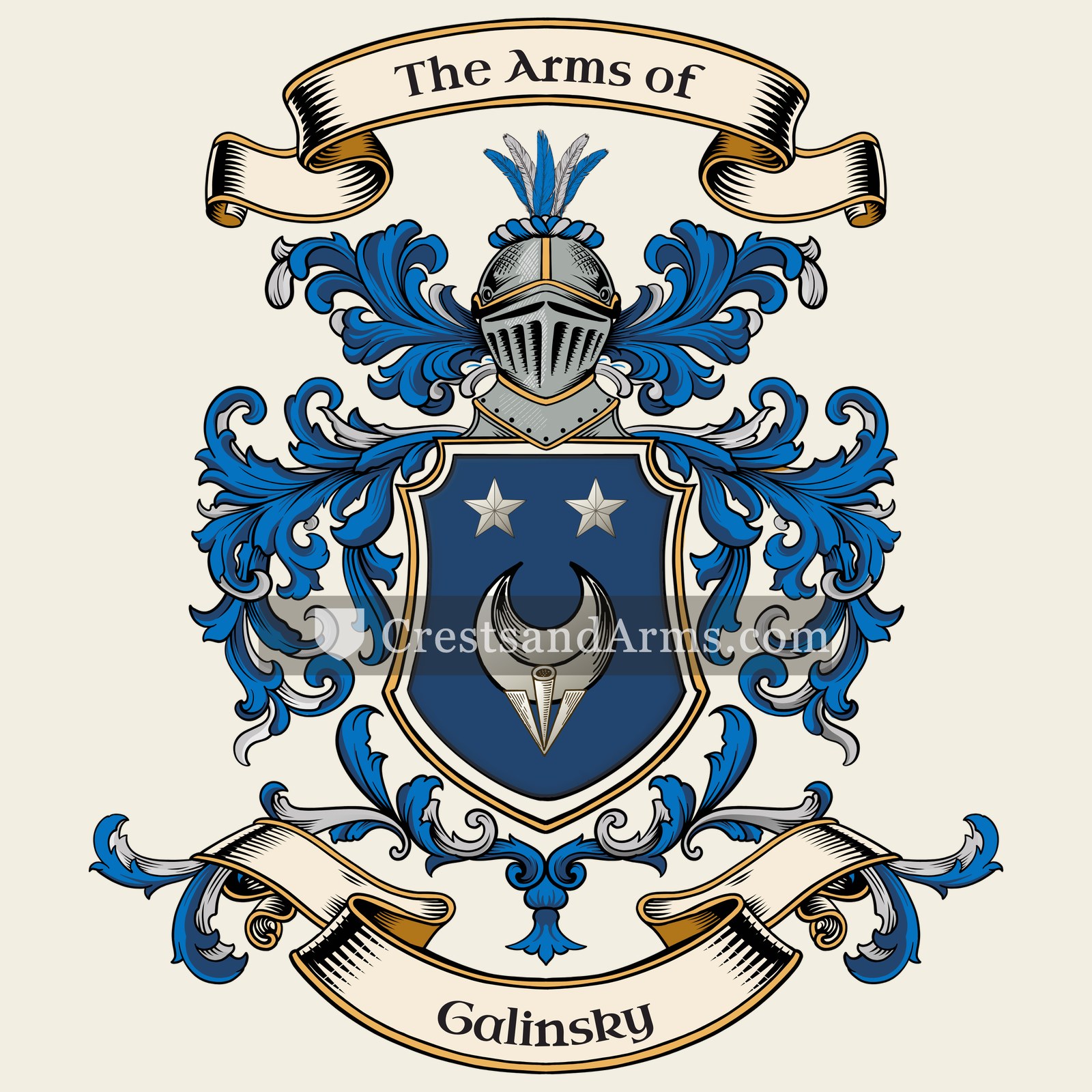
Symbols on this shield
crescentHonour by the sovereign, and the second son
mulletThe third son, and a divine quality from above
arrowReadiness for battle, and affliction endured
Colours
Blue (Azure)Means: Loyalty and truth
Silver (Argent)Means: Peace and sincerity
Historical info
Source
J. B. Rietstap, Armorial Général, Gouda: G. B. van Goor Zonen, 1884–87
Blazon (the actual original written record)
“D'azur à un croiss. figuré versé, acc. en chef de deux étoiles et en p. d'une flèche en pal, la pointe en haut, le tout d'arg. C.: un vol à l'antique, coupé d'arg. sur azur.”
SilesiaSilesia, c. 1765
Digital archive packCoat of arms PNG, gold border print PDF, vector SVG and the certificate of authenticity. Sent to your email in minutes.
Map of Germany showing where the Galinsky arms are recorded
The Galinsky arms were recorded in Silesia, c. 1765.
Silesia was farming country in the east of the German lands, held in large estates by families who stayed put for generations. Owning land was what entitled a family to arms, so the region fills a good deal of the register.
This is where the arms were entered in the register. Families often moved to other parts of the country, so the same name can turn up in more than one region.
The body that granted and recorded arms in Germany in this period.
Francis I, Holy Roman Emperor
Sovereign of the period
Francis I, Holy Roman Emperor
1745–1765
Reigning in Poland when the Galinsky arms are first recorded.
How Arms Worked in Germany
In the Holy Roman Empire, coats of arms were often granted to individuals by the Emperor or his representatives. These arms were then passed down through the generations to all legitimate descendants of the original holder. Younger branches of a family usually kept the same shield design without needing to change it, as the arms belonged to the entire lineage.
Granting authority
The Holy Roman Emperor held the sole power to grant new coats of arms throughout his vast imperial territories.
How they got arms
Families typically obtained their coats of arms through a formal imperial grant or by proving their noble status to the authorities.
Where arms were recorded
These grants were officially recorded in the Imperial Chancery registers, which began keeping formal records of such honors during the Middle Ages.
The family's standing
Recorded among the armigerous families of Silesia.
Origin & History of the Galinsky Family in Germany
The family name Galinsky is rooted in the historical region of Silesia, which was a crossroads of culture and migration within the German-speaking lands during the eighteenth century. By 1765, records confirm that members of the family were established in this area, which was then part of the Kingdom of Prussia. The name itself is likely derived from the Slavic word for a hazel grouse, a bird common in the dense forests of Central Europe. This suggests that the family’s earliest ancestors may have been identified by their connection to the local landscape or by a descriptive nickname used in their community. As the region underwent significant administrative changes and industrial growth, families like the Galinskys became part of the complex social fabric of Silesia. Their presence in the mid-1700s places them in a time of transition when surnames were becoming more permanent and officially recorded in local tax and parish registers.
Related Branches & Arms
Root word
Gal
A Slavic term referring to a rooster or a cockerel.
This name
GalinskyA habitational name for someone originating from a place called Galin or Galiny.
also spelled
Glinsky
Documented Sources
J. B. Rietstap, Armorial Général, Gouda: G. B. van Goor Zonen, 1884–87
Gieysztor, Aleksander, Dzieje Mazowsza, 1994
Kozierowski, Stanisław, Badania nazw topograficznych dzisiejszej diecezji płockiej, 1928
Archiwum Główne Akt Dawnych w Warszawie, Księgi metrykalne parafii rzymskokatolickich z terenu Mazowsza, 1772
Digital archive packCoat of arms PNG, gold border print PDF, vector SVG and the certificate of authenticity. Sent to your email in minutes.


 anchorHope, and steadfastness in trouble
 cramponFirm hold on what has been gained
 anchorHope, and steadfastness in trouble
 cramponFirm hold on what has been gained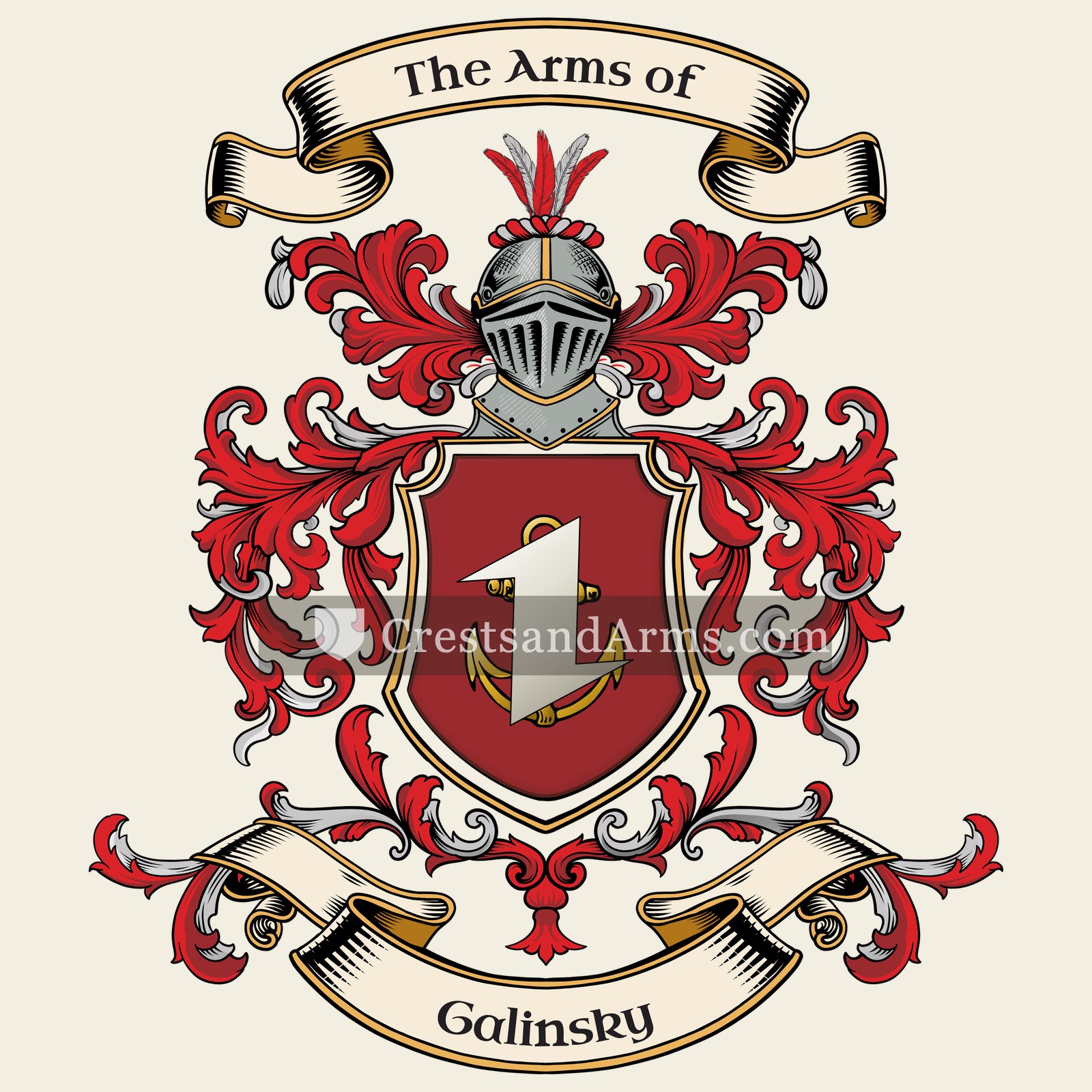


 crescentHonour by the sovereign, and the second son
 mulletThe third son, and a divine quality from above
 arrowReadiness for battle, and affliction endured