Map of Germany showing where the Gall arms are recorded
The Gall arms were recorded in Hesse, c. 1601.
Hesse was central German country, divided among a large number of small landowners and prosperous towns. So many separate households held ground there that the region produced an unusual number of coats of arms.
This is where the arms were entered in the register. Families often moved to other parts of the country, so the same name can turn up in more than one region.
The body that granted and recorded arms in Germany in this period.
Emperor Rudolf II
Sovereign of the period
Emperor Rudolf II
1576–1612
Reigning in Germany when the Gall arms are first recorded.
How Arms Worked in Germany
In the Holy Roman Empire, coats of arms were often granted to individuals by the Emperor or his representatives. These arms were then passed down through the generations to all legitimate descendants of the original holder. Younger branches of a family usually kept the same shield design without needing to change it, as the arms belonged to the entire lineage.
Granting authority
The Holy Roman Emperor held the sole power to grant new coats of arms throughout his vast imperial territories.
How they got arms
Families typically obtained their coats of arms through a formal imperial grant or by proving their noble status to the authorities.
Where arms were recorded
These grants were officially recorded in the Imperial Chancery registers, which began keeping formal records of such honors during the Middle Ages.
The family's standing
Recorded among the armigerous families of Hesse.
Origin & History of the Gall Family in Germany
The family name Gall has deep roots in the German region of Hesse, where records confirm members of the family were living as early as 1601. Historically, the name is often linked to the Old High German word *galla*, which referred to a person with a bitter or sharp temperament. In the social structure of the seventeenth century, such names frequently began as nicknames that neighbors used to describe a person’s personality or physical traits before they became permanent family surnames. As the family established itself in Hesse, they likely participated in the local agricultural or trade-based economy typical of the Holy Roman Empire during that era. Over time, the name became a fixed identifier that passed from one generation to the next, marking the family as a stable part of the local community throughout the turbulent years of the early modern period.
Meaning of the Gall family crest colors & symbols
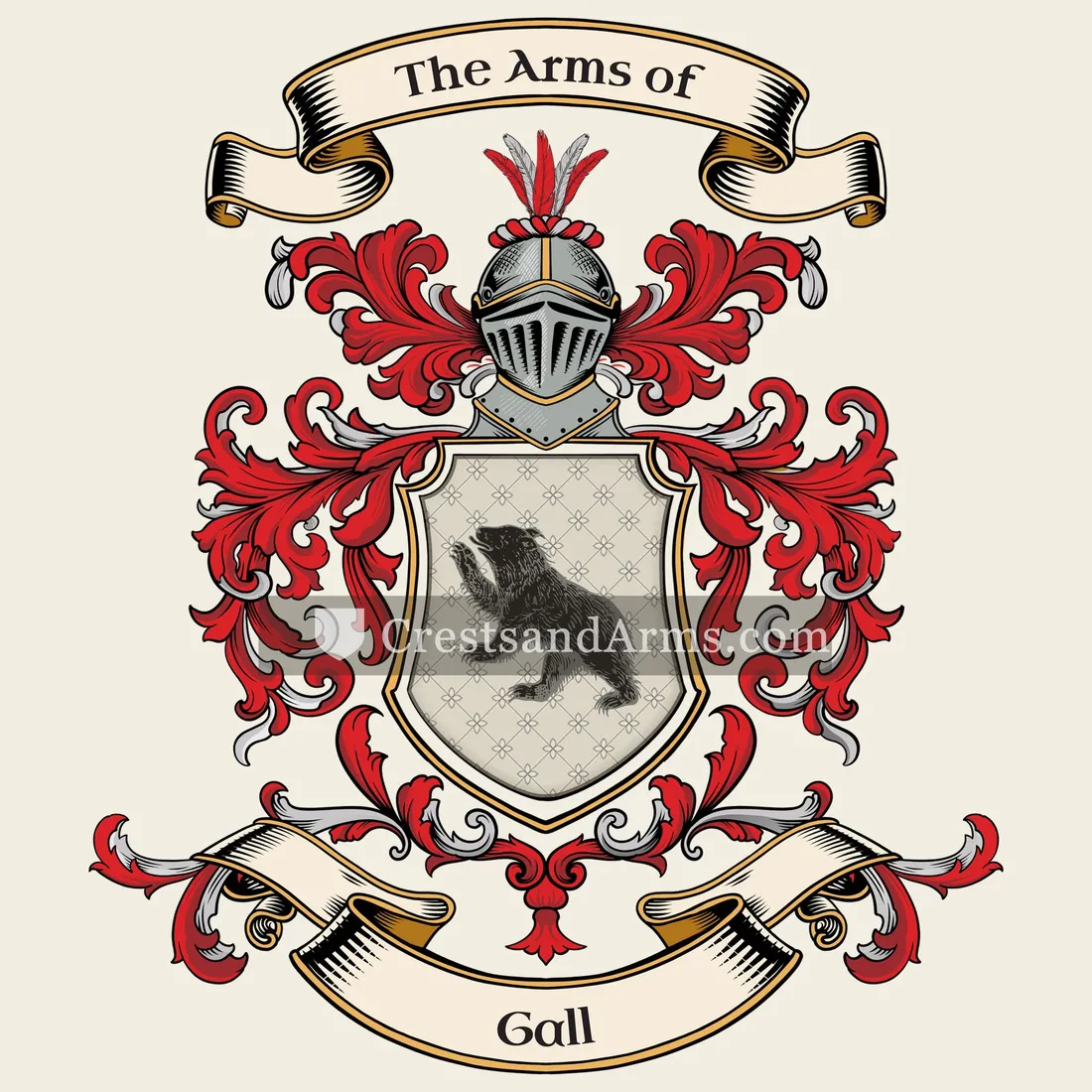
Symbols on this shield
bearStrength, cunning and protection of kin
Colours
Silver (Argent)Means: Peace and sincerity
Black (Sable)Means: Constancy
Historical info
Source
Sir Bernard Burke, The General Armory of England, Scotland, Ireland and Wales, London: Harrison & Sons, 1884
Blazon (the actual original written record)
“Ar. a bear sejant ramp. sa. muzzled gu”
Irelandc. 1645
Digital archive packCoat of arms PNG, gold border print PDF, vector SVG and the certificate of authenticity. Sent to your email in minutes.
Map of Ireland showing where the Gall arms are recorded
The Gall arms were recorded in Ireland, c. 1645.
Arms such as these were typically recorded in Dublin.
Dublin was the seat of government in Ireland and the place where grants were sought and recorded. Families with business at the castle or the courts settled nearby, and settling there put their arms on record.
This is where the arms were entered in the register. Families often moved to other parts of the country, so the same name can turn up in more than one region.
The body that granted and recorded arms in Ireland in this period.
Charles I of England
Sovereign of the period
Charles I of England
1625–1649
Reigning in Germany when the Gall arms are first recorded.
How Arms Worked in Ireland
The Ulster King of Arms granted coats of arms to individuals who proved their social standing and good character. These symbols were typically inherited by all legitimate descendants of the original holder. If a family branch wanted a unique look, they could apply for a specific change to their design through the office to ensure their identity remained distinct.
Granting authority
The Ulster King of Arms acted as the official body that regulated and issued all coats of arms throughout Ireland.
How they got arms
Families obtained their arms through formal grants issued by the office after proving their eligibility and paying the required fees.
Where arms were recorded
All official grants were recorded in the registers held by the Ulster King of Arms starting from the year 1552.
The family's standing
Recorded among the armigerous families of Ireland.
Origin & History of the Gall Family in Ireland
The family name Gall has a long and complex history in Ireland, often linked to the Gaelic word gall, which historically referred to a foreigner or a stranger. While the name is sometimes associated with settlers from overseas, records confirm that members of the Gall family were firmly established in Dublin by 1645. During this period, Dublin was a bustling center of trade and political change, and families like the Galls often integrated into the urban professional and merchant classes. Over time, the name became a permanent part of the Irish landscape, reflecting the way different groups of people moved into the country and eventually became local residents. By tracing their presence in the capital city during the mid-seventeenth century, we see that the Gall family was part of the diverse social fabric that defined Ireland at a time of great historical transition.
Gall Meaning & Related Branches
Root word
Gallus
Latin term meaning a rooster or a person from Gaul.
This name
GallA nickname for a proud or loud person, or a topographic name for someone from France.
also spelled
Gal
Galle
Gallee
Gaull
Related arms
Autenriedsimilar arms
Biron-Wartenbergsimilar arms
Kettlersimilar arms
Documented Sources
J. B. Rietstap, Armorial Général, Gouda: G. B. van Goor Zonen, 1884–87
Bahlow, Hans, Deutsches Namenlexikon: Familien- und Vornamen nach Ursprung und Sinn erklärt, 1967
Heßisches Staatsarchiv Marburg, Kirchenbücher der Landgrafschaft Hessen-Kassel, 1601
Gottschald, Max, Deutsche Namenkunde: Unsere Familiennamen, 1982
Digital archive packCoat of arms PNG, gold border print PDF, vector SVG and the certificate of authenticity. Sent to your email in minutes.


 bendDefence, and the scarf of a commander
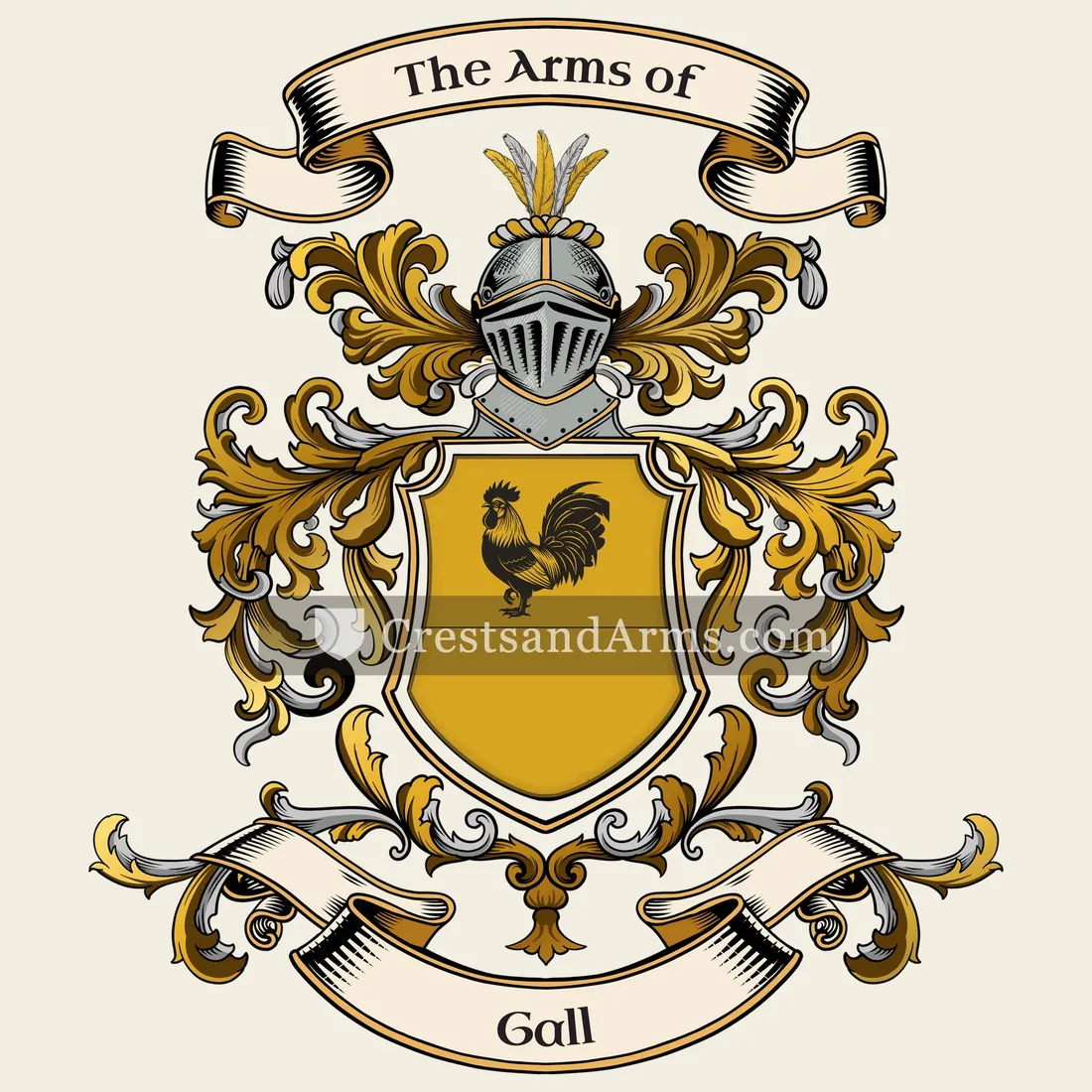
 cockCourage, vigilance and readiness for battle
 bendDefence, and the scarf of a commander
 cockCourage, vigilance and readiness for battle


 bearStrength, cunning and protection of kin