Map of France showing where the Galle arms are recorded
The Galle arms were recorded in France, c. 1651.
Arms such as these were typically recorded in Bretagne.
More families held coats of arms in Bretagne than anywhere else in France. The land was divided into many small estates rather than a few large ones, so far more households counted as gentry, and each needed a shield of its own to be told apart.
This is where the arms were entered in the register. Families often moved to other parts of the country, so the same name can turn up in more than one region.
The body that granted and recorded arms in France in this period.
Louis XIV of France
Sovereign of the period
Louis XIV of France
1643–1715
Reigning in France when the Galle arms are first recorded.
How Arms Worked in France
In France, a coat of arms was a mark of honor that passed down through the male line to all legitimate descendants. Families often used the same shield without changes to show their shared heritage. If a branch wanted to stand out, they could add a small mark to their shield to show their specific place in the family tree.
Granting authority
The Juge d'armes de France acted as the official authority that regulated and verified coats of arms across the country.
How they got arms
Families typically inherited their arms from ancestors, though they could also receive them through royal grants or by proving their noble status.
Where arms were recorded
Coats of arms were officially recorded in the Armorial Général de France, which began its main collection in the year 1696.
The family's standing
Recorded among the armigerous families of France.
Origin & History of the Galle Family in France
The family name Galle has deep roots in the historical landscape of France, particularly within the rugged and culturally distinct region of Brittany. By the middle of the seventeenth century, records confirm that members of the family were firmly established in this area by 1651. During this period, Brittany functioned as a province with its own unique customs and a strong maritime identity. Families living there often relied on the land or the sea to sustain their livelihoods, and those bearing the name Galle likely participated in the local agricultural or trade networks that defined life in the western reaches of the kingdom. As the name spread through the region, it became part of the social fabric of the local parishes, where families were recorded in church registers that tracked births, marriages, and deaths. These early records offer a glimpse into a time when the Galle family was already an integrated part of the Breton community, living through the social changes of the French seventeenth century.
Coat of Arms & Family Crest Details
Symbols on this shield
leafHappiness and abundance
Colours
Silver (Argent)Means: Peace and sincerity
Red (Gules)Means: Military strength
Green (Vert)Means: Hope
Historical info
Source
J. B. Rietstap, Armorial Général, Gouda: G. B. van Goor Zonen, 1884–87
Blazon (the actual original written record)
“D'arg. à une eau d'azur, de laquelle s'élève une feuille de tilleul de gu., tigée de sin. et accostée de feuilles oblongues de sin., mouv. d'une même racine. C.: une colonne d'or, sommée d'une rose du même; accostée de deux baïonnettes d'arg., sommées chacune d'une moitié de la feuille de tilleul, dextre et sen. de gu.; lesdites baïonnettes accostées de deux palmes de sin. L.: à dextre de gu. et d'or, à sen. d'azur et d'or.”
Swedenc. 1560
Digital archive packCoat of arms PNG, gold border print PDF, vector SVG and the certificate of authenticity. Sent to your email in minutes.
Map of Sweden showing where the Galle arms are recorded
The Galle arms were recorded in Sweden, c. 1560.
Arms such as these were typically recorded in Stockholm.
Stockholm held the Swedish court and the House of Nobility, where every noble family's arms were entered and kept. Families ennobled for service registered there, which is why so many are recorded around the city.
This is where the arms were entered in the register. Families often moved to other parts of the country, so the same name can turn up in more than one region.
The body that granted and recorded arms in Sweden in this period.
Gustav I of Sweden
Sovereign of the period
Gustav I of Sweden
1523–1560
Reigning in France when the Galle arms are first recorded.
How Arms Worked in Sweden
In Sweden, a coat of arms belonged to a noble family as a whole rather than just one individual. These arms were passed down through the generations to all legitimate descendants. Younger branches of the family used the same shield without needing to change it. This system ensured that the entire lineage shared the same identity and status under the law.
Granting authority
The Riddarhuset, or House of Nobility, regulated all noble coats of arms in Sweden under royal authority.
How they got arms
Families received their coats of arms through royal grants of nobility which were then officially registered with the House.
Where arms were recorded
Coats of arms were officially recorded in the Swedish House of Nobility register starting in the year 1626.
The family's standing
Recorded among the armigerous families of Sweden.
Origin & History of the Galle Family in Sweden
The Galle family name has deep roots in the urban landscape of sixteenth-century Sweden. By the year 1560, members of the family were already established residents of Stockholm, which was then a growing center of political and economic power under the Vasa dynasty. During this era, individuals with this surname were often integrated into the administrative and merchant classes that helped manage the city’s expanding trade networks. Because Stockholm served as the primary gateway for international influence in the Baltic region, the family likely navigated a society transitioning from medieval traditions to a more centralized state. Their presence in the capital during this formative period suggests they were active participants in the civic life of a nation that was rapidly defining its modern identity.
Coat of Arms & Family Crest Details
Symbols on this shield
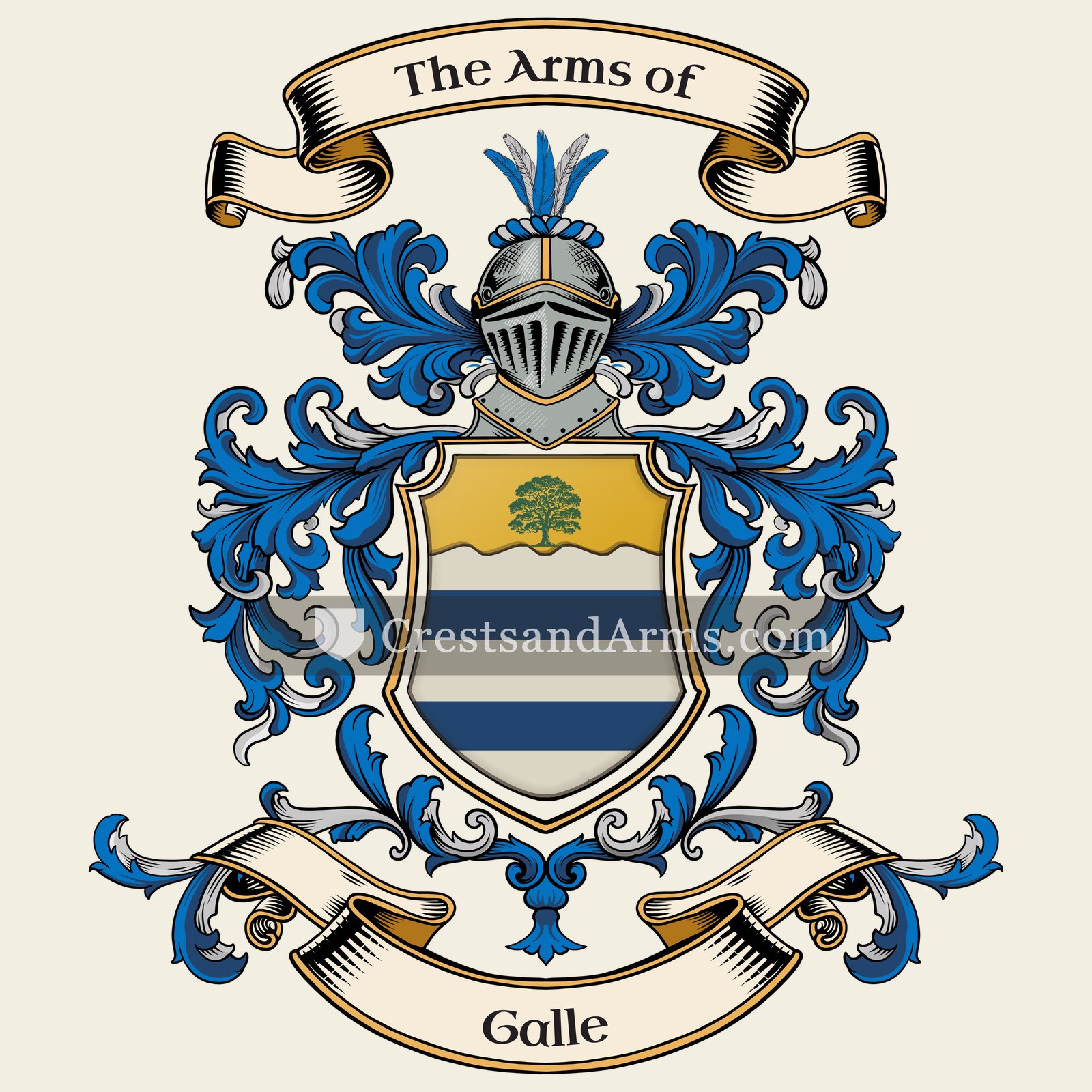
fessThe military belt, and readiness to serve
chiefAuthority, wisdom and dominion
treeLife, endurance and deep roots
Colours
Silver (Argent)Means: Peace and sincerity
Blue (Azure)Means: Loyalty and truth
Gold (Or)Means: Generosity
Green (Vert)Means: Hope
Historical info
Source
J. B. Rietstap, Armorial Général, Gouda: G. B. van Goor Zonen, 1884–87
Blazon (the actual original written record)
“D'arg. à trois fasces ondées d'azur; au chef d'or, ch. d'un arbre de sin.”
NetherlandsBois-le, c. 1815
Digital archive packCoat of arms PNG, gold border print PDF, vector SVG and the certificate of authenticity. Sent to your email in minutes.
Map of Netherlands showing where the Galle arms are recorded
The Galle arms were recorded in Bois-le, c. 1815.
This is where the arms were entered in the register. Families often moved to other parts of the country, so the same name can turn up in more than one region.
Region
Bois-le
Town
Bois-le
First recorded
1815
Granting Authority for the Galle Arms
Hoge Raad van Adel
Photograph made by me · CC BY-SA 3.0
The body that granted and recorded arms in Netherlands in this period.
William I of the Netherlands
Sovereign of the period
William I of the Netherlands
1815–1840
Reigning in France when the Galle arms are first recorded.
How Arms Worked in Netherlands
In the Netherlands, coats of arms were often used by noble families and those who held specific public offices. These arms were passed down through the generations to legitimate descendants. Younger branches of a family usually kept the original design without needing to add special marks. This system ensured that the family identity remained clear and consistent over many years.
Granting authority
The Hoge Raad van Adel is the official body that regulates and manages noble titles and coats of arms in the Netherlands.
How they got arms
Families typically obtained their coats of arms through official royal grants or by proving their long-standing historical use of the symbols.
Where arms were recorded
Coats of arms are officially recorded in the registers held by the Hoge Raad van Adel, which began its work in 1814.
The family's standing
Recorded among the armigerous families of Netherlands.
Origin & History of the Galle Family in Netherlands
The family name Galle has deep roots in the southern regions of the Netherlands, particularly near the city of Bois-le-Duc, which is known locally as 's-Hertogenbosch. By the year 1815, records confirm that members of the Galle family were established residents in this area. The name itself likely originated as a descriptive nickname or a shortened form of a longer Germanic given name, which was a common way for surnames to form during the Middle Ages. As the family settled in the North Brabant province, they became part of the local social fabric during a time of great political change in the Netherlands. Because 's-Hertogenbosch served as a vital military and trade hub, the early Galle family members were positioned in an environment where they could participate in the growth of the region. Their presence in official records from the early nineteenth century suggests that they were settled citizens who contributed to the local community as the modern Dutch state began to take its current shape.
Galle Meaning & Related Branches
Root word
Gallo
Latin term referring to a person from Gaul or a rooster.
This name
GalleA habitational name for someone from the region of Gaul or a nickname for a proud person.
also spelled
Gallee
Gallei
Gallo
Galay
Related arms
Cruus d'Edbysimilar arms
Desguilhots de Labatutsimilar arms
Osterrohtsimilar arms
Gallivariant spelling
Documented Sources
J. B. Rietstap, Armorial Général, Gouda: G. B. van Goor Zonen, 1884–87
Archives départementales d'Ille-et-Vilaine, Registres paroissiaux et d'état civil
Galliot, Marcel, Histoire de la Bretagne et des Bretons, 1972
Le Moyne de La Borderie, Arthur, Histoire de Bretagne, 1896
Digital archive packCoat of arms PNG, gold border print PDF, vector SVG and the certificate of authenticity. Sent to your email in minutes.


 crescentHonour by the sovereign, and the second son
 crescentHonour by the sovereign, and the second son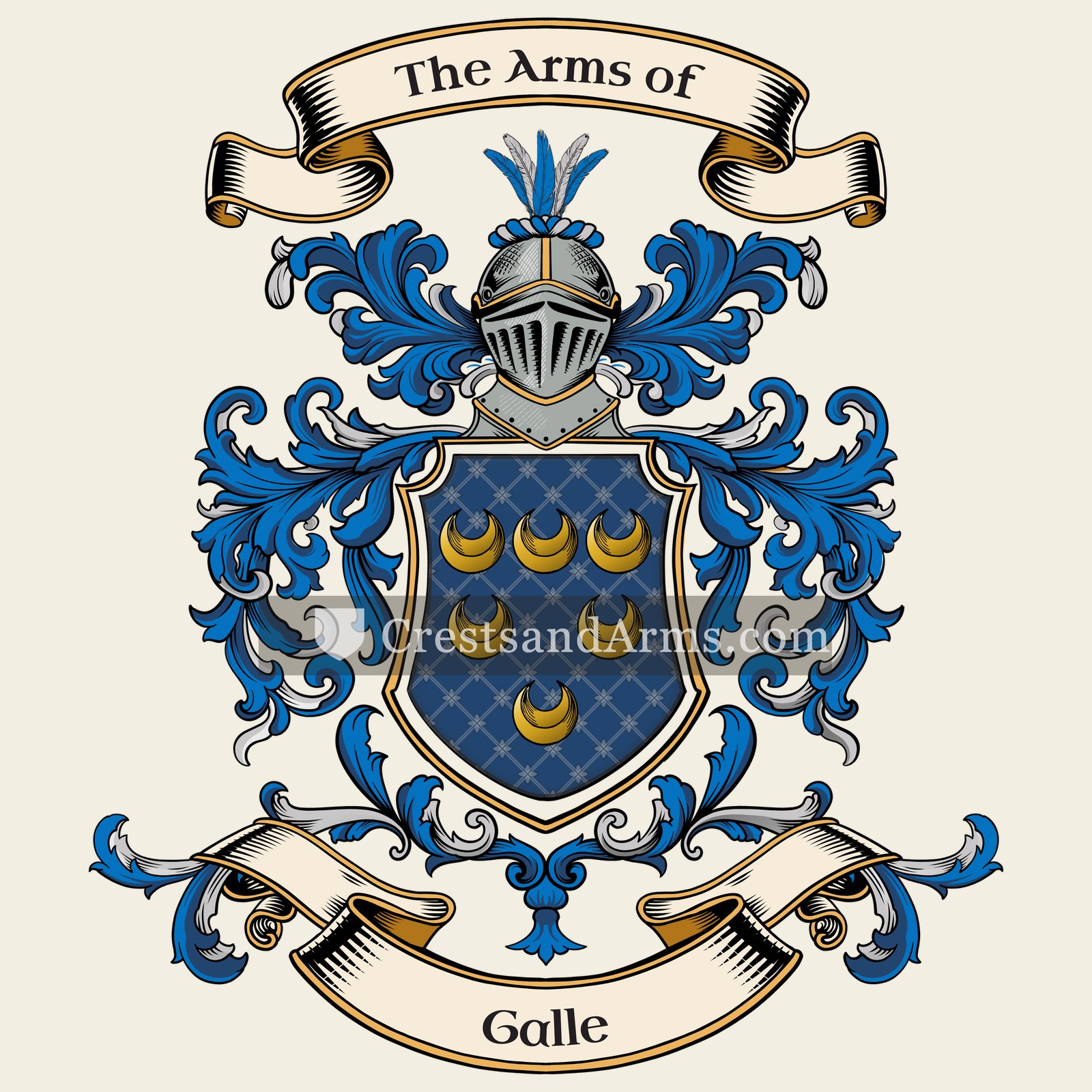


 leafHappiness and abundance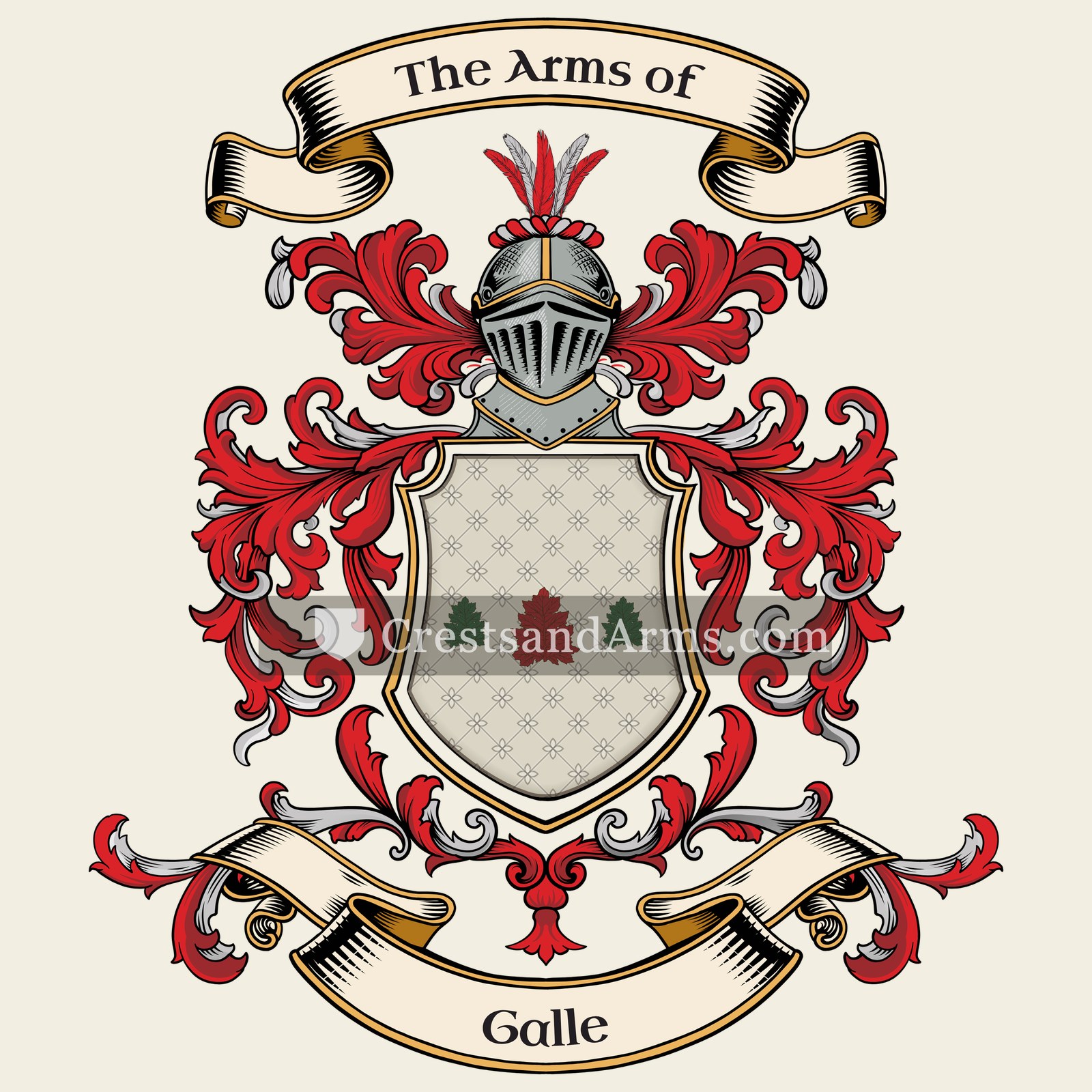


 fessThe military belt, and readiness to serve
 chiefAuthority, wisdom and dominion
 treeLife, endurance and deep roots