Map of Italy showing where the Gallivan arms are recorded
The Gallivan arms were recorded in Bologne, c. 1775.
This is where the arms were entered in the register. Families often moved to other parts of the country, so the same name can turn up in more than one region.
The body that granted and recorded arms in Italy in this period.
Alvise Giovanni Mocenigo
Sovereign of the period
Alvise Giovanni Mocenigo
1763–1778
Reigning in Italy when the Gallivan arms are first recorded.
How Arms Worked in Italy
In the Italian states, coats of arms were often used by noble families to show their status and history. These symbols were passed down through the generations to all legitimate male descendants. Younger branches of a family usually kept the original design but sometimes added small changes to distinguish their specific line from the main branch.
Granting authority
Various local rulers and city governments controlled the use of coats of arms across the different Italian states.
How they got arms
Families often assumed their own arms or received them as official grants from local lords, popes, or city councils.
Where arms were recorded
Arms were recorded in local city archives or private family books rather than in one single national register.
The family's standing
Recorded among the armigerous families of Italy.
Origin & History of the Gallivan Family in Italy
The Gallivan family name carries a rich history that is deeply rooted in the cultural landscape of eighteenth-century Europe. Records confirm that members of the family were established in the French port city of Boulogne by 1775. During this period, Boulogne served as a vital hub for trade and cross-channel travel, suggesting that the early Gallivans were likely involved in maritime commerce or international exchange. The name itself is often associated with linguistic roots that point toward a lineage of resilience and mobility. As the family settled into the coastal environment of northern France, they became part of a diverse community that navigated the complex social changes leading up to the French Revolution. By maintaining a presence in such a strategic location, the early Gallivans were positioned at the intersection of continental European history and the evolving connections between neighboring nations.
Gallivan Meaning & Related Branches
Root word
Gallus
Latin term referring to a person from Gaul or a rooster.
This name
GallivanA surname derived from a nickname for someone of Gallic origin or possessing rooster-like traits.
also spelled
Galvany
Documented Sources
J. B. Rietstap, Armorial Général, Gouda: G. B. van Goor Zonen, 1884–87
Archives départementales du Pas-de-Calais, Registres paroissiaux et d'état civil de Boulogne-sur-Mer, 1775
Lart, Charles E., The Huguenot Settlements in Ireland and France, 1928
Digital archive packCoat of arms PNG, gold border print PDF, vector SVG and the certificate of authenticity. Sent to your email in minutes.


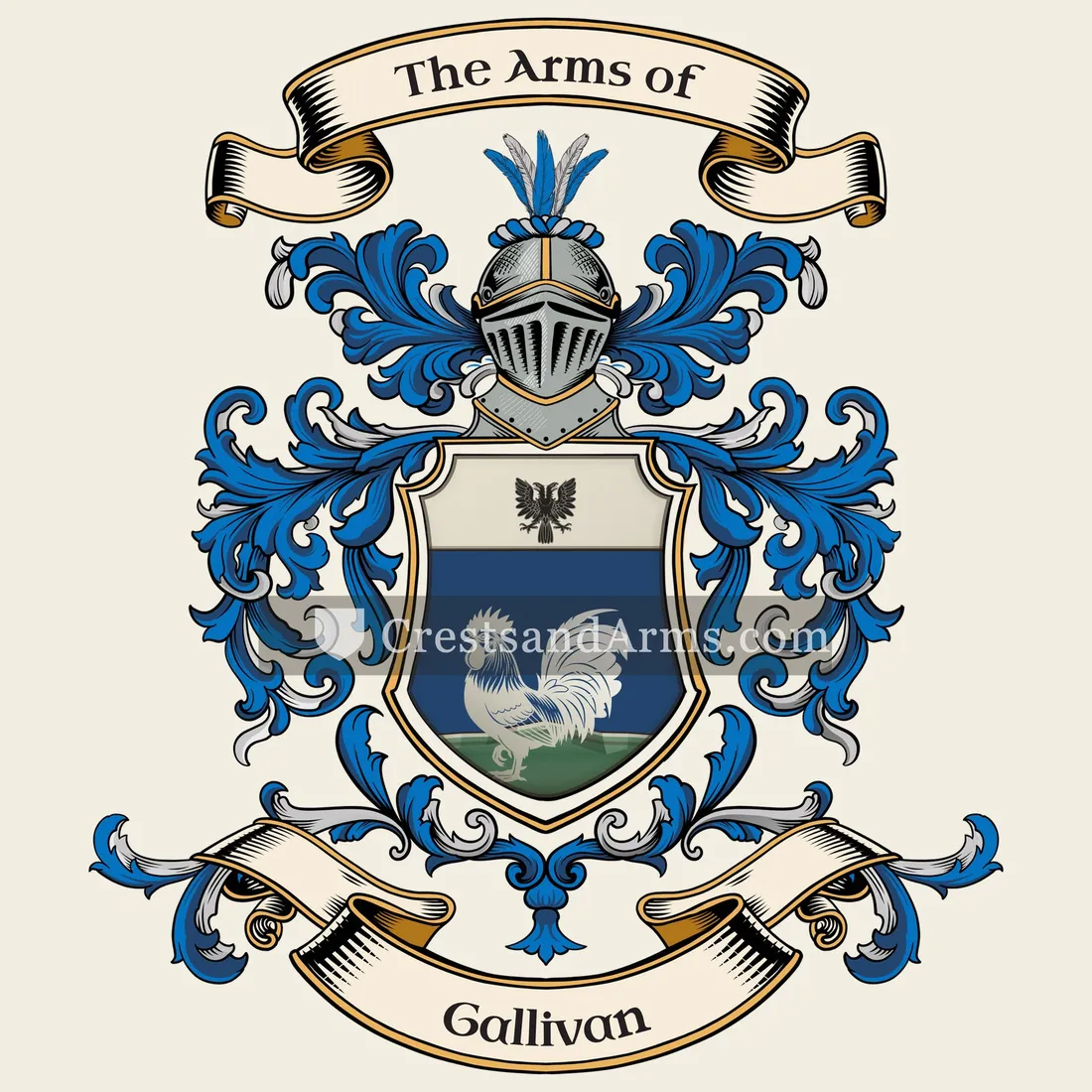
 mountThe ground held, and steadfastness upon it
 chiefAuthority, wisdom and dominion
 cockCourage, vigilance and readiness for battle
 eagleNobility, strength and a keen mind
 mountThe ground held, and steadfastness upon it
 chiefAuthority, wisdom and dominion
 cockCourage, vigilance and readiness for battle
 eagleNobility, strength and a keen mind