Map of Wales showing where the Gambon arms are recorded
The Gambon arms were recorded in Dorset, c. 1647.
Dorset was quiet farming and grazing country along the south coast. Its gentry were middling rather than grand, but they held their manors for a very long time, and long holding is what puts a name in the records.
This is where the arms were entered in the register. Families often moved to other parts of the country, so the same name can turn up in more than one region.
The body that granted and recorded arms in Wales in this period.
Charles I of England
Sovereign of the period
Charles I of England
1625–1649
Reigning in Wales when the Gambon arms are first recorded.
How Arms Worked in Wales
English heraldry allowed arms to be shared by all legitimate descendants of the original owner. These symbols were treated as personal property that moved through the generations to all children. While the eldest son kept the original design, other family members could use the same shield without needing to change it or register their own unique versions.
Granting authority
The College of Arms in London has regulated the use of coats of arms throughout England and Wales since 1484.
How they got arms
Families typically obtained their coats of arms through a formal grant from the Crown or by proving their ancient right to them.
Where arms were recorded
All official coats of arms are recorded in the registers kept at the College of Arms, which date back to the fifteenth century.
The family's standing
Recorded among the armigerous families of Dorset.
Origin & History of the Gambon Family in Wales
The name Gambon has roots that reach back into the medieval period, though its presence in Wales is often tied to the movement of families across the border into England. While historical records confirm that members of the Gambon family were well-established in the county of Dorset by 1647, the name itself likely evolved from older linguistic traditions found in the Welsh Marches. During this era, families frequently migrated between the rugged landscapes of Wales and the neighboring English counties to seek new opportunities in farming or trade. As these individuals moved, their surnames often shifted in spelling to match the local dialects of the regions where they settled. This process of migration helped the family name transition from its regional origins into a more permanent fixture within the English countryside. By the mid-seventeenth century, the Gambon family had become a recognized part of the local community in Dorset, reflecting a long history of movement and adaptation that defined many families of that time.
Coat of Arms & Family Crest Details
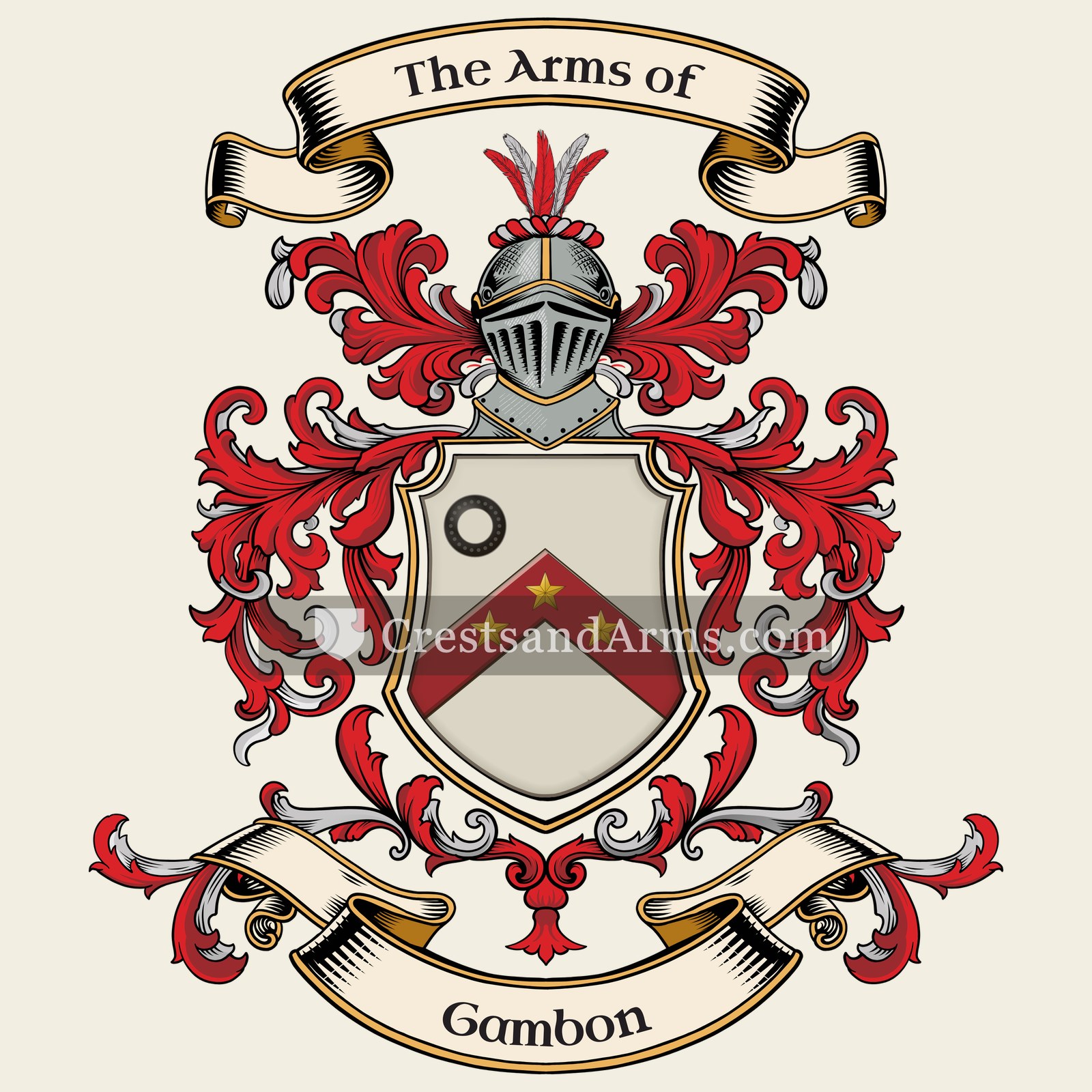
Symbols on this shield
chevronProtection, and faithful service completed
mulletThe third son, and a divine quality from above
ringFidelity, and a promise kept
Colours
Silver (Argent)Means: Peace and sincerity
Red (Gules)Means: Military strength
Gold (Or)Means: Generosity
Black (Sable)Means: Constancy
Historical info
Source
Sir Bernard Burke, The General Armory of England, Scotland, Ireland and Wales, London: Harrison & Sons, 1884
Blazon (the actual original written record)
“Ar. on a chev. gu. three mullets or, in chief an annulet sa”
Englandc. 1620
Digital archive packCoat of arms PNG, gold border print PDF, vector SVG and the certificate of authenticity. Sent to your email in minutes.
Map of England showing where the Gambon arms are recorded
The Gambon arms were recorded in England, c. 1620.
Arms such as these were typically recorded in York.
Yorkshire is the largest of the English counties, and it held more gentry families than any other. Land there was split among a great many households rather than a few, so a great many of them carried arms.
This is where the arms were entered in the register. Families often moved to other parts of the country, so the same name can turn up in more than one region.
The body that granted and recorded arms in England in this period.
James VI and I
Sovereign of the period
James VI and I
1603–1625
Reigning in Wales when the Gambon arms are first recorded.
How Arms Worked in England
English heraldry allowed arms to be shared by all legitimate descendants of the original owner. These symbols were treated as personal property that moved through the generations to all children. While the eldest son kept the original design, other family members could use the same shield without needing to change it or register their own unique versions.
Granting authority
The College of Arms in London has regulated the use of coats of arms throughout England and Wales since 1484.
How they got arms
Families typically obtained their coats of arms through a formal grant from the Crown or by proving their ancient right to them.
Where arms were recorded
All official coats of arms are recorded in the registers kept at the College of Arms, which date back to the fifteenth century.
The family's standing
Recorded among the armigerous families of England.
Origin & History of the Gambon Family in England
The surname Gambon is rooted in the social landscape of medieval England, where it likely originated as a descriptive nickname or a locational identifier. By the early seventeenth century, the family had established a notable presence in the historic city of York. Records from 1620 confirm that members of the Gambon family were active participants in the local community during this period of significant urban growth. As residents of a major northern trade hub, these early Gambons were likely integrated into the merchant or artisan classes that defined York’s economy. Their presence in such a prominent city suggests that the family was well-settled and connected to the regional administration of the time. This historical foothold provides a clear glimpse into the family’s long-standing connection to the north of England, where they contributed to the local life and development of the region for generations.
Gambon Meaning & Related Branches
Root word
Gamba
An Italian or Old French term referring to a leg or shank.
This name
GambonA locative or descriptive surname likely denoting someone with a distinctive gait or leg shape.
also spelled
Gamboun
Gamon
Related arms
Gambounvariant spelling
Gamonvariant spelling
Documented Sources
Sir Bernard Burke, The General Armory of England, Scotland, Ireland and Wales, London: Harrison & Sons, 1884
Reaney, P.H. and Wilson, R.M., A Dictionary of English Surnames, 1991
Lower, Mark Antony, Patronymica Britannica: A Dictionary of the Family Names of the United Kingdom, 1860
The National Archives, State Papers Domestic: Charles I, 1647, SP 16
Digital archive packCoat of arms PNG, gold border print PDF, vector SVG and the certificate of authenticity. Sent to your email in minutes.


 fessThe military belt, and readiness to serve
 legStrength and swiftness
 fessThe military belt, and readiness to serve
 legStrength and swiftness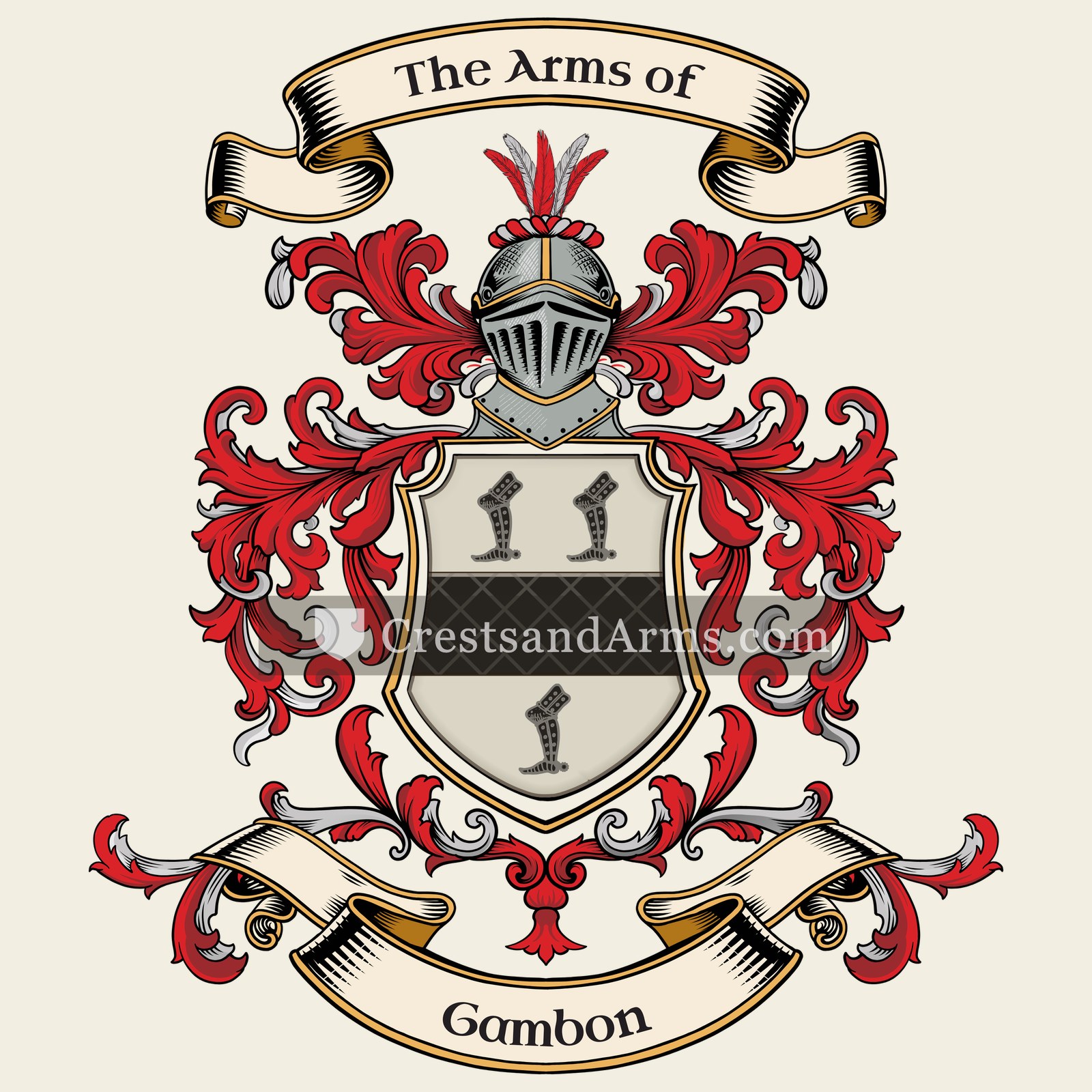


 chevronProtection, and faithful service completed
 mulletThe third son, and a divine quality from above
 ringFidelity, and a promise kept