Map of England showing where the Gant arms are recorded
The Gant arms were recorded in Lincoln, c. 1295.
Lincolnshire was rich farming country, and its wealth was spread across many middling families. Households of that size bought land and took arms, and the county holds a large share of English names.
This is where the arms were entered in the register. Families often moved to other parts of the country, so the same name can turn up in more than one region.
The body that granted and recorded arms in England in this period.
Edward I of England
Sovereign of the period
Edward I of England
1272–1307
Reigning in England when the Gant arms are first recorded.
How Arms Worked in England
English heraldry allowed arms to be shared by all legitimate descendants of the original owner. These symbols were treated as personal property that moved through the generations to all children. While the eldest son kept the original design, other family members could use the same shield without needing to change it or register their own unique versions.
Granting authority
The College of Arms in London has regulated the use of coats of arms throughout England and Wales since 1484.
How they got arms
Families typically obtained their coats of arms through a formal grant from the Crown or by proving their ancient right to them.
Where arms were recorded
All official coats of arms are recorded in the registers kept at the College of Arms, which date back to the fifteenth century.
The family's standing
Recorded among the armigerous families of Lincoln.
Origin & History of the Gant Family in England
The name Gant has deep roots in English history, particularly within the county of Lincolnshire. By the year 1295, records confirm that members of the family were well-established in the city of Lincoln. The name is believed to be locative in origin, meaning it likely refers to the town of Ghent in modern-day Belgium. During the medieval period, many families moved across the English Channel to settle in England, often taking the name of their place of origin as a way to identify themselves in a new land. As these families integrated into local society, they became part of the growing administrative and social structures of the region. Over several generations, the name evolved from a geographic descriptor into a permanent family surname that persisted through the centuries in the English Midlands.
Coat of Arms & Family Crest Details
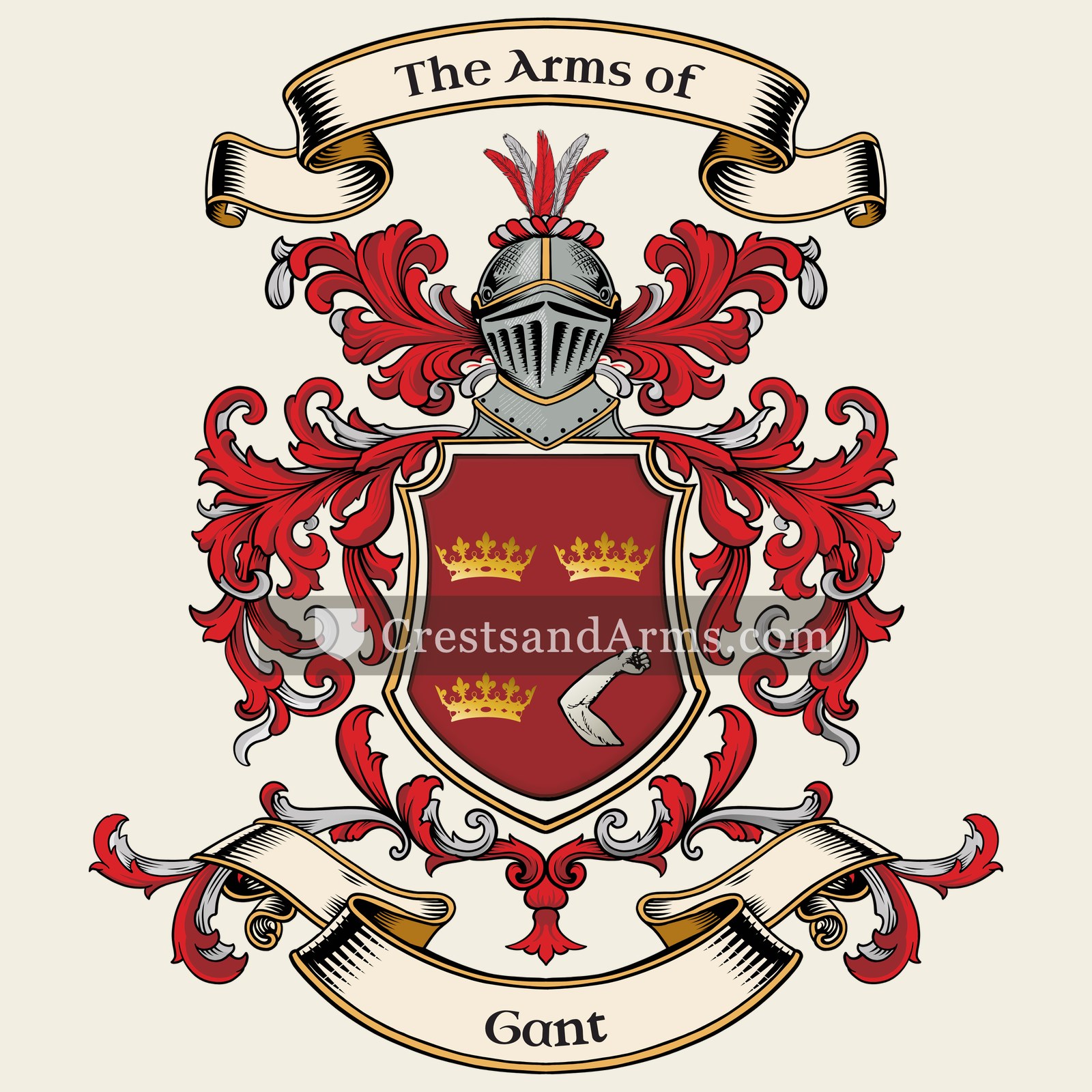
Symbols on this shield
crownSovereignty, authority and just reward
armA person of action, industrious and laborious
Colours
Red (Gules)Means: Military strength
Gold (Or)Means: Generosity
Historical info
Source
Sir Bernard Burke, The General Armory of England, Scotland, Ireland and Wales, London: Harrison & Sons, 1884
Blazon (the actual original written record)
“Gu. three antique crowns or, in fess point a dexter arm in armour fessways couped ppr. garnished or, holding a cross crosslet fitchée of the last”
BanffAberlour · Banff, c. 1810
Digital archive packCoat of arms PNG, gold border print PDF, vector SVG and the certificate of authenticity. Sent to your email in minutes.
Map of Scotland showing where the Gant arms are recorded
The Gant arms were recorded in Banff, c. 1810.
Banffshire was farming and fishing country on Scotland's north-east coast. Its landed families were long-settled and closely related, and each line recorded arms to be told apart from the rest.
This is where the arms were entered in the register. Families often moved to other parts of the country, so the same name can turn up in more than one region.
The body that granted and recorded arms in Scotland in this period.
George III of Great Britain
Sovereign of the period
George III of Great Britain
1801–1820
Reigning in England when the Gant arms are first recorded.
How Arms Worked in Scotland
Scottish heraldry is unique because it treats a coat of arms as a piece of personal property protected by law. Only one person can own a specific design at any given time. When a family grows, the head keeps the original shield while other relatives must apply for their own distinct version with slight changes to prove their specific identity.
Granting authority
The Court of the Lord Lyon acts as the official body that regulates and controls all heraldic matters throughout Scotland.
How they got arms
Individuals obtain a legal right to their arms through a formal petition process that confirms their identity and family connection.
Where arms were recorded
All valid coats of arms are officially entered into the Public Register of All Arms and Bearings starting from 1672.
The family's standing
Recorded among the armigerous families of Banff.
Origin & History of the Gant Family in Scotland
The surname Gant has deep historical roots that trace back to the rugged landscapes of Scotland, particularly within the coastal regions of the northeast. By the early nineteenth century, records confirm that members of the family were established in the royal burgh of Banff. This area was a bustling center for trade and fishing, suggesting that early ancestors likely participated in the maritime economy that defined the Moray Firth. While the name is often associated with broader migrations across the British Isles, its specific presence in Banff by 1810 highlights a family deeply integrated into the local community life of the era. These early settlers lived through a time of significant social change in Scotland, as the region transitioned from traditional agrarian practices toward the industrial developments of the modern age. Through their presence in parish registers and local administrative documents, the Gant family remains a part of the enduring historical tapestry of the Scottish northeast.
Gant Meaning & Related Branches
Root word
Ghent
A city in modern-day Belgium located at a river confluence.
This name
GantA habitational name for someone who originated from the city of Ghent.
also spelled
Gaunt
Related arms
Gauntvariant spelling
Documented Sources
Sir Bernard Burke, The General Armory of England, Scotland, Ireland and Wales, London: Harrison & Sons, 1884
Bardsley, Charles Wareing, A Dictionary of English and Welsh Surnames, 1901
Reaney, P.H., A Dictionary of British Surnames, 1958
The National Archives, Parliamentary Writs and Returns of Members of Parliament, 1295
Digital archive packCoat of arms PNG, gold border print PDF, vector SVG and the certificate of authenticity. Sent to your email in minutes.


 bendDefence, and the scarf of a commander
 bendDefence, and the scarf of a commander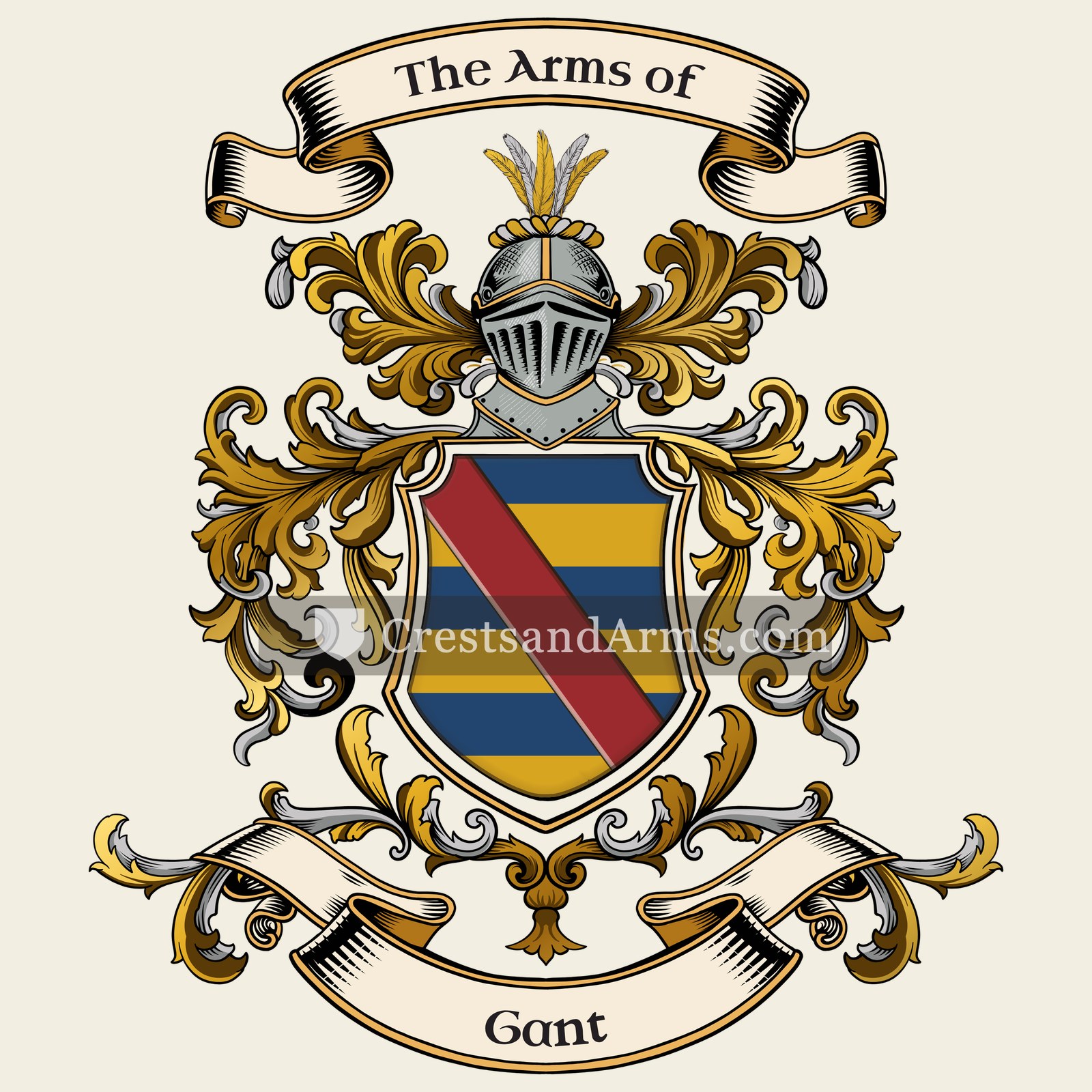


 crownSovereignty, authority and just reward
 armA person of action, industrious and laborious