A record of documented arms, meaning and origin, researched for the Gard family lines. Documented in 2 countries.
Reg. 2460 · Swiss, G–I
Coat of Arms & Family Crest Details
Symbols on this shield
chevronProtection, and faithful service completed
mountThe ground held, and steadfastness upon it
eagleNobility, strength and a keen mind
mulletThe third son, and a divine quality from above
Colours
Gold (Or)Means: Generosity
Blue (Azure)Means: Loyalty and truth
Green (Vert)Means: Hope
Black (Sable)Means: Constancy
Historical info
Source
J. B. Rietstap, Armorial Général, Gouda: G. B. van Goor Zonen, 1884–87
Blazon (the actual original written record)
“Coupé: au 1 d'or à une aigle de profil de sa., cour. du même, le vol ouv. et abaissé, la patte dextre levée; au 2 d'azur au chev. de sa., acc. de trois étoiles (5) d'or, celle en p. surmontant un tertre de trois pies de sin.”
SwitzerlandValais, c. 1745
Digital archive packCoat of arms PNG, gold border print PDF, vector SVG and the certificate of authenticity. Sent to your email in minutes.
Map of Switzerland showing where the Gard arms are recorded
The Gard arms were recorded in Valais, c. 1745.
This is where the arms were entered in the register. Families often moved to other parts of the country, so the same name can turn up in more than one region.
The body that granted and recorded arms in Switzerland in this period.
How Arms Worked in Switzerland
In Switzerland, coats of arms were not restricted to the nobility and were often adopted by common citizens and families. These symbols were passed down through generations to show family identity. When branches of a family grew, they often changed small details of the design to distinguish their own line from the original group.
Granting authority
Cantonal and civic authorities managed the use of coats of arms within their specific regions and local jurisdictions.
How they got arms
Families typically assumed their own coats of arms based on local custom rather than receiving them from a central monarch.
Where arms were recorded
Arms were recorded in various cantonal and civic registers starting from the fourteenth century throughout the Swiss region.
The family's standing
Recorded among the armigerous families of Switzerland.
Origin & History of the Gard Family in Switzerland
The family name Gard has deep roots in the rugged landscape of the Swiss canton of Valais, where records confirm their presence as early as 1745. During this period, the region was defined by small, tight-knit mountain communities that relied heavily on alpine agriculture and trade routes through the high mountain passes. The name likely originated as a topographical descriptor, referring to individuals who lived near a guarded or protected enclosure, or perhaps near a specific lookout point in the steep terrain. As members of the Gard family established themselves in these valleys, they became integrated into the local social and economic structures that governed life in the Swiss Alps. Over the generations, they adapted to the challenging climate and the unique political autonomy of the Valais region, gradually spreading from their initial settlements into the surrounding districts. Their history reflects the broader story of Swiss families who maintained strong ties to their ancestral land while navigating the shifts in local administration and rural development throughout the eighteenth century.
Coat of Arms & Family Crest Details
Symbols on this shield
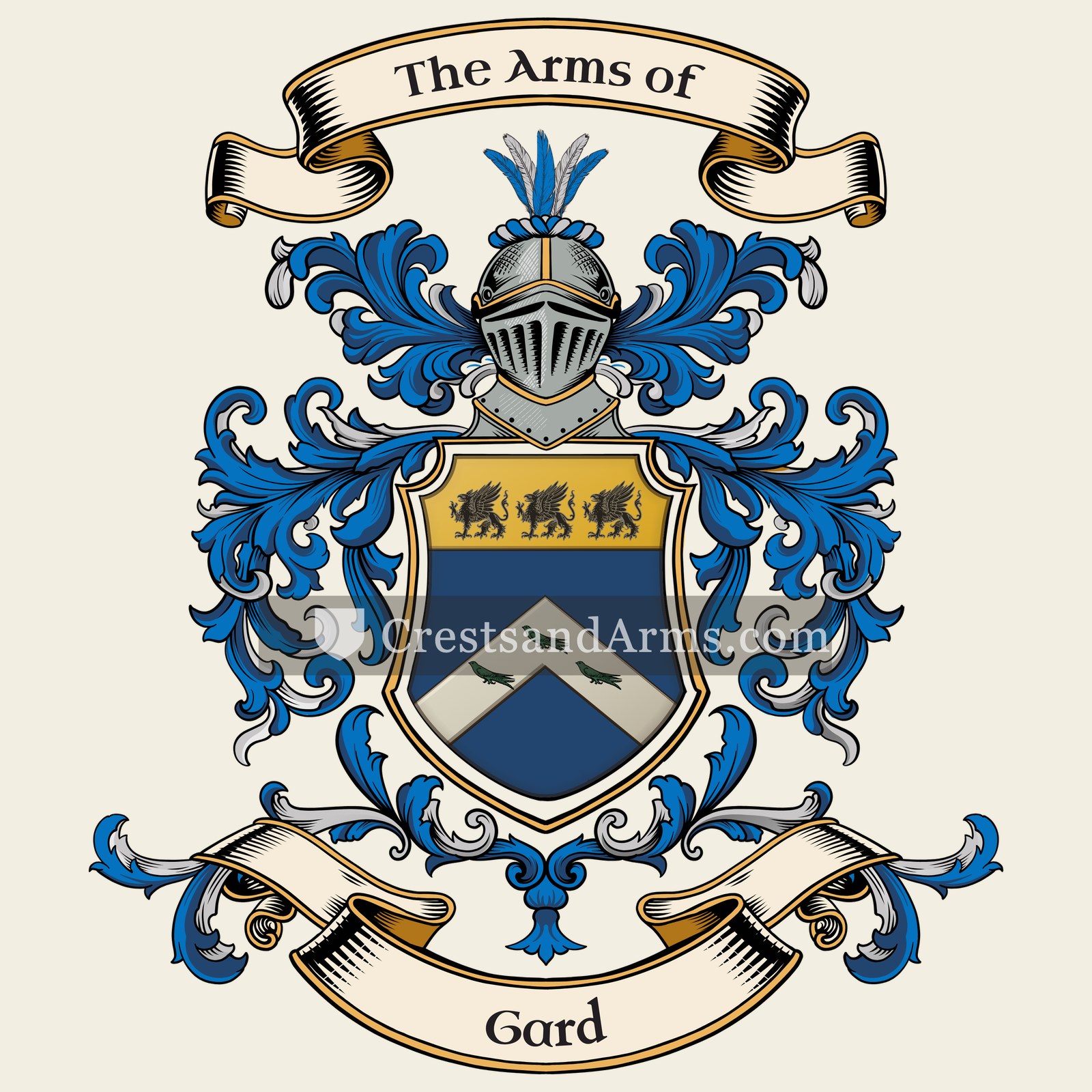
chevronProtection, and faithful service completed
chiefAuthority, wisdom and dominion
martletA younger son, who must win his own land
griffinValour and vigilance, guarding great treasure
Colours
Blue (Azure)Means: Loyalty and truth
Silver (Argent)Means: Peace and sincerity
Gold (Or)Means: Generosity
Green (Vert)Means: Hope
Black (Sable)Means: Constancy
Historical info
Source
Sir Bernard Burke, The General Armory of England, Scotland, Ireland and Wales, London: Harrison & Sons, 1884
Blazon (the actual original written record)
“Az. on a chev. ar. three birds vert membered gu. on a chief or, three griffins segreant sa”
KentKent, c. 1620
Digital archive packCoat of arms PNG, gold border print PDF, vector SVG and the certificate of authenticity. Sent to your email in minutes.
Map of England showing where the Gard arms are recorded
The Gard arms were recorded in Kent, c. 1620.
Kent sits between London and the short crossing to Europe, and the trade passing through made it wealthy. Merchant families bought land with that money, and it was landowners who took coats of arms.
This is where the arms were entered in the register. Families often moved to other parts of the country, so the same name can turn up in more than one region.
The body that granted and recorded arms in England in this period.
James VI and I
Sovereign of the period
James VI and I
1603–1625
Reigning in Switzerland when the Gard arms are first recorded.
How Arms Worked in England
English heraldry allowed arms to be shared by all legitimate descendants of the original owner. These symbols were treated as personal property that moved through the generations to all children. While the eldest son kept the original design, other family members could use the same shield without needing to change it or register their own unique versions.
Granting authority
The College of Arms in London has regulated the use of coats of arms throughout England and Wales since 1484.
How they got arms
Families typically obtained their coats of arms through a formal grant from the Crown or by proving their ancient right to them.
Where arms were recorded
All official coats of arms are recorded in the registers kept at the College of Arms, which date back to the fifteenth century.
The family's standing
Recorded among the armigerous families of Kent.
Origin & History of the Gard Family in England
The surname Gard is deeply rooted in the historical landscape of southern England, with records confirming the family’s presence in the county of Kent by the early seventeenth century. During this period, the name was often associated with individuals living near enclosed grounds or gardens, as the term itself likely evolved from Old French or Middle English descriptors for a protected yard or defensive enclosure. By 1620, families bearing this name were well-established within local parish communities, where they participated in the agricultural and trade-based economy of the region. As the seventeenth century progressed, members of the Gard family became part of the shifting social fabric of England, contributing to the local governance and religious life of their Kentish parishes. Their history reflects the broader movement of families who maintained steady roots in rural English counties while navigating the economic changes of the early modern era.
Gard Meaning & Related Branches
Root word
Gart
Old High German term referring to an enclosed space or garden.
This name
GardA topographic name for someone who lived near an enclosed yard or garden.
also spelled
Garde
Gards
Gart
Documented Sources
J. B. Rietstap, Armorial Général, Gouda: G. B. van Goor Zonen, 1884–87
Archives: Archives de l'État du Valais, Registres paroissiaux de la commune de Bagnes
Archives: Archives de l'État du Valais, Recensements de la population du Valais
Book: Furrer, Ignaz, Statistische Beschreibung des Kantons Wallis, 1847
Digital archive packCoat of arms PNG, gold border print PDF, vector SVG and the certificate of authenticity. Sent to your email in minutes.


 chevronProtection, and faithful service completed
 mountThe ground held, and steadfastness upon it
 eagleNobility, strength and a keen mind
 mulletThe third son, and a divine quality from above
 chevronProtection, and faithful service completed
 mountThe ground held, and steadfastness upon it
 eagleNobility, strength and a keen mind
 mulletThe third son, and a divine quality from above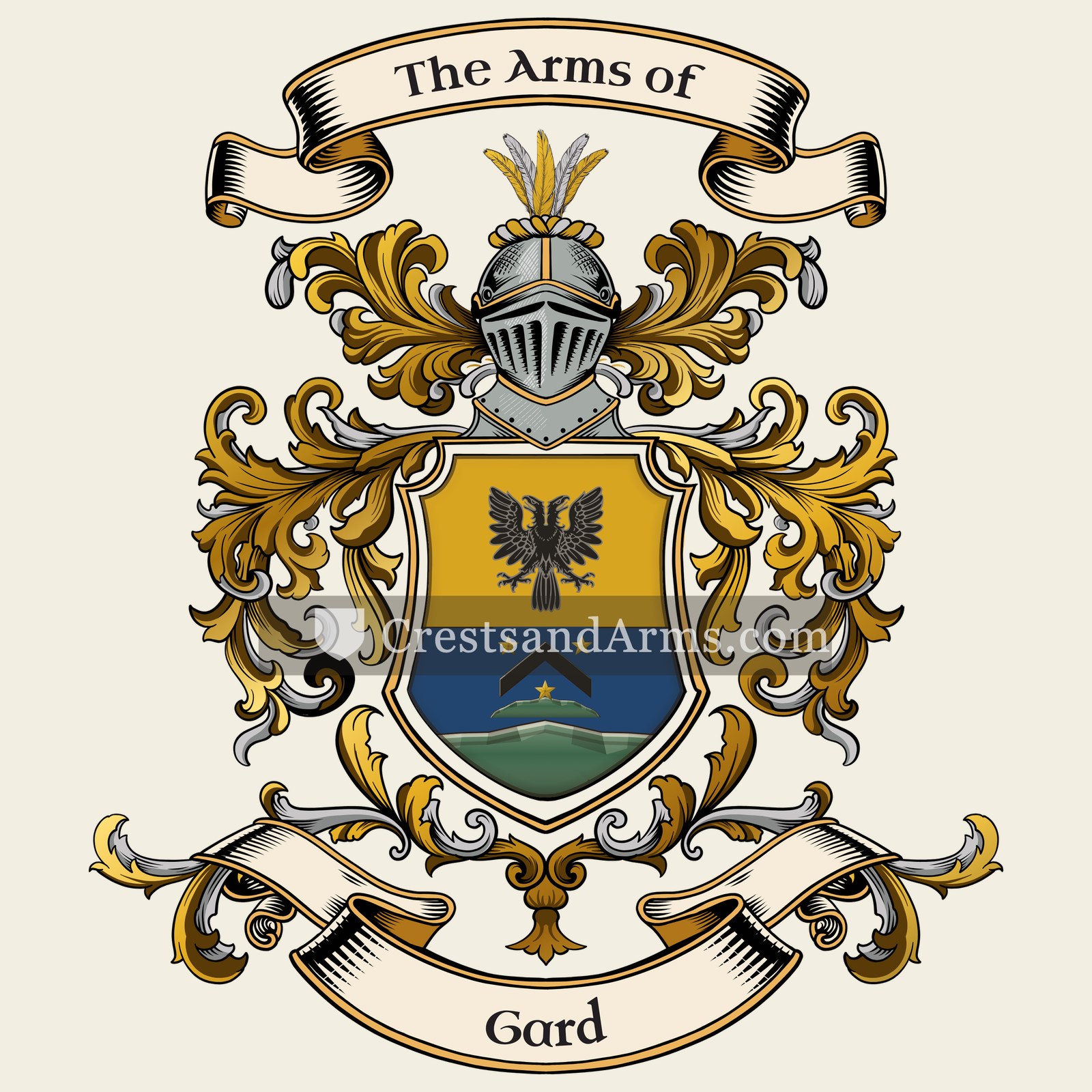

 chiefAuthority, wisdom and dominion
 martletA younger son, who must win his own land
 griffinValour and vigilance, guarding great treasure