A record of documented arms, meaning and origin, researched for the Gardiner family lines. Documented in 3 countries.
Reg. 1922 · French, G–I
Coat of Arms & Family Crest Details
Symbols on this shield
fessThe military belt, and readiness to serve
chequyConstancy, and the counting-board
chiefAuthority, wisdom and dominion
arms pheon arrowheadReadiness for battle, and the broad arrow of the sovereign
lionCourage, strength and royalty
griffinValour and vigilance, guarding great treasure
Colours
Gold (Or)Means: Generosity
Black (Sable)Means: Constancy
Blue (Azure)Means: Loyalty and truth
Silver (Argent)Means: Peace and sincerity
Historical info
Source
J. B. Rietstap, Armorial Général, Gouda: G. B. van Goor Zonen, 1884–87
Blazon (the actual original written record)
“Ec.: aux 1 et 4 d'or à la fasce échiq. d'arg. et d'azur de trois tires, acc. de trois lions léopardés de sa. (Stewart); aux 2 et 3 d'or à un griffon pass. d'azur; au chef de sa., ch. de trois phéons d'arg. (Gardiner). C.: une tête d'aigle, entre un vol. T.: à dextre un chevalier, arm. de toutes pièces, le casque panaché de trois pl. d'aut., une de gu. entre deux d'arg.; à sen. une reine, hab. de gu., ceinte d'azur, revêtue d'un manteau royal de pourpre doublé d'herm., les pieds nus, chevelée d'or, cour. du même. D.: NIL DESPERANDUM.”
Francec. 1789
Digital archive packCoat of arms PNG, gold border print PDF, vector SVG and the certificate of authenticity. Sent to your email in minutes.
Map of France showing where the Gardiner arms are recorded
The Gardiner arms were recorded in France, c. 1789.
Arms such as these were typically recorded in Bretagne.
More families held coats of arms in Bretagne than anywhere else in France. The land was divided into many small estates rather than a few large ones, so far more households counted as gentry, and each needed a shield of its own to be told apart.
This is where the arms were entered in the register. Families often moved to other parts of the country, so the same name can turn up in more than one region.
The body that granted and recorded arms in France in this period.
Louis XVI of France
Sovereign of the period
Louis XVI of France
1774–1791
Reigning in France when the Gardiner arms are first recorded.
How Arms Worked in France
In France, a coat of arms was a mark of honor that passed down through the male line to all legitimate descendants. Families often used the same shield without changes to show their shared heritage. If a branch wanted to stand out, they could add a small mark to their shield to show their specific place in the family tree.
Granting authority
The Juge d'armes de France acted as the official authority that regulated and verified coats of arms across the country.
How they got arms
Families typically inherited their arms from ancestors, though they could also receive them through royal grants or by proving their noble status.
Where arms were recorded
Coats of arms were officially recorded in the Armorial Général de France, which began its main collection in the year 1696.
The family's standing
Recorded among the armigerous families of France.
Origin & History of the Gardiner Family in France
The name Gardiner traces its roots to the occupational title of a gardener, which evolved from the Old French word *jardin*. While the name is often associated with England, families bearing this name held a documented presence in the region of Bretagne by 1789. During this period of the French Revolution, the family lived through a time of massive social upheaval that reshaped the local landscape of western France. Many families with this name in Bretagne were deeply connected to the land and the agricultural traditions of the countryside. As the political structure of France shifted, these individuals navigated the transition from the feudal era to the modern republic. Their history reflects the broader movement of families who maintained their identity through generations of change in the Breton provinces.
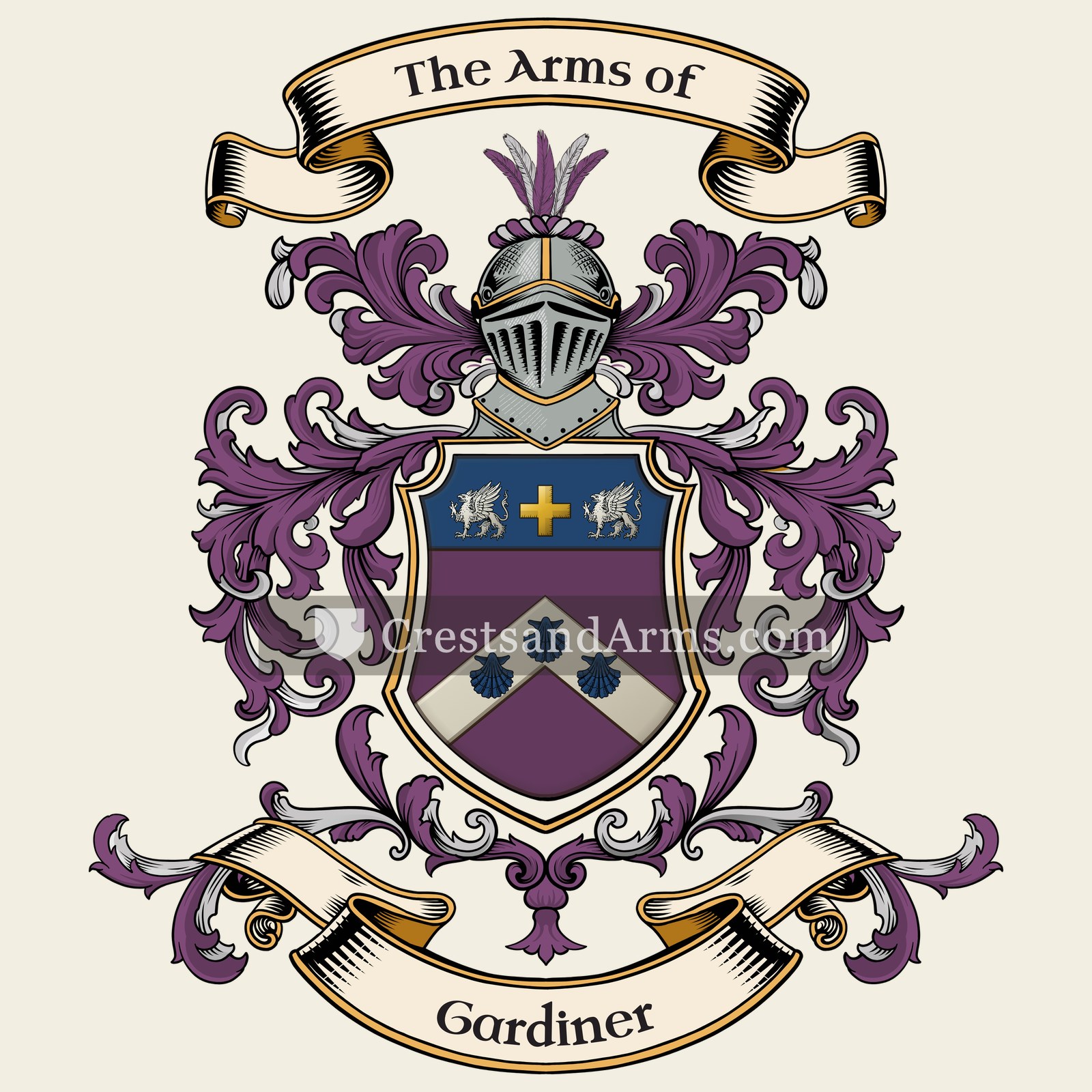
Coat of Arms & Family Crest Details
Symbols on this shield
chevronProtection, and faithful service completed
chiefAuthority, wisdom and dominion
cross symbolChristian faith and service
escallopThe pilgrim's shell, and a long journey made
griffinValour and vigilance, guarding great treasure
Colours
Purple (Purpure)Means: Royal majesty
Silver (Argent)Means: Peace and sincerity
Blue (Azure)Means: Loyalty and truth
Gold (Or)Means: Generosity
Historical info
Source
Sir Bernard Burke, The General Armory of England, Scotland, Ireland and Wales, London: Harrison & Sons, 1884
Blazon (the actual original written record)
“Purp. on a chev. ar. three escallops az. on a chief embattled of the third a cross potent or, betw. two griffins' heads erased of the second”
EnglandLondon, c. 1478
Digital archive packCoat of arms PNG, gold border print PDF, vector SVG and the certificate of authenticity. Sent to your email in minutes.
Map of England showing where the Gardiner arms are recorded
The Gardiner arms were recorded in London, c. 1478.
This is where the arms were entered in the register. Families often moved to other parts of the country, so the same name can turn up in more than one region.
The body that granted and recorded arms in England in this period.
Edward IV of England
Sovereign of the period
Edward IV of England
1471–1483
Reigning in France when the Gardiner arms are first recorded.
How Arms Worked in England
English heraldry allowed arms to be shared by all legitimate descendants of the original owner. These symbols were treated as personal property that moved through the generations to all children. While the eldest son kept the original design, other family members could use the same shield without needing to change it or register their own unique versions.
Granting authority
The College of Arms in London has regulated the use of coats of arms throughout England and Wales since 1484.
How they got arms
Families typically obtained their coats of arms through a formal grant from the Crown or by proving their ancient right to them.
Where arms were recorded
All official coats of arms are recorded in the registers kept at the College of Arms, which date back to the fifteenth century.
The family's standing
Recorded among the armigerous families of England.
Origin & History of the Gardiner Family in England
The surname Gardiner originated as an occupational name for a person who tended a garden or worked as a professional groundskeeper. During the Middle Ages, many people adopted surnames based on their trade to distinguish themselves in growing towns and villages. By 1478, records confirm that members of the Gardiner family were well-established in London. At that time, London was a bustling center of commerce where skilled workers often organized into guilds to protect their interests and maintain high standards for their crafts. Families with this name likely lived near the city walls or in the surrounding parishes, contributing to the local economy through their expertise in horticulture or land management. Over time, the name became a permanent fixture of the English landscape as families moved from these urban centers into various rural counties, carrying their occupational heritage with them across generations.
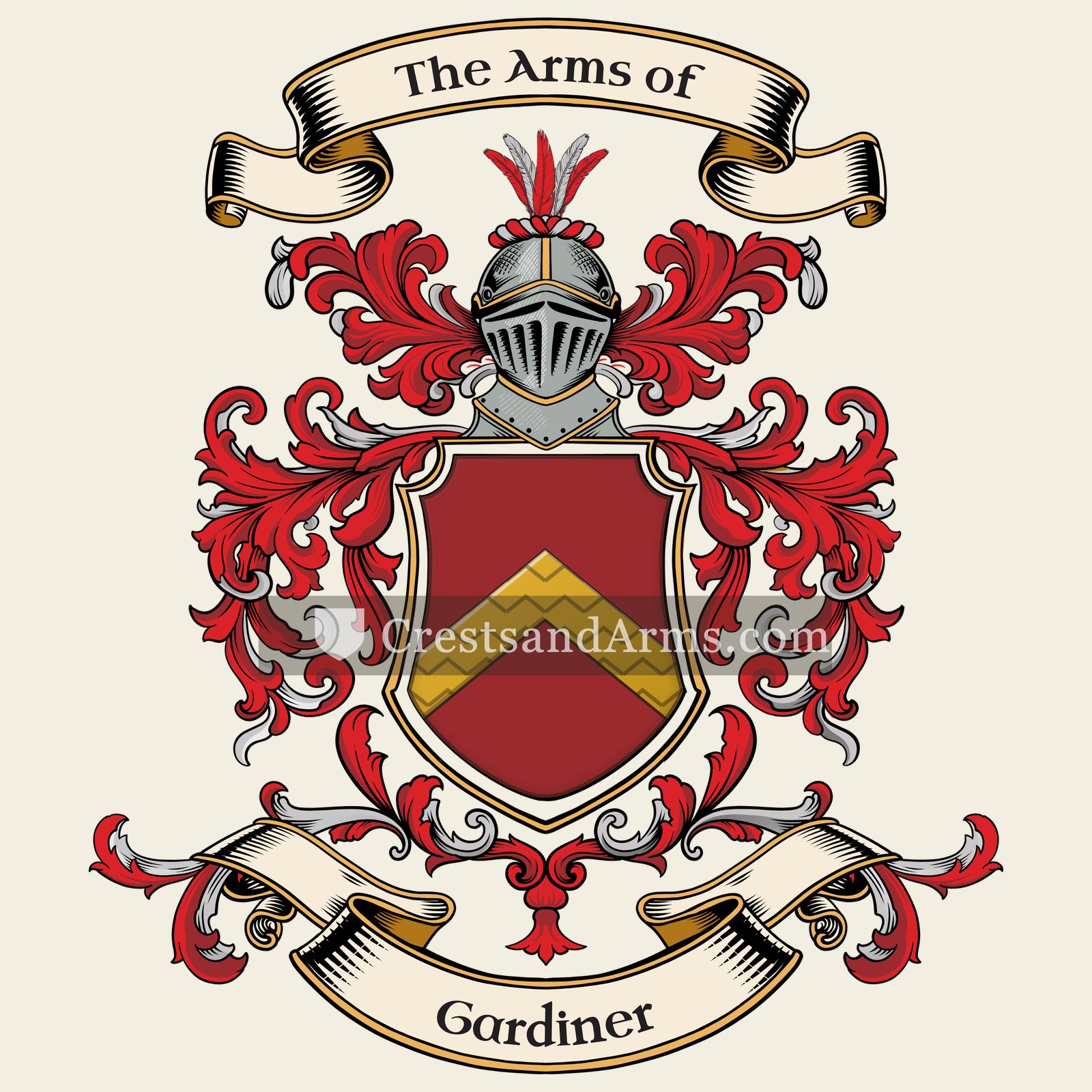
Coat of Arms & Family Crest Details
Symbols on this shield
chevronProtection, and faithful service completed
Colours
Red (Gules)Means: Military strength
Gold (Or)Means: Generosity
Historical info
Source
Sir Bernard Burke, The General Armory of England, Scotland, Ireland and Wales, London: Harrison & Sons, 1884
Blazon (the actual original written record)
“Gu. a chev. betw. three heraldic tigers' heads erased or”
Irelandc. 1586
Digital archive packCoat of arms PNG, gold border print PDF, vector SVG and the certificate of authenticity. Sent to your email in minutes.
Map of Ireland showing where the Gardiner arms are recorded
The Gardiner arms were recorded in Ireland, c. 1586.
Arms such as these were typically recorded in Dublin.
Dublin was the seat of government in Ireland and the place where grants were sought and recorded. Families with business at the castle or the courts settled nearby, and settling there put their arms on record.
This is where the arms were entered in the register. Families often moved to other parts of the country, so the same name can turn up in more than one region.
The body that granted and recorded arms in Ireland in this period.
Elizabeth I of England
Sovereign of the period
Elizabeth I of England
1558–1603
Reigning in France when the Gardiner arms are first recorded.
How Arms Worked in Ireland
The Ulster King of Arms granted coats of arms to individuals who proved their social standing and good character. These symbols were typically inherited by all legitimate descendants of the original holder. If a family branch wanted a unique look, they could apply for a specific change to their design through the office to ensure their identity remained distinct.
Granting authority
The Ulster King of Arms acted as the official body that regulated and issued all coats of arms throughout Ireland.
How they got arms
Families obtained their arms through formal grants issued by the office after proving their eligibility and paying the required fees.
Where arms were recorded
All official grants were recorded in the registers held by the Ulster King of Arms starting from the year 1552.
The family's standing
Recorded among the armigerous families of Ireland.
Origin & History of the Gardiner Family in Ireland
The Gardiner family name arrived in Ireland during a period of significant political and social transition. By the year 1586, records confirm that members of the family were already established in Dublin, serving as a point of origin for their influence in the region. The name itself is occupational in nature, derived from the Middle English word for someone who tended a garden or managed grounds. As the family settled into the urban landscape of Dublin, they integrated into the local administration and trade networks that defined the city during the late sixteenth century. Over the following generations, the Gardiners transitioned from their initial roles into broader civic life, eventually becoming landowners and public officials who helped shape the development of the capital. Their early presence in the city suggests they were part of the demographic shifts that occurred as Dublin expanded its role as a center of government and commerce under the English crown.
Gardiner Meaning & Related Branches
Root word
gardin
Old French term for a garden or enclosed piece of land.
This name
GardinerAn occupational surname for a person who worked as a gardener.
also spelled
Gardener
Gardner
Related arms
Gardenersimilar arms
Gardnersimilar arms
Gairdnervariant spelling
Gardnersvariant spelling
Documented Sources
J. B. Rietstap, Armorial Général, Gouda: G. B. van Goor Zonen, 1884–87
Archives départementales d'Ille-et-Vilaine, Série L: Documents de la période révolutionnaire (1790-1800)
Dauzat, Albert, Dictionnaire étymologique des noms et prénoms de France, 1951
Le Moyne de La Borderie, Arthur, Histoire de Bretagne, 1896
Digital archive packCoat of arms PNG, gold border print PDF, vector SVG and the certificate of authenticity. Sent to your email in minutes.


 fessThe military belt, and readiness to serve
 chequyConstancy, and the counting-board
 chiefAuthority, wisdom and dominion
 arms pheon arrowheadReadiness for battle, and the broad arrow of the sovereign
 lionCourage, strength and royalty
 griffinValour and vigilance, guarding great treasure
 fessThe military belt, and readiness to serve
 chequyConstancy, and the counting-board
 chiefAuthority, wisdom and dominion
 arms pheon arrowheadReadiness for battle, and the broad arrow of the sovereign
 lionCourage, strength and royalty
 griffinValour and vigilance, guarding great treasure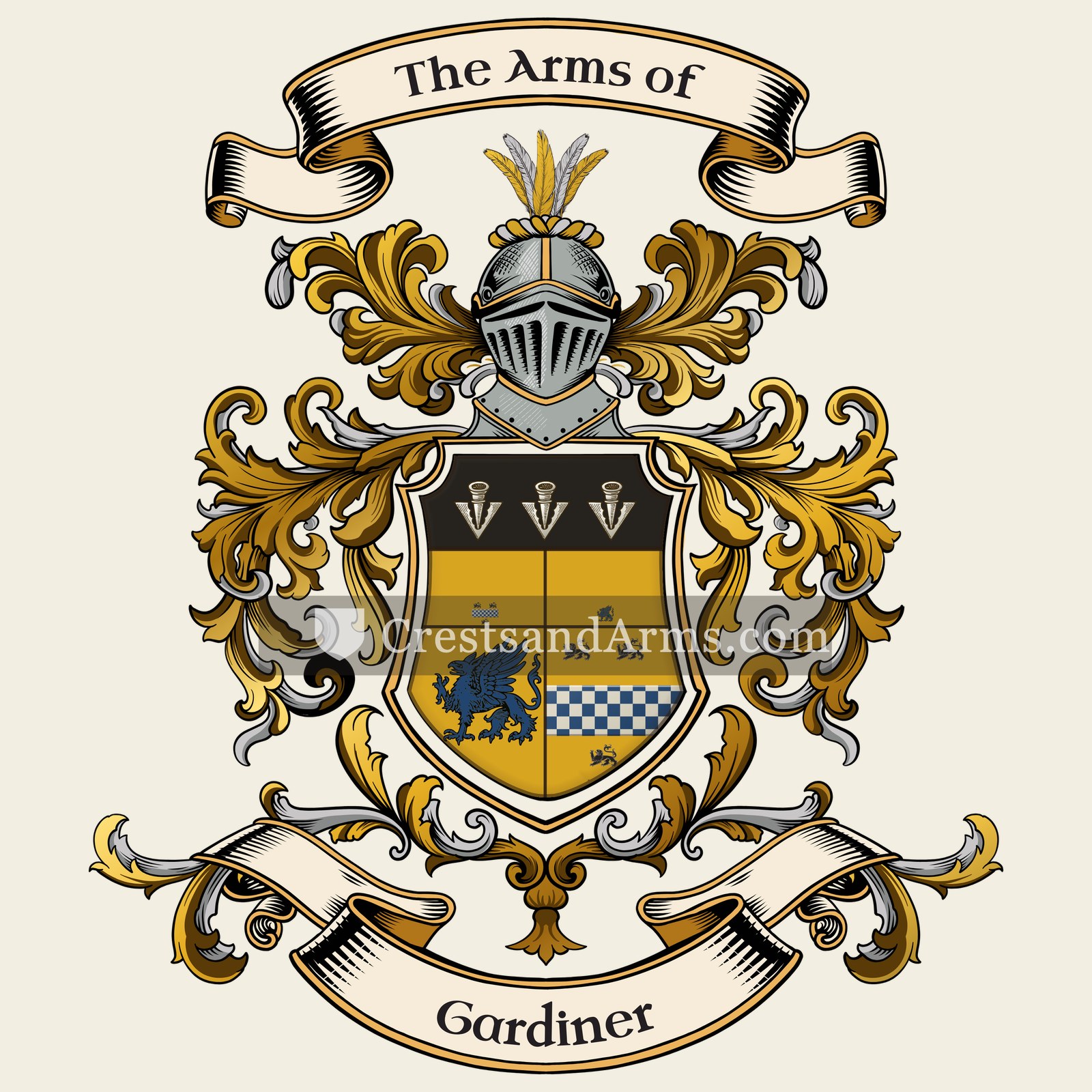


 chevronProtection, and faithful service completed
 cross symbolChristian faith and service
 escallopThe pilgrim's shell, and a long journey made