Map of France showing where the Garnier arms are recorded
The Garnier arms were recorded in Ile-de-France, c. 1663.
Ile-de-France is the country around Paris, and proximity to the court mattered. Families who served the crown were rewarded with land near it, and land near the capital carried arms almost as a matter of course.
This is where the arms were entered in the register. Families often moved to other parts of the country, so the same name can turn up in more than one region.
The body that granted and recorded arms in France in this period.
Louis XIV of France
Sovereign of the period
Louis XIV of France
1643–1715
Reigning in France when the Garnier arms are first recorded.
How Arms Worked in France
In France, a coat of arms was a mark of honor that passed down through the male line to all legitimate descendants. Families often used the same shield without changes to show their shared heritage. If a branch wanted to stand out, they could add a small mark to their shield to show their specific place in the family tree.
Granting authority
The Juge d'armes de France acted as the official authority that regulated and verified coats of arms across the country.
How they got arms
Families typically inherited their arms from ancestors, though they could also receive them through royal grants or by proving their noble status.
Where arms were recorded
Coats of arms were officially recorded in the Armorial Général de France, which began its main collection in the year 1696.
The family's standing
Recorded among the armigerous families of Ile-de-France.
Origin & History of the Garnier Family in France
The surname Garnier traces its roots to the ancient Germanic name Warinhari, which eventually evolved into the French form we recognize today. By the time the name became established in the Île-de-France region during the mid-seventeenth century, it was already well-integrated into the social fabric of the French countryside. Families bearing this name were often associated with the agricultural life of the Paris Basin, where they worked the land and contributed to the local economy. The presence of the Garnier family in this area by 1663 reflects a period of stability for many rural households who lived under the administrative structures of the Old Regime. These early ancestors were part of a growing population that helped shape the identity of the region through their labor, community ties, and daily survival in a changing French landscape.
Coat of Arms & Family Crest Details
Symbols on this shield
mulletThe third son, and a divine quality from above
eagleNobility, strength and a keen mind
Colours
Blue (Azure)Means: Loyalty and truth
Gold (Or)Means: Generosity
Black (Sable)Means: Constancy
Historical info
Source
J. B. Rietstap, Armorial Général, Gouda: G. B. van Goor Zonen, 1884–87
Blazon (the actual original written record)
“Ec.: aux 1 et 4 d'azur à trois étoiles d'or; aux 2 et 3 d'or à l'aigle ép. de sa., bq. et m. d'or, chaque tête cour. du même. Cq. cour. C.: 1° une étoile d'or, sommée de sept pl. d'aut. de sa.; 1. d'or et d'azur; 2° l'aigle ép.; 1. d'or et de sa.”
SilesiaSilesia, c. 1663
Digital archive packCoat of arms PNG, gold border print PDF, vector SVG and the certificate of authenticity. Sent to your email in minutes.
Map of Germany showing where the Garnier arms are recorded
The Garnier arms were recorded in Silesia, c. 1663.
Silesia was farming country in the east of the German lands, held in large estates by families who stayed put for generations. Owning land was what entitled a family to arms, so the region fills a good deal of the register.
This is where the arms were entered in the register. Families often moved to other parts of the country, so the same name can turn up in more than one region.
The body that granted and recorded arms in Germany in this period.
Leopold I, Holy Roman Emperor
Sovereign of the period
Leopold I, Holy Roman Emperor
1658–1705
Reigning in France when the Garnier arms are first recorded.
How Arms Worked in Germany
In the Holy Roman Empire, coats of arms were often granted to individuals by the Emperor or his representatives. These arms were then passed down through the generations to all legitimate descendants of the original holder. Younger branches of a family usually kept the same shield design without needing to change it, as the arms belonged to the entire lineage.
Granting authority
The Holy Roman Emperor held the sole power to grant new coats of arms throughout his vast imperial territories.
How they got arms
Families typically obtained their coats of arms through a formal imperial grant or by proving their noble status to the authorities.
Where arms were recorded
These grants were officially recorded in the Imperial Chancery registers, which began keeping formal records of such honors during the Middle Ages.
The family's standing
Recorded among the armigerous families of Silesia.
Origin & History of the Garnier Family in Germany
The family name Garnier has deep roots that trace back to ancient Germanic origins, specifically stemming from the Old High German name Warinhari, which translates to a guardian of the army. While the name is often associated with French regions, its presence in German-speaking lands became firmly established through centuries of migration and cultural exchange. By the year 1663, records confirm that members of the Garnier family were living in the region of Silesia. During this period, Silesia was a vibrant crossroads of trade and intellectual growth, and families like the Garniers often served in roles related to local administration or land management. Their settlement in this area highlights how the name evolved from its early linguistic roots into a recognized part of the social fabric in Central Europe. As these families moved across borders, they adapted to local customs while maintaining the identity passed down through their ancestors.
Coat of Arms & Family Crest Details
Symbols on this shield
bordureA difference between branches of one family
swordJustice, and military honour
fleur de lisPurity, light, and the sixth son
oakGreat age, strength and steadfastness
eagleNobility, strength and a keen mind
roundelA coin, and one who has been to the crusades
Colours
Blue (Azure)Means: Loyalty and truth
Gold (Or)Means: Generosity
Historical info
Source
Sir Bernard Burke, The General Armory of England, Scotland, Ireland and Wales, London: Harrison & Sons, 1884
Blazon (the actual original written record)
“Quarterly, 1st and 4th, az. a sword bendwise, point downwards ppr., betw. in the sinister chief a fleur-de-lis and in the dexter base an oak branch or, a border embattled also or, for GARNIER; 2nd and 3rd, per pale indented or and az. an eagle displ. and in chief two pellets counterchanged, for CARPENTER”
DevonDevon, c. 1620
Digital archive packCoat of arms PNG, gold border print PDF, vector SVG and the certificate of authenticity. Sent to your email in minutes.
Map of England showing where the Garnier arms are recorded
The Garnier arms were recorded in Devon, c. 1620.
Devon was a county of small manors and seafaring families. Its gentry were spread thickly across the countryside, and money made at sea often bought an estate, which in turn brought a coat of arms.
This is where the arms were entered in the register. Families often moved to other parts of the country, so the same name can turn up in more than one region.
The body that granted and recorded arms in England in this period.
James VI and I
Sovereign of the period
James VI and I
1603–1625
Reigning in France when the Garnier arms are first recorded.
How Arms Worked in England
English heraldry allowed arms to be shared by all legitimate descendants of the original owner. These symbols were treated as personal property that moved through the generations to all children. While the eldest son kept the original design, other family members could use the same shield without needing to change it or register their own unique versions.
Granting authority
The College of Arms in London has regulated the use of coats of arms throughout England and Wales since 1484.
How they got arms
Families typically obtained their coats of arms through a formal grant from the Crown or by proving their ancient right to them.
Where arms were recorded
All official coats of arms are recorded in the registers kept at the College of Arms, which date back to the fifteenth century.
The family's standing
Recorded among the armigerous families of Devon.
Origin & History of the Garnier Family in England
The surname Garnier has deep roots that trace back to the Germanic name Warin, which eventually evolved into the French form we recognize today. While the name is strongly associated with French origins, members of the family were firmly established in the English county of Devon by 1620. During this period, families with this name often worked as skilled tradespeople or landowners who integrated into the local English economy. The presence of the Garnier family in Devon suggests that they were part of the broader movement of people crossing the English Channel for trade, religious refuge, or professional opportunities. By settling in the rural landscapes of the West Country, these early ancestors helped weave their name into the local history of the region, transitioning from their continental beginnings to becoming a recognized part of the Devonshire community.
Garnier Meaning & Related Branches
Root word
Warin
A Germanic element meaning guard, protector, or to defend.
This name
GarnierDerived from the Germanic name Warinhari, signifying a warrior who acts as a protector.
also spelled
Garnyer
Garnyay
Garner
Related arms
Bruyèresimilar arms
Gaspardsimilar arms
Maire (le) de Falletanssimilar arms
Garnervariant spelling
Documented Sources
J. B. Rietstap, Armorial Général, Gouda: G. B. van Goor Zonen, 1884–87
Dauzat, Albert, Dictionnaire étymologique des noms et prénoms de France, 1951
Morlet, Marie-Thérèse, Dictionnaire étymologique des noms de famille, 1991
Archives Nationales, Minutier central des notaires de Paris, Series Y
Digital archive packCoat of arms PNG, gold border print PDF, vector SVG and the certificate of authenticity. Sent to your email in minutes.


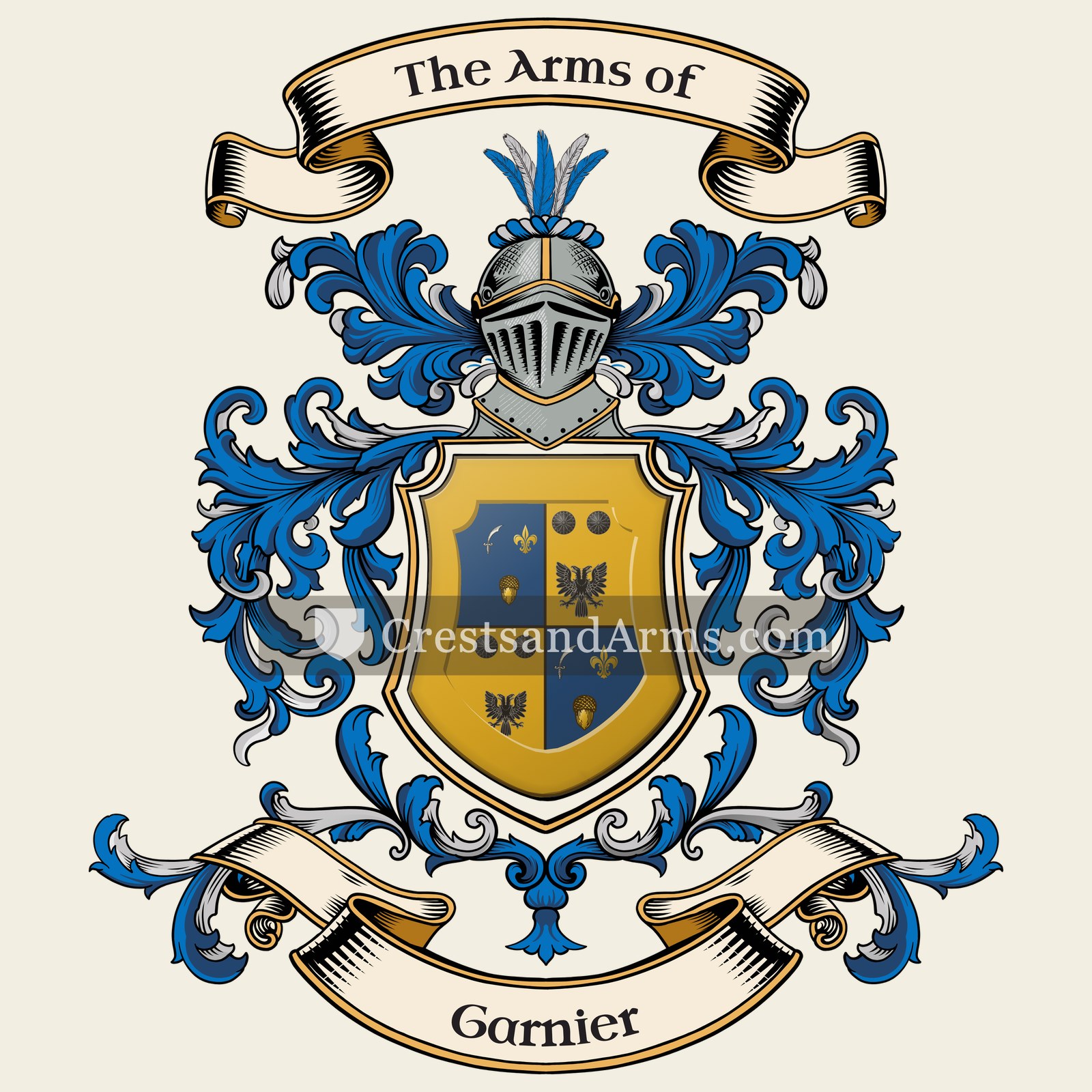
 chevronProtection, and faithful service completed
 mulletThe third son, and a divine quality from above
 trefoilPerpetuity, and the Trinity
 handFaith, sincerity and justice
 chevronProtection, and faithful service completed
 mulletThe third son, and a divine quality from above
 trefoilPerpetuity, and the Trinity
 handFaith, sincerity and justice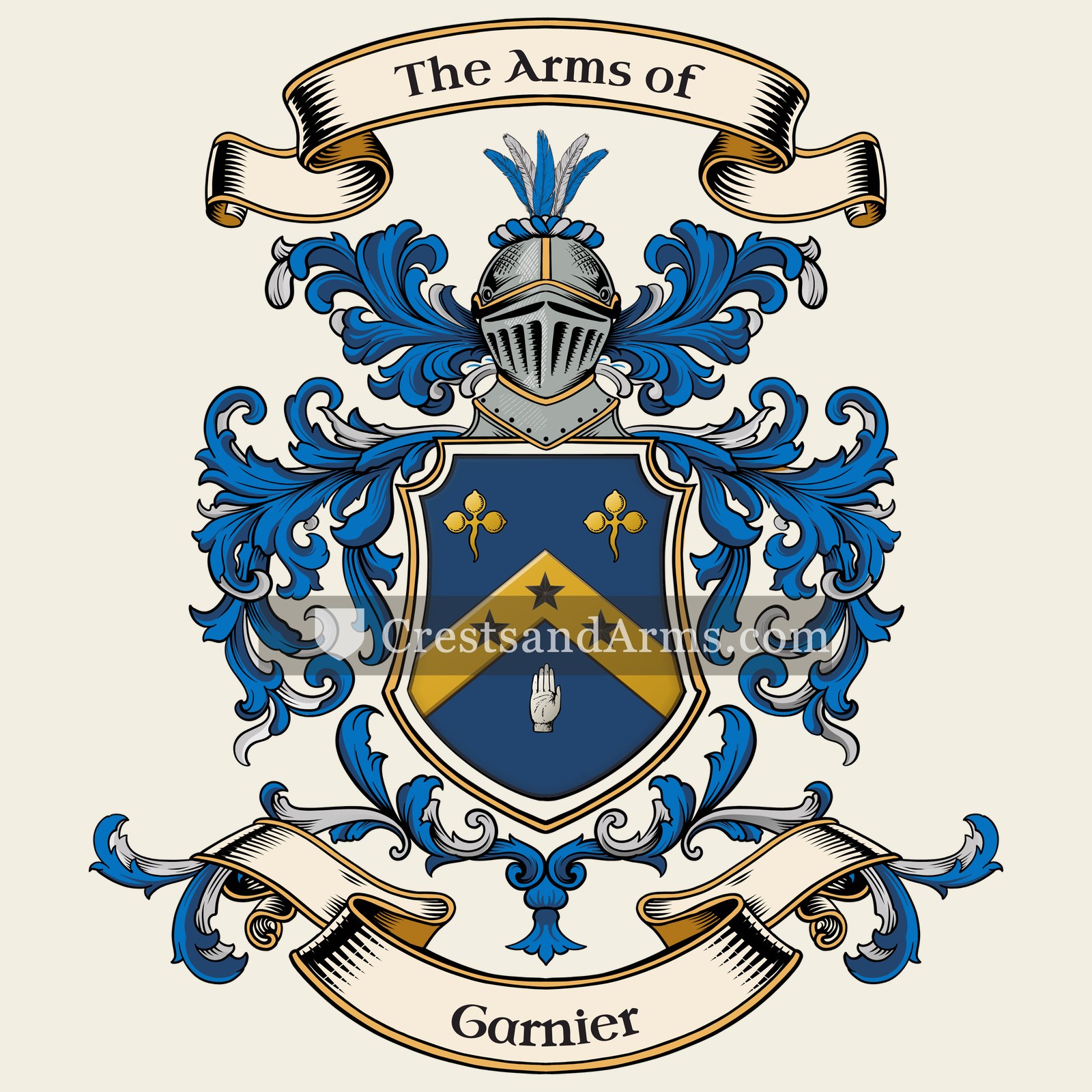


 eagleNobility, strength and a keen mind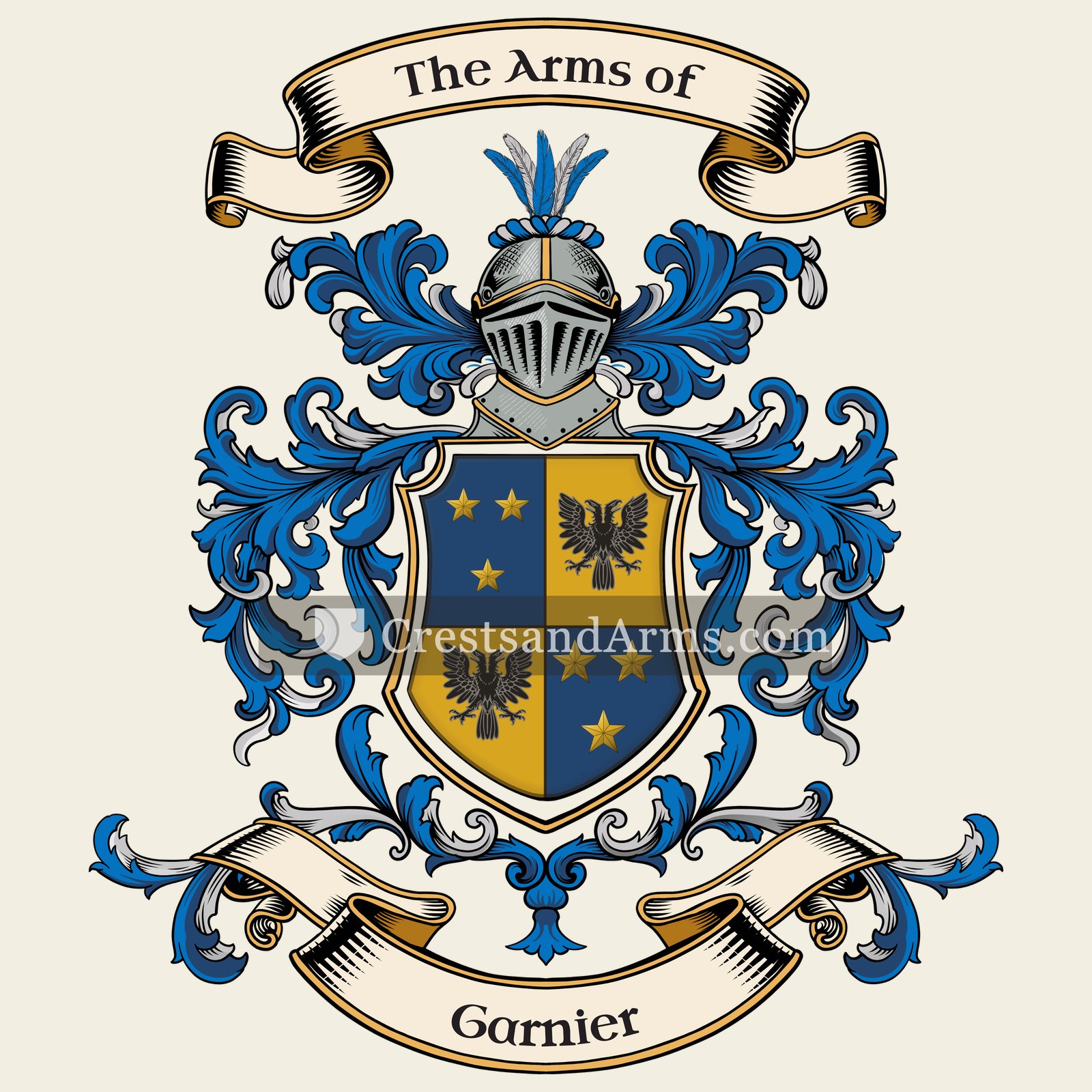


 bordureA difference between branches of one family
 swordJustice, and military honour
 fleur de lisPurity, light, and the sixth son
 oakGreat age, strength and steadfastness
 roundelA coin, and one who has been to the crusades