Map of Germany showing where the Garr arms are recorded
The Garr arms were recorded in Bavaria, c. 1592.
Bavaria was a country of old landed families and walled market towns. Estates passed down the same line for centuries, and both the landowners and the leading townsmen kept arms, which is why so many Bavarian names sit in the registers.
This is where the arms were entered in the register. Families often moved to other parts of the country, so the same name can turn up in more than one region.
The body that granted and recorded arms in Germany in this period.
Emperor Rudolf II
Sovereign of the period
Emperor Rudolf II
1576–1612
Reigning in Germany when the Garr arms are first recorded.
How Arms Worked in Germany
In the Holy Roman Empire, coats of arms were often granted to individuals by the Emperor or his representatives. These arms were then passed down through the generations to all legitimate descendants of the original holder. Younger branches of a family usually kept the same shield design without needing to change it, as the arms belonged to the entire lineage.
Granting authority
The Holy Roman Emperor held the sole power to grant new coats of arms throughout his vast imperial territories.
How they got arms
Families typically obtained their coats of arms through a formal imperial grant or by proving their noble status to the authorities.
Where arms were recorded
These grants were officially recorded in the Imperial Chancery registers, which began keeping formal records of such honors during the Middle Ages.
The family's standing
Recorded among the armigerous families of Bavaria.
Origin & History of the Garr Family in Germany
The family name Garr traces its roots back to the mountainous regions of Bavaria, where records confirm the presence of family members as early as 1592. During this period, the name was closely tied to the rural landscape and the agricultural traditions of southern Germany. Families with this surname often lived in small, tight-knit communities where they worked as skilled craftsmen or farmers. As the centuries progressed, the name evolved alongside the shifting borders and local dialects of the region. Many early members of the family were known for their resilience and their ability to adapt to the changing political climate of the Holy Roman Empire. By maintaining deep connections to their ancestral lands, the early bearers of the Garr name helped establish a legacy that persisted through generations of European history.
Garr Meaning & Related Branches
Root word
Gari
Old High German word meaning spear or lance.
This name
GarrA habitational name for someone from a place named Garr or a topographic name for a spearman.
also spelled
Garr
Katzberg
Garr-Katzberg
Garaufkatsberg
Documented Sources
J. B. Rietstap, Armorial Général, Gouda: G. B. van Goor Zonen, 1884–87
John Wesley Garr and John Calhoun Garr, Genealogy of the Descendants of John Gar, or More Particularly of His Son, Andreas Gaar, Who Emigrated from Bavaria to America in 1732, 1894


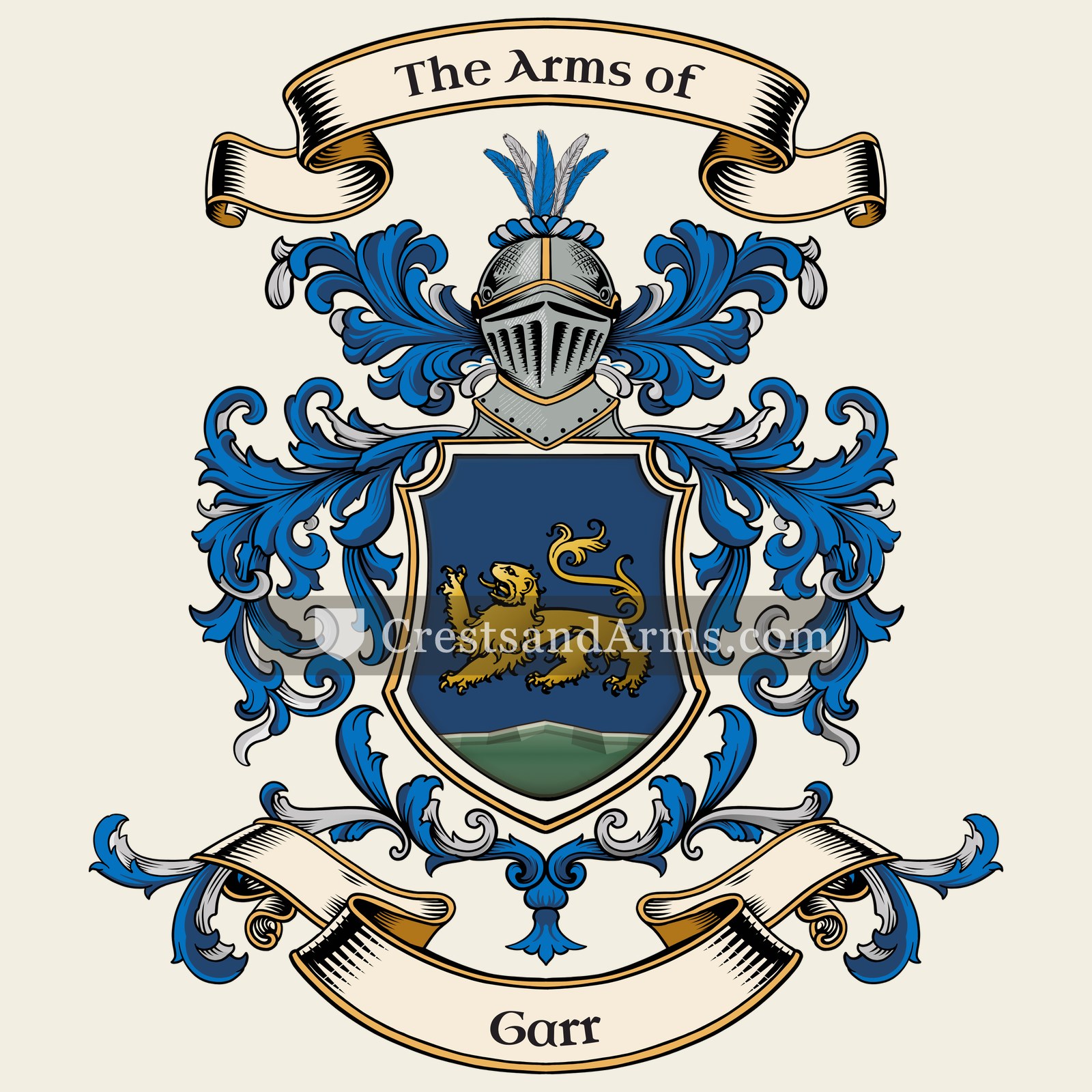
 mountThe ground held, and steadfastness upon it
 lionCourage, strength and royalty
 mountThe ground held, and steadfastness upon it
 lionCourage, strength and royalty