Map of England showing where the Garstang arms are recorded
The Garstang arms were recorded in England, c. 1620.
Arms such as these were typically recorded in York.
Yorkshire is the largest of the English counties, and it held more gentry families than any other. Land there was split among a great many households rather than a few, so a great many of them carried arms.
This is where the arms were entered in the register. Families often moved to other parts of the country, so the same name can turn up in more than one region.
The body that granted and recorded arms in England in this period.
James VI and I
Sovereign of the period
James VI and I
1603–1625
Reigning in England when the Garstang arms are first recorded.
How Arms Worked in England
English heraldry allowed arms to be shared by all legitimate descendants of the original owner. These symbols were treated as personal property that moved through the generations to all children. While the eldest son kept the original design, other family members could use the same shield without needing to change it or register their own unique versions.
Granting authority
The College of Arms in London has regulated the use of coats of arms throughout England and Wales since 1484.
How they got arms
Families typically obtained their coats of arms through a formal grant from the Crown or by proving their ancient right to them.
Where arms were recorded
All official coats of arms are recorded in the registers kept at the College of Arms, which date back to the fifteenth century.
The family's standing
Recorded among the armigerous families of England.
Origin & History of the Garstang Family in England
The family name Garstang is a classic example of a locative surname, which means it originated from a specific place rather than a trade or a personal characteristic. The name is derived from the ancient market town of Garstang in Lancashire, England. The word itself likely comes from the Old Norse language, combining terms that describe a triangular piece of land or a grassy area. By the early 17th century, members of the family had migrated from their ancestral roots in Lancashire to the historic city of York. Records confirm their presence there by 1620, suggesting that the family was part of the movement of people into urban centers during the Stuart period. As they settled in York, these early family members became part of the city’s vibrant social and economic life, helping to carry the name far from its original rural beginnings in the north of England.
Garstang Meaning & Related Branches
Root word
Gaerstang
Old English for a spear or grass pole and a pool.
This name
GarstangRefers to a dweller by a spear-shaped pool or a grassy landing place near water.
also spelled
Garstong
Garsteng
Garstane
Documented Sources
Sir Bernard Burke, The General Armory of England, Scotland, Ireland and Wales, London: Harrison & Sons, 1884
Ekwall, Eilert, The Place-Names of Lancashire, 1922
Mills, A.D., A Dictionary of English Place-Names, 2011
The National Archives, Prerogative Court of Canterbury and related Probate Jurisdictions: Will Registers, 1620
Digital archive packCoat of arms PNG, gold border print PDF, vector SVG and the certificate of authenticity. Sent to your email in minutes.


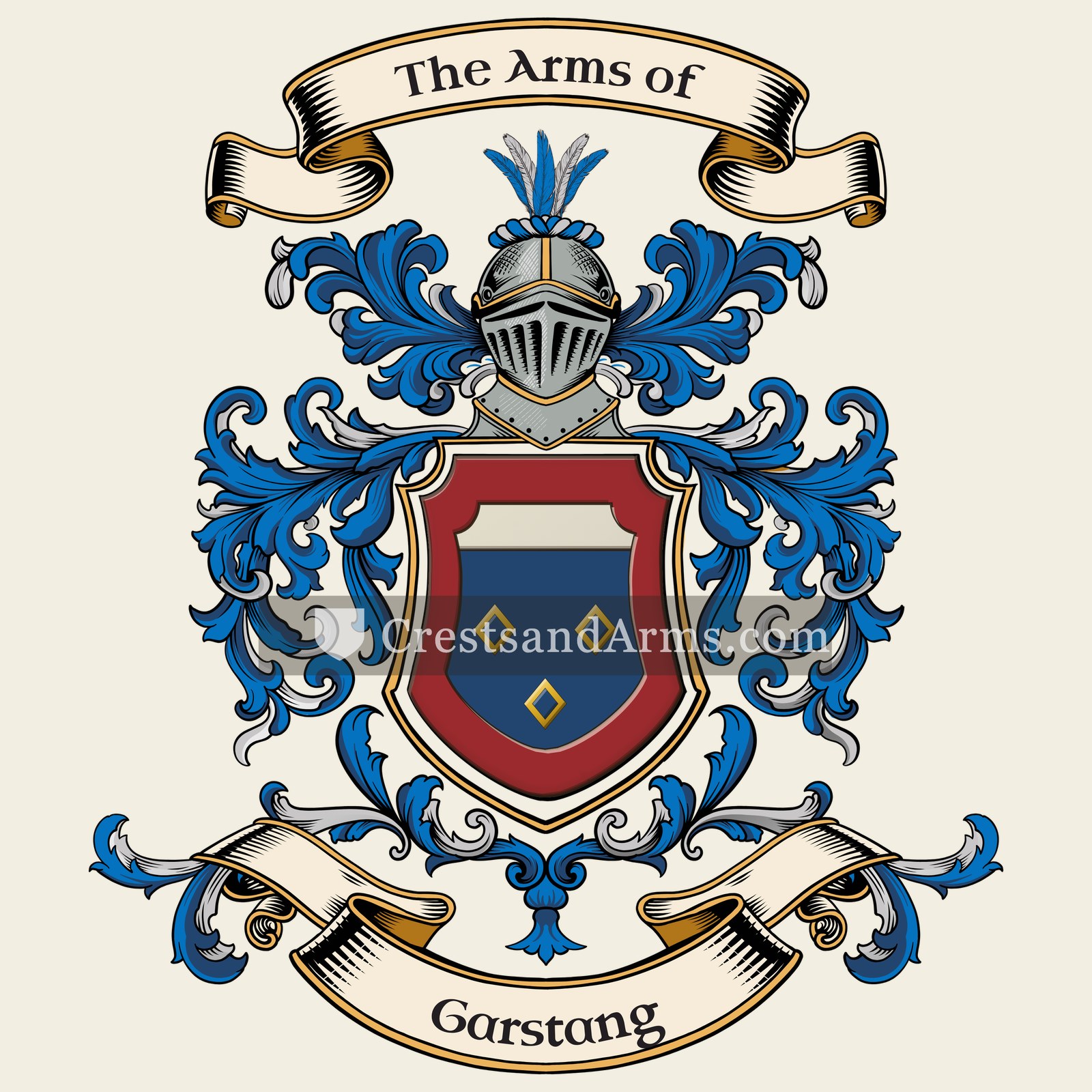
 chiefAuthority, wisdom and dominion
 bordureA difference between branches of one family
 masclePersuasion and the mail of a knight's coat
 chiefAuthority, wisdom and dominion
 bordureA difference between branches of one family
 masclePersuasion and the mail of a knight's coat