A record of documented arms, meaning and origin, researched for the Gartner family lines. Documented in 2 countries.
Reg. 0049 · German, G–I
Coat of Arms & Family Crest Details
Symbols on this shield
fessThe military belt, and readiness to serve
mountThe ground held, and steadfastness upon it
treeLife, endurance and deep roots
crescentHonour by the sovereign, and the second son
eagleNobility, strength and a keen mind
Colours
Blue (Azure)Means: Loyalty and truth
Gold (Or)Means: Generosity
Green (Vert)Means: Hope
Black (Sable)Means: Constancy
Silver (Argent)Means: Peace and sincerity
Historical info
Source
J. B. Rietstap, Armorial Général, Gouda: G. B. van Goor Zonen, 1884–87
Blazon (the actual original written record)
“Ec.: aux 1 et 4 d'azur à la demi-aigle d'arg., mouv. du parti; aux 2 et 3 d'or à trois fasces de sa. Sur le tout d'or à un arbre sec de sa., posé sur un tertre de sin. Deux cq. cour. C.: 1° un vol cont. d'arg.; 1. d'arg. et d'azur; 2° une queue de paon, au nat.; l. d'or et de sa. S.: deux lions reg. d'or [D'après le diplôme de 1750 un oranger de sin., planté dans un vase d'or, était posé entre les deux cq., découronnés.]”
SaxonySaxony, c. 1750
Digital archive packCoat of arms PNG, gold border print PDF, vector SVG and the certificate of authenticity. Sent to your email in minutes.
Map of Germany showing where the Gartner arms are recorded
The Gartner arms were recorded in Saxony, c. 1750.
Saxony had mines, trade and old landed families all at once. Silver made some fortunes and land held others, and both sorts of family kept arms, which is why Saxon names appear so often in the registers.
This is where the arms were entered in the register. Families often moved to other parts of the country, so the same name can turn up in more than one region.
The body that granted and recorded arms in Germany in this period.
Francis I, Holy Roman Emperor
Sovereign of the period
Francis I, Holy Roman Emperor
1745–1765
Reigning in Germany when the Gartner arms are first recorded.
How Arms Worked in Germany
In the Holy Roman Empire, coats of arms were often granted to individuals by the Emperor or his representatives. These arms were then passed down through the generations to all legitimate descendants of the original holder. Younger branches of a family usually kept the same shield design without needing to change it, as the arms belonged to the entire lineage.
Granting authority
The Holy Roman Emperor held the sole power to grant new coats of arms throughout his vast imperial territories.
How they got arms
Families typically obtained their coats of arms through a formal imperial grant or by proving their noble status to the authorities.
Where arms were recorded
These grants were officially recorded in the Imperial Chancery registers, which began keeping formal records of such honors during the Middle Ages.
The family's standing
Recorded among the armigerous families of Saxony.
Origin & History of the Gartner Family in Germany
The surname Gartner is an occupational name that originated in the German-speaking regions of Europe during the Middle Ages. It is derived from the Middle High German word *gartener*, which refers to a person who worked as a gardener or a small-scale farmer. In the social structure of the time, a Gartner was often someone who held a small plot of land and grew produce for local markets. By the time the family was established in Saxony in 1750, the name had become a common way to identify individuals based on their trade and their connection to the land. This history reflects the transition of German society from feudal systems to a more organized structure where family names were increasingly tied to a person's daily labor and community role. As the family lived in the Saxon region, they were part of a long tradition of agrarian workers who helped shape the rural economy of central Germany.
Coat of Arms & Family Crest Details
Symbols on this shield
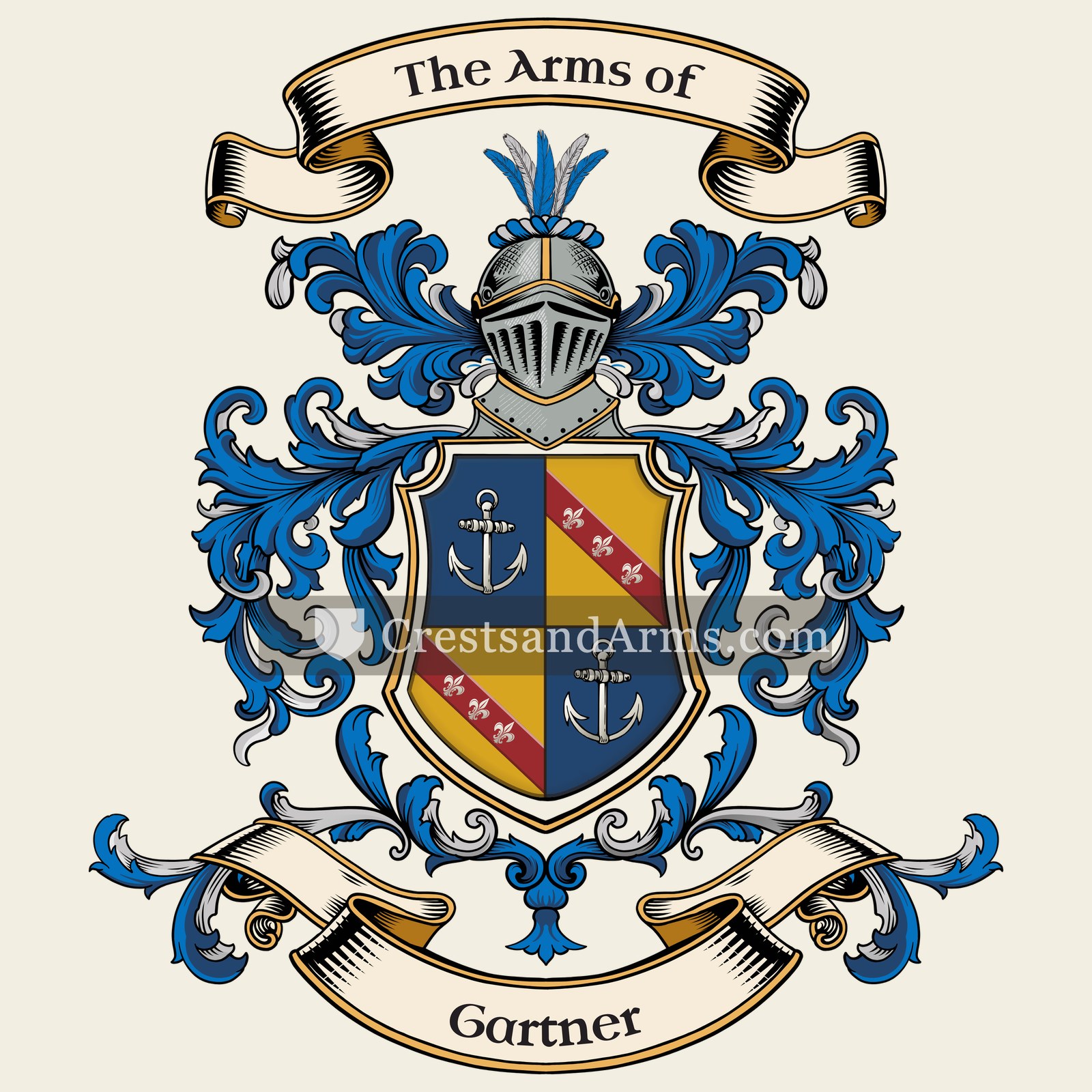
bendDefence, and the scarf of a commander
anchorHope, and steadfastness in trouble
fleur de lisPurity, light, and the sixth son
Colours
Blue (Azure)Means: Loyalty and truth
Gold (Or)Means: Generosity
Red (Gules)Means: Military strength
Silver (Argent)Means: Peace and sincerity
Historical info
Source
J. B. Rietstap, Armorial Général, Gouda: G. B. van Goor Zonen, 1884–87
Blazon (the actual original written record)
“Ec.: aux 1 et 4 d'azur à une ancre au nat., posée en barre; aux 2 et 3 d'or à la bande de gu., ch. de trois fleurs-de-lis d'arg.”
Francec. 1806
Digital archive packCoat of arms PNG, gold border print PDF, vector SVG and the certificate of authenticity. Sent to your email in minutes.
Map of France showing where the Gartner arms are recorded
The Gartner arms were recorded in France, c. 1806.
Arms such as these were typically recorded in Bretagne.
More families held coats of arms in Bretagne than anywhere else in France. The land was divided into many small estates rather than a few large ones, so far more households counted as gentry, and each needed a shield of its own to be told apart.
This is where the arms were entered in the register. Families often moved to other parts of the country, so the same name can turn up in more than one region.
The body that granted and recorded arms in France in this period.
Napoleon
Sovereign of the period
Napoleon
1804–1814
Reigning in Germany when the Gartner arms are first recorded.
How Arms Worked in France
In France, a coat of arms was a mark of honor that passed down through the male line to all legitimate descendants. Families often used the same shield without changes to show their shared heritage. If a branch wanted to stand out, they could add a small mark to their shield to show their specific place in the family tree.
Granting authority
The Juge d'armes de France acted as the official authority that regulated and verified coats of arms across the country.
How they got arms
Families typically inherited their arms from ancestors, though they could also receive them through royal grants or by proving their noble status.
Where arms were recorded
Coats of arms were officially recorded in the Armorial Général de France, which began its main collection in the year 1696.
The family's standing
Recorded among the armigerous families of France.
Origin & History of the Gartner Family in France
The surname Gartner carries deep roots that reflect the movement of people across European borders during times of significant social change. While the name is often associated with Germanic origins, its presence in the Brittany region of France by 1806 suggests a history of migration and integration into local communities. During the early nineteenth century, families in this coastal area were often deeply connected to the land and the evolving administrative systems of the Napoleonic era. As the family settled into the Breton landscape, they likely adapted to the local culture and language while maintaining the identity passed down through their name. This transition marks the family as part of a broader story of movement, where individuals moved across regions to find new opportunities and establish roots in a changing French society.
Gartner Meaning & Related Branches
Root word
Gart
An enclosed area or garden space.
This name
GartnerAn occupational surname for a gardener or someone who tended a garden.
also spelled
Gartener
Gartnar
Gardner
Related arms
Heyszler de Rosenfeldsimilar arms
Löwensimilar arms
Gardnervariant spelling
Documented Sources
J. B. Rietstap, Armorial Général, Gouda: G. B. van Goor Zonen, 1884–87
Bahlow, Hans, Deutsches Namenlexikon: Familien- und Vornamen nach Ursprung und Sinn erklärt, 1967
Heintze, Albert, Die deutschen Familien-Namen: geschichtlich, geographisch, sprachlich, 1903
Sächsisches Staatsarchiv, Kirchenbücher der evangelisch-lutherischen Landeskirche Sachsens, 1750
Digital archive packCoat of arms PNG, gold border print PDF, vector SVG and the certificate of authenticity. Sent to your email in minutes.


 fessThe military belt, and readiness to serve
 mountThe ground held, and steadfastness upon it
 treeLife, endurance and deep roots
 crescentHonour by the sovereign, and the second son
 eagleNobility, strength and a keen mind
 fessThe military belt, and readiness to serve
 mountThe ground held, and steadfastness upon it
 treeLife, endurance and deep roots
 crescentHonour by the sovereign, and the second son
 eagleNobility, strength and a keen mind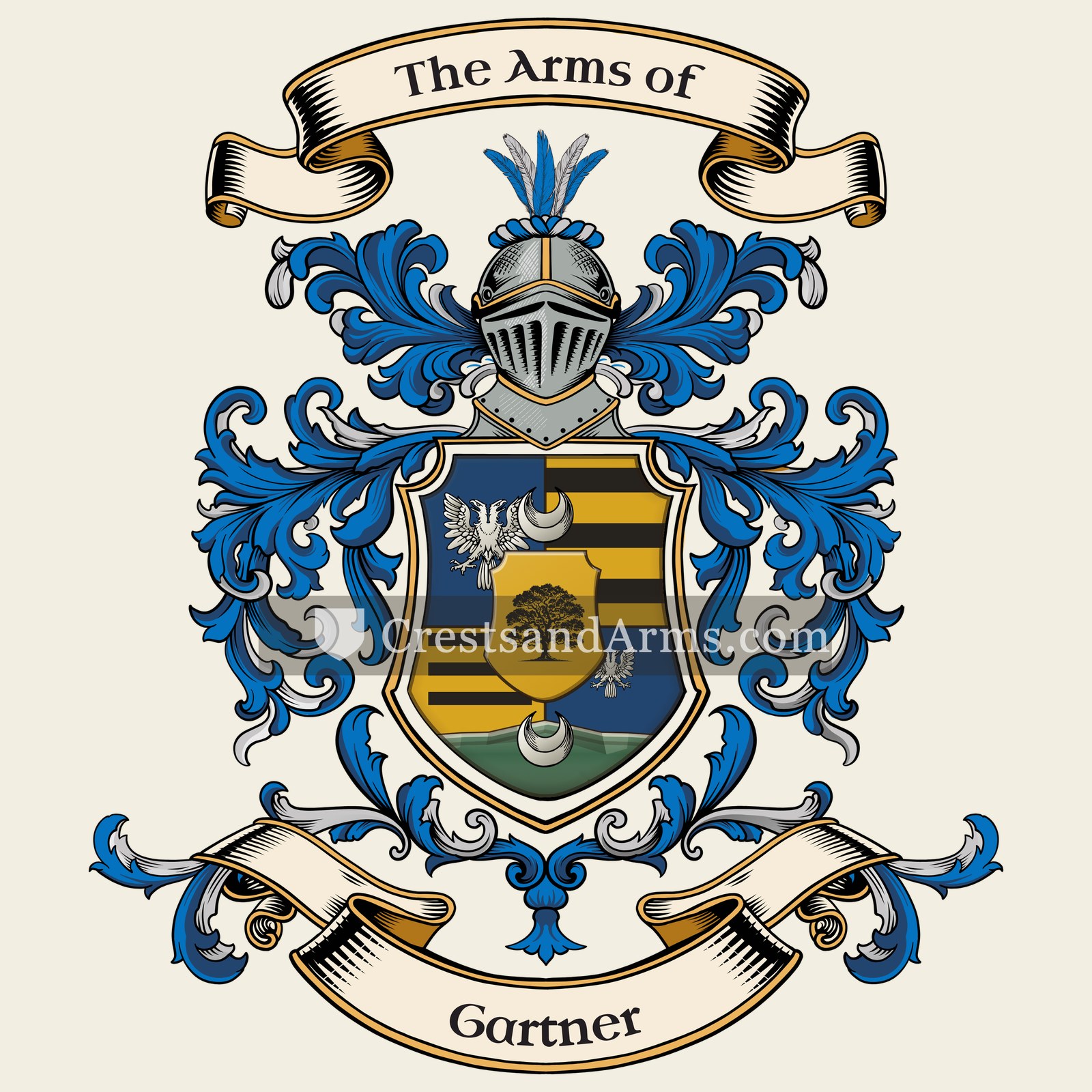


 bendDefence, and the scarf of a commander
 anchorHope, and steadfastness in trouble
 fleur de lisPurity, light, and the sixth son