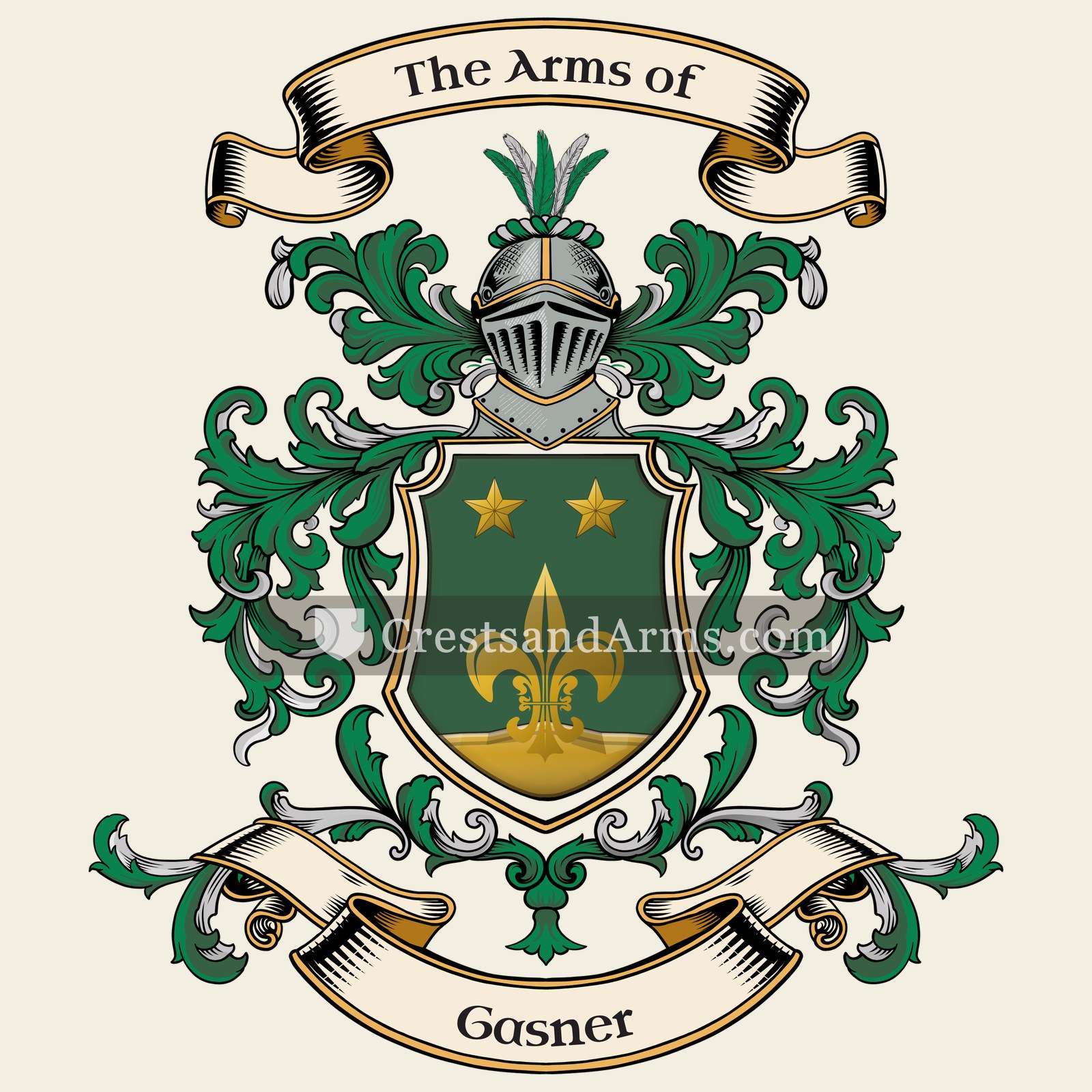
A record of documented arms, meaning and origin, researched for the Gasner family lines. Documented in 2 countries.
Reg. 6948 · German, G–I
Coat of Arms & Family Crest Details
Symbols on this shield
bendDefence, and the scarf of a commander
Colours
Red (Gules)Means: Military strength
Silver (Argent)Means: Peace and sincerity
Historical info
Source
J. B. Rietstap, Armorial Général, Gouda: G. B. van Goor Zonen, 1884–87
Blazon (the actual original written record)
“De gu. à la bande d'arg., ch. de trois socs de charrue de sa., posés dans le sens de la bande, les pointes en bas. C.: deux prob., celle à dextre barrée et celle à sen. bandée de gu. et d'arg.”
GermanyBiberach Wurt, c. 1765
Digital archive packCoat of arms PNG, gold border print PDF, vector SVG and the certificate of authenticity. Sent to your email in minutes.
Map of Germany showing where the Gasner arms are recorded
The Gasner arms were recorded in Biberach Wurt, c. 1765.
This is where the arms were entered in the register. Families often moved to other parts of the country, so the same name can turn up in more than one region.
The body that granted and recorded arms in Germany in this period.
Francis I, Holy Roman Emperor
Sovereign of the period
Francis I, Holy Roman Emperor
1745–1765
Reigning in Germany when the Gasner arms are first recorded.
How Arms Worked in Germany
In the Holy Roman Empire, coats of arms were often granted to individuals by the Emperor or his representatives. These arms were then passed down through the generations to all legitimate descendants of the original holder. Younger branches of a family usually kept the same shield design without needing to change it, as the arms belonged to the entire lineage.
Granting authority
The Holy Roman Emperor held the sole power to grant new coats of arms throughout his vast imperial territories.
How they got arms
Families typically obtained their coats of arms through a formal imperial grant or by proving their noble status to the authorities.
Where arms were recorded
These grants were officially recorded in the Imperial Chancery registers, which began keeping formal records of such honors during the Middle Ages.
The family's standing
Recorded among the armigerous families of Germany.
Origin & History of the Gasner Family in Germany
The name Gasner is deeply rooted in the southern German regions, where it likely originated as a descriptive term for someone who lived near a specific location or worked in a particular trade. By the mid-eighteenth century, historical records confirm that members of the family were established in the town of Biberach an der Riß. During this era, Biberach was a bustling Imperial City known for its weaving industry and trade, which provided a stable environment for families to grow and contribute to the local economy. The presence of the Gasner name in these municipal documents suggests that the family was integrated into the social and professional life of the region. Over generations, the family name became a permanent fixture in the local landscape, reflecting the broader patterns of settlement and community development found throughout the Swabian region of Germany.
Coat of Arms & Family Crest Details
Symbols on this shield
mountThe ground held, and steadfastness upon it
fleur de lisPurity, light, and the sixth son
mulletThe third son, and a divine quality from above
Colours
Green (Vert)Means: Hope
Gold (Or)Means: Generosity
Historical info
Source
J. B. Rietstap, Armorial Général, Gouda: G. B. van Goor Zonen, 1884–87
Blazon (the actual original written record)
“De sin. à une fleur-de-lis, acc. en chef de deux étoiles (6) et en p. d'un tertre de trois coupeaux, le tout d'or.”
SwitzerlandValais, c. 1745
Digital archive packCoat of arms PNG, gold border print PDF, vector SVG and the certificate of authenticity. Sent to your email in minutes.
Map of Switzerland showing where the Gasner arms are recorded
The Gasner arms were recorded in Valais, c. 1745.
This is where the arms were entered in the register. Families often moved to other parts of the country, so the same name can turn up in more than one region.
The body that granted and recorded arms in Switzerland in this period.
How Arms Worked in Switzerland
In Switzerland, coats of arms were not restricted to the nobility and were often adopted by common citizens and families. These symbols were passed down through generations to show family identity. When branches of a family grew, they often changed small details of the design to distinguish their own line from the original group.
Granting authority
Cantonal and civic authorities managed the use of coats of arms within their specific regions and local jurisdictions.
How they got arms
Families typically assumed their own coats of arms based on local custom rather than receiving them from a central monarch.
Where arms were recorded
Arms were recorded in various cantonal and civic registers starting from the fourteenth century throughout the Swiss region.
The family's standing
Recorded among the armigerous families of Switzerland.
Origin & History of the Gasner Family in Switzerland
The family name Gasner has deep roots in the rugged landscape of the Swiss canton of Valais, where the family was firmly established by 1745. During this period, families in the alpine regions were often defined by their connection to the land and the specific mountain valleys they inhabited. The name likely evolved from local dialects and occupational descriptions common to the German-speaking parts of the Upper Valais. Life in the eighteenth century for the Gasner family revolved around high-altitude agriculture and the seasonal movement of livestock, which required close cooperation with other village residents. As members of the community, they would have been recorded in local parish registers that tracked births, marriages, and deaths to maintain social order. These early ancestors were part of a resilient population that navigated the challenges of living in isolated mountain settlements while contributing to the unique cultural identity of the region.
Gasner Meaning & Related Branches
Root word
Gassner
A person who lived by a narrow street or lane.
This name
GasnerAn occupational or topographic name derived from the Middle High German word for lane.
also spelled
Gassnier
Gassnor
Gasner
Documented Sources
J. B. Rietstap, Armorial Général, Gouda: G. B. van Goor Zonen, 1884–87
Stadtarchiv Biberach, Bürgeraufnahmen und Zunftprotokolle der Reichsstadt Biberach, 1765
Kohlhammer, W., Historischer Atlas von Baden-Württemberg, 1972
Brechenmacher, Josef Karlmann, Etymologisches Wörterbuch der deutschen Familiennamen, 1957
Digital archive packCoat of arms PNG, gold border print PDF, vector SVG and the certificate of authenticity. Sent to your email in minutes.


 bendDefence, and the scarf of a commander
 bendDefence, and the scarf of a commander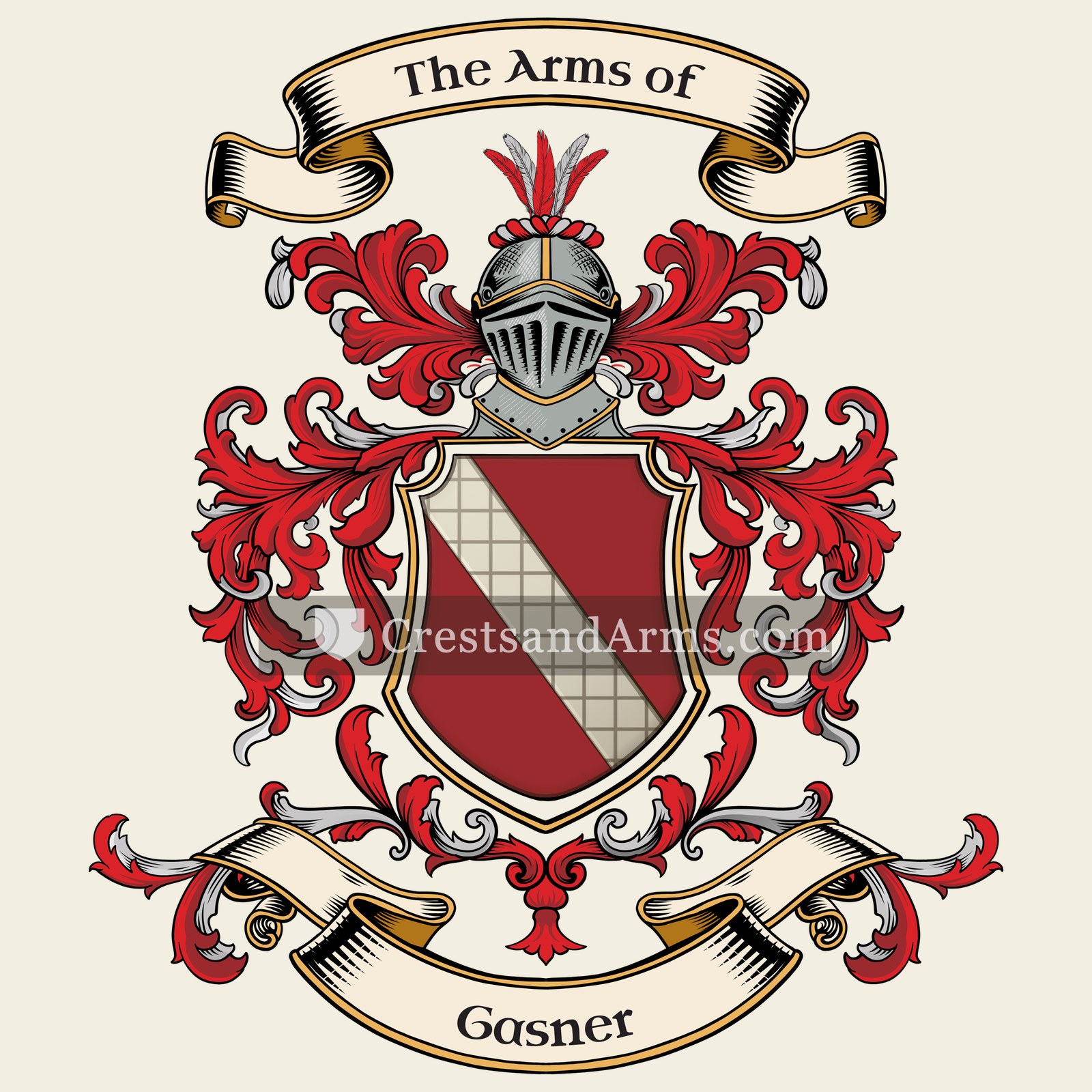


 mountThe ground held, and steadfastness upon it
 fleur de lisPurity, light, and the sixth son
 mulletThe third son, and a divine quality from above