Map of Italy showing where the Gasparino arms are recorded
The Gasparino arms were recorded in Vérone, c. 1775.
This is where the arms were entered in the register. Families often moved to other parts of the country, so the same name can turn up in more than one region.
The body that granted and recorded arms in Italy in this period.
Alvise Giovanni Mocenigo
Sovereign of the period
Alvise Giovanni Mocenigo
1763–1778
Reigning in Italy when the Gasparino arms are first recorded.
How Arms Worked in Italy
In the Italian states, coats of arms were often used by noble families to show their status and history. These symbols were passed down through the generations to all legitimate male descendants. Younger branches of a family usually kept the original design but sometimes added small changes to distinguish their specific line from the main branch.
Granting authority
Various local rulers and city governments controlled the use of coats of arms across the different Italian states.
How they got arms
Families often assumed their own arms or received them as official grants from local lords, popes, or city councils.
Where arms were recorded
Arms were recorded in local city archives or private family books rather than in one single national register.
The family's standing
Recorded among the armigerous families of Italy.
Origin & History of the Gasparino Family in Italy
The surname Gasparino finds its roots in the Italian tradition of creating patronymic names from the given name Gaspare, which itself evolved from the ancient Persian name Kaspar. By the late 18th century, the family had established a notable presence in the historic city of Verona. During this period, Verona was a key cultural and economic hub within the Republic of Venice, providing a stable environment for families to grow and document their lives through parish registers and municipal records. The name likely began as a way to distinguish individual branches of a family line, eventually becoming a fixed hereditary surname as record-keeping practices became more formal across Northern Italy. This transition from a simple identifier to a permanent family name reflects the broader social changes occurring in the Veneto region as families settled into specific trades and communities during the twilight of the Venetian era.
Coat of Arms & Family Crest Details
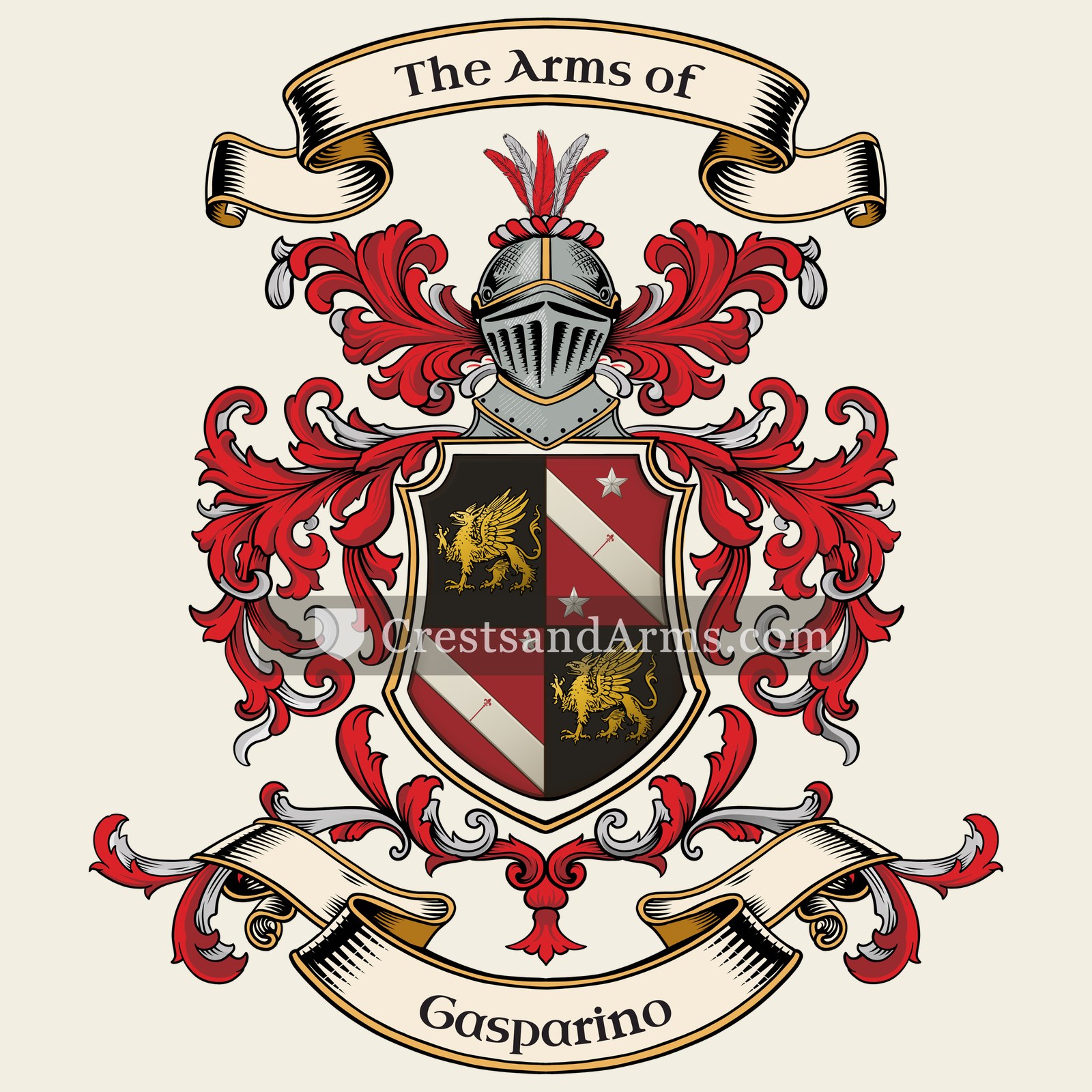
Symbols on this shield
bendDefence, and the scarf of a commander
griffinValour and vigilance, guarding great treasure
mulletThe third son, and a divine quality from above
batonAuthority and office held under the crown
Colours
Black (Sable)Means: Constancy
Red (Gules)Means: Military strength
Silver (Argent)Means: Peace and sincerity
Gold (Or)Means: Generosity
Historical info
Source
J. B. Rietstap, Armorial Général, Gouda: G. B. van Goor Zonen, 1884–87
Blazon (the actual original written record)
“Ec.: aux 1 et 4 de sa. à un griffon d'or, tenant une épée d'arg.; aux 2 et 3 de gu. à la bande d'arg., acc. de deux étoiles du même et ch. d'une verge de gu., accolée de deux serpents de sin. Deux cq. cour. C.: 1º le griffon, iss. et cont.; 1. d'or et de sa.; 2º une licorne iss. d'arg., entre deux prob. coupées, à dextre d'or sur sa., à sen. de gu. sur arg.; 1. d'arg. et de gu.”
Austriac. 1743
Digital archive packCoat of arms PNG, gold border print PDF, vector SVG and the certificate of authenticity. Sent to your email in minutes.
Map of Austria showing where the Gasparino arms are recorded
The Gasparino arms were recorded in Austria, c. 1743.
Arms such as these were typically recorded in Tyrol.
Tyrol was mountain country in western Austria, where the valleys were held by families who had been there a very long time. Old tenure counted for more than money, and old families carried arms.
This is where the arms were entered in the register. Families often moved to other parts of the country, so the same name can turn up in more than one region.
Region
Tyrol
First recorded
1743
Granting Authority for the Gasparino Arms
Imperial and Royal chancery
Sodacan · CC BY-SA 3.0
The body that granted and recorded arms in Austria in this period.
Charles VII, Holy Roman Emperor
Sovereign of the period
Charles VII, Holy Roman Emperor
1742–1745
Reigning in Italy when the Gasparino arms are first recorded.
How Arms Worked in Austria
Austrian coats of arms were often linked directly to noble titles granted by the Emperor. These symbols belonged to the entire family line rather than just one individual. When a family grew, new branches kept the original design without needing to change it. This system allowed all members of a noble house to share the same identity across many generations.
Granting authority
The Imperial and Royal chancery managed all heraldic matters and controlled the official granting of arms throughout the Austrian lands.
How they got arms
Families typically received their arms through a formal imperial decree that often accompanied the elevation of a person to noble status.
Where arms were recorded
Official records of these grants were kept in the Imperial Register of Nobility which began its formal documentation process in 1453.
The family's standing
Recorded among the armigerous families of Austria.
Origin & History of the Gasparino Family in Austria
The Gasparino family name carries a deep connection to the mountainous landscape of the Tyrol region, where records confirm their presence as early as 1743. During this period, the area was part of the Habsburg Monarchy, and families like the Gasparinos were often deeply integrated into the local agricultural and alpine economy. The name itself reflects the strong influence of Italian linguistic roots moving across the border into the German-speaking territories of the Austrian Empire. Living in the rugged terrain of Tyrol, the family likely navigated the complex social structures of the eighteenth century, which were defined by village life and the seasonal demands of mountain farming. This early history suggests that the Gasparinos were part of a resilient community that maintained its identity while adapting to the unique cultural blend of the Austro-Italian frontier. By settling in this region, the family became part of the long-standing tradition of families who helped shape the social fabric of the Alpine provinces during the late Enlightenment era.
Gasparino Meaning & Related Branches
Root word
Kaspar
Persian origin meaning treasurer or keeper of the treasure.
This name
GasparinoAn Italian patronymic surname derived from the name Gaspar, signifying one who is a treasurer.
also spelled
Gasparino
Gasparin
Gaspari
Documented Sources
J. B. Rietstap, Armorial Général, Gouda: G. B. van Goor Zonen, 1884–87
De Felice, Emidio. Dizionario dei cognomi italiani. 1978
Facchinetti, Umberto. Storia di Verona. 1952
Archivio di Stato di Verona, Stato Civile della Restaurazione
Archivio Storico della Diocesi di Verona, Libri Parrocchiali
Digital archive packCoat of arms PNG, gold border print PDF, vector SVG and the certificate of authenticity. Sent to your email in minutes.


 fessThe military belt, and readiness to serve
 mulletThe third son, and a divine quality from above
 fessThe military belt, and readiness to serve
 mulletThe third son, and a divine quality from above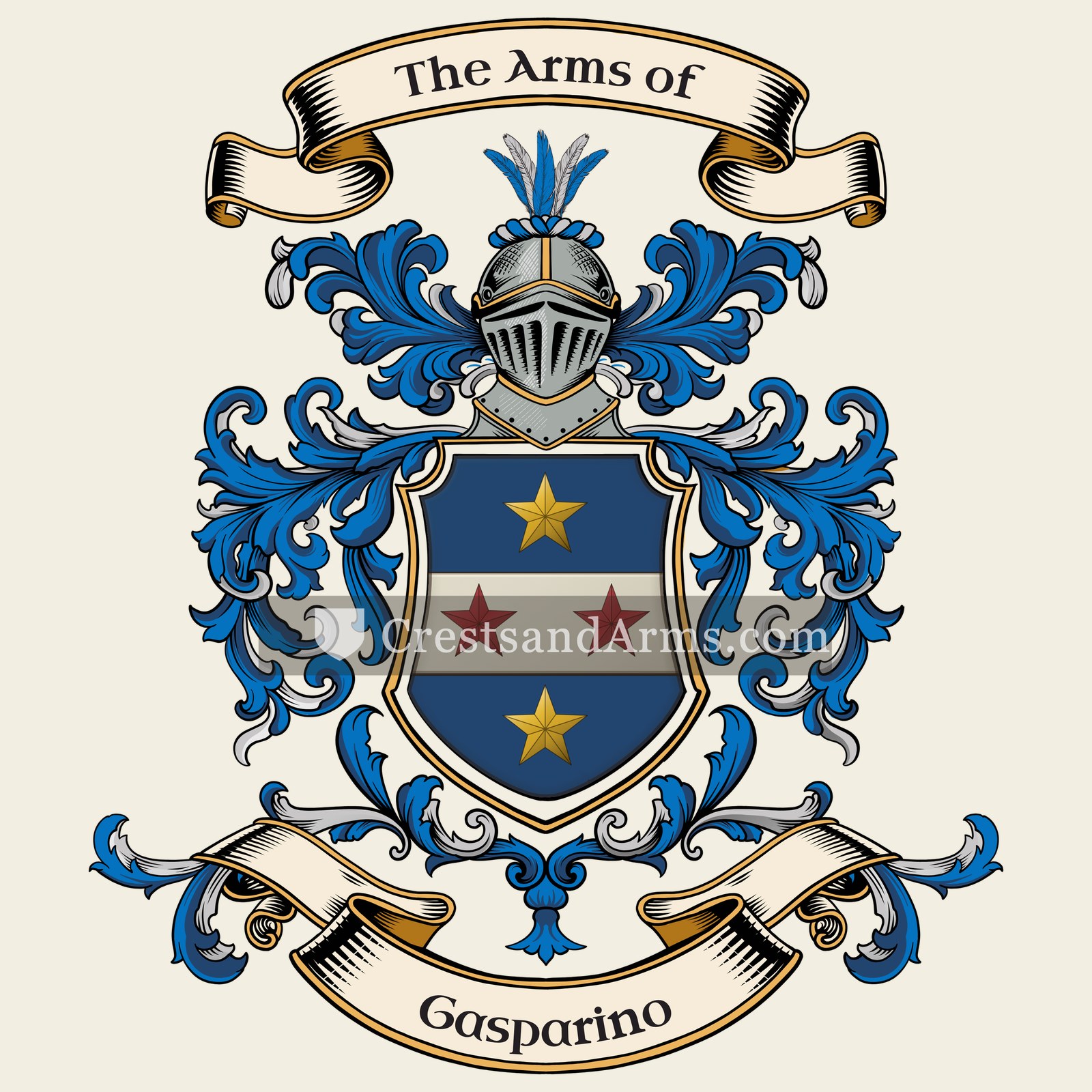


 bendDefence, and the scarf of a commander
 griffinValour and vigilance, guarding great treasure
 batonAuthority and office held under the crown