Map of France showing where the Gaudin arms are recorded
The Gaudin arms were recorded in Normandie, c. 1663.
Normandie held a dense crowd of knightly families on some of the best farmland in France. Its men had fought and settled abroad for generations, and a family that sent sons to war needed a shield they could be recognised by.
This is where the arms were entered in the register. Families often moved to other parts of the country, so the same name can turn up in more than one region.
The body that granted and recorded arms in France in this period.
Louis XIV of France
Sovereign of the period
Louis XIV of France
1643–1715
Reigning in France when the Gaudin arms are first recorded.
How Arms Worked in France
In France, a coat of arms was a mark of honor that passed down through the male line to all legitimate descendants. Families often used the same shield without changes to show their shared heritage. If a branch wanted to stand out, they could add a small mark to their shield to show their specific place in the family tree.
Granting authority
The Juge d'armes de France acted as the official authority that regulated and verified coats of arms across the country.
How they got arms
Families typically inherited their arms from ancestors, though they could also receive them through royal grants or by proving their noble status.
Where arms were recorded
Coats of arms were officially recorded in the Armorial Général de France, which began its main collection in the year 1696.
The family's standing
Recorded among the armigerous families of Normandie.
Origin & History of the Gaudin Family in France
The name Gaudin finds its roots in the ancient Germanic language, evolving from the name Waldo, which signifies a ruler or a guardian. As the name spread across France, it became a common surname in regions like Normandy, where families bearing this name were well-established by the mid-seventeenth century. By 1663, records confirm that the Gaudin family was firmly rooted in the social and agricultural life of the Norman countryside. During this era, many people with this name worked as farmers or artisans, contributing to the local economy of their parishes. The name reflects a long history of migration and settlement within the French provinces, marking the family as a stable part of the regional population long before the great waves of expansion that would eventually carry the name across the globe.
Coat of Arms & Family Crest Details
Symbols on this shield
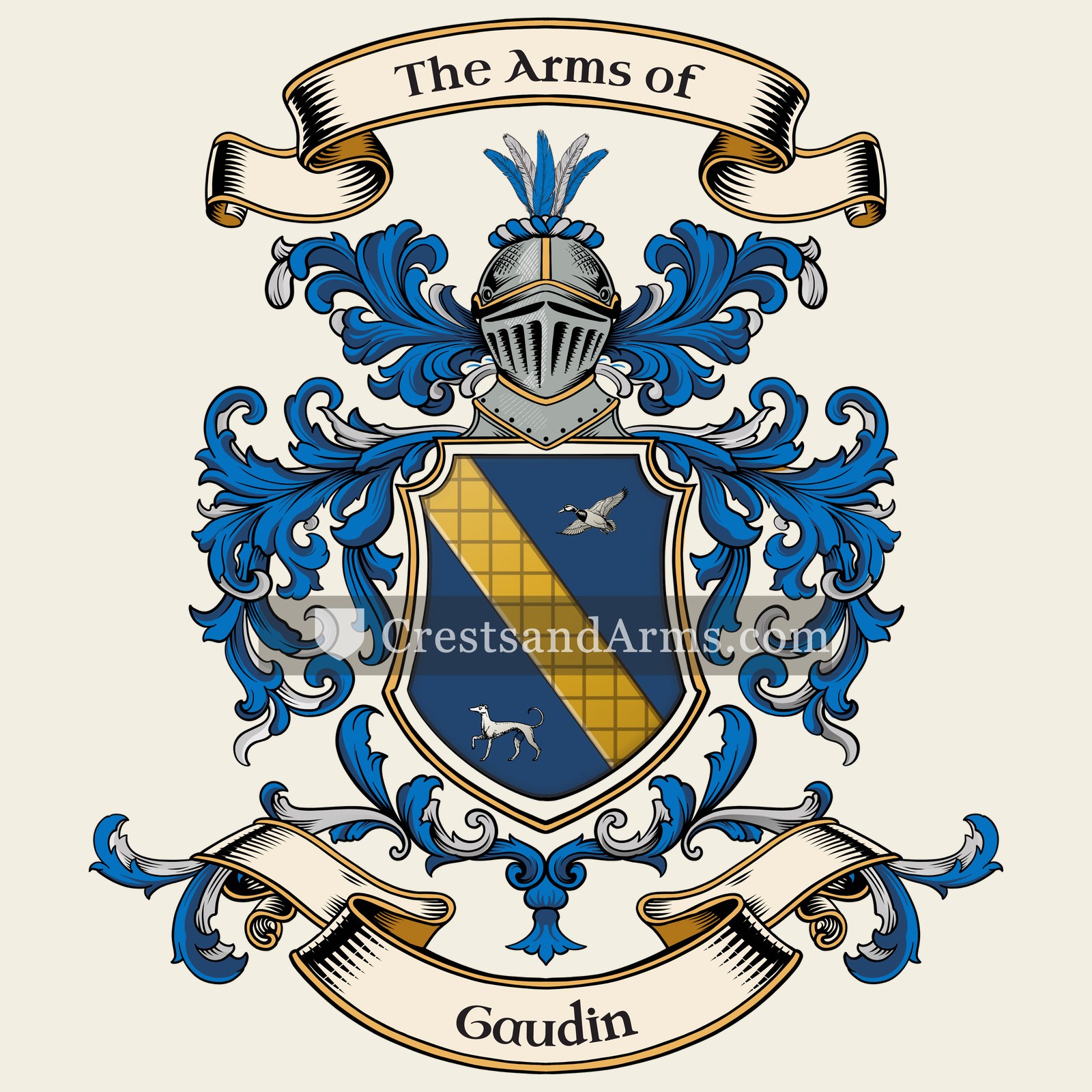
bendDefence, and the scarf of a commander
duckResourcefulness on land and water
greyhoundCourage, vigilance and loyalty
Colours
Blue (Azure)Means: Loyalty and truth
Gold (Or)Means: Generosity
Silver (Argent)Means: Peace and sincerity
Historical info
Source
J. B. Rietstap, Armorial Général, Gouda: G. B. van Goor Zonen, 1884–87
Blazon (the actual original written record)
“D'azur à la bande d'or, acc. en chef d'un jars d'arg., le vol étendu, et en p. d'un lévrier ramp. du même.”
Switzerlandc. 1745
Digital archive packCoat of arms PNG, gold border print PDF, vector SVG and the certificate of authenticity. Sent to your email in minutes.
Map of Switzerland showing where the Gaudin arms are recorded
The Gaudin arms were recorded in Switzerland, c. 1745.
Arms such as these were typically recorded in Bern.
Bern was the largest of the Swiss cantons and ran itself, with its own council and its own courts. Its governing families held office for generations, and office of that kind carried a shield with it.
This is where the arms were entered in the register. Families often moved to other parts of the country, so the same name can turn up in more than one region.
The body that granted and recorded arms in Switzerland in this period.
How Arms Worked in Switzerland
In Switzerland, coats of arms were not restricted to the nobility and were often adopted by common citizens and families. These symbols were passed down through generations to show family identity. When branches of a family grew, they often changed small details of the design to distinguish their own line from the original group.
Granting authority
Cantonal and civic authorities managed the use of coats of arms within their specific regions and local jurisdictions.
How they got arms
Families typically assumed their own coats of arms based on local custom rather than receiving them from a central monarch.
Where arms were recorded
Arms were recorded in various cantonal and civic registers starting from the fourteenth century throughout the Swiss region.
The family's standing
Recorded among the armigerous families of Switzerland.
Origin & History of the Gaudin Family in Switzerland
The surname Gaudin has deep roots in the French-speaking regions of Switzerland, where it emerged as a patronymic name derived from the ancient Germanic personal name Waldo. By the mid-eighteenth century, the family had established a notable presence in the city of Bern, which served as a major political and economic hub of the Swiss Confederation. Records from 1745 confirm that members of the Gaudin family were active participants in the urban life of Bern during this era, likely contributing to the city’s growing trade and administrative sectors. As a family living in a region defined by complex linguistic and cultural shifts, the Gaudins integrated into the local Swiss social fabric while maintaining a name that reflected their ancestral ties to broader European naming traditions. Their presence in Bern during this period highlights the movement of families across regional borders in search of stability and opportunity within the Swiss cantons.
Gaudin Meaning & Related Branches
Root word
Wado
A Germanic root meaning to go, walk, or wade through water.
This name
GaudinDerived from a Germanic personal name meaning one who is bold or brave.
also spelled
Gaudyn
Godin
Documented Sources
J. B. Rietstap, Armorial Général, Gouda: G. B. van Goor Zonen, 1884–87
Dauzat, Albert, Dictionnaire étymologique des noms et prénoms de France, 1951
Morlet, Marie-Thérèse, Dictionnaire étymologique des noms de famille, 1991
Archives départementales de la Seine-Maritime, Registres paroissiaux et d'état civil, 1663
Digital archive packCoat of arms PNG, gold border print PDF, vector SVG and the certificate of authenticity. Sent to your email in minutes.


 chevronProtection, and faithful service completed
 chiefAuthority, wisdom and dominion
 eagleNobility, strength and a keen mind
 chevronProtection, and faithful service completed
 chiefAuthority, wisdom and dominion
 eagleNobility, strength and a keen mind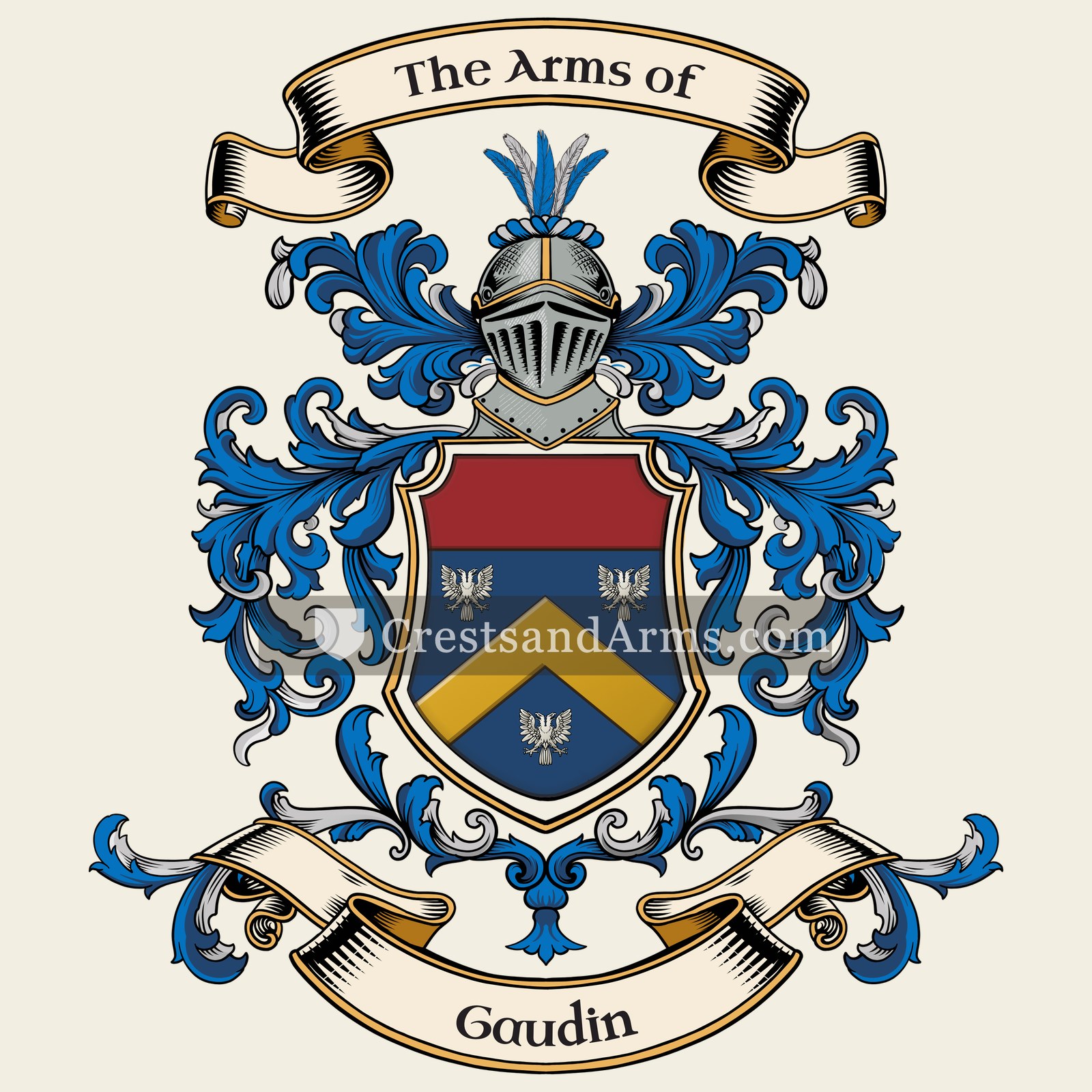


 bendDefence, and the scarf of a commander
 duckResourcefulness on land and water
 greyhoundCourage, vigilance and loyalty