Map of Wales showing where the Gawne arms are recorded
The Gawne arms were recorded in Wales, c. 1647.
Arms such as these were typically recorded in Denbigh.
Denbighshire was north Welsh country of hills and small estates. Land was held by a great many families rather than a few, and each holding brought its own claim to a coat of arms.
This is where the arms were entered in the register. Families often moved to other parts of the country, so the same name can turn up in more than one region.
The body that granted and recorded arms in Wales in this period.
Charles I of England
Sovereign of the period
Charles I of England
1625–1649
Reigning in Wales when the Gawne arms are first recorded.
How Arms Worked in Wales
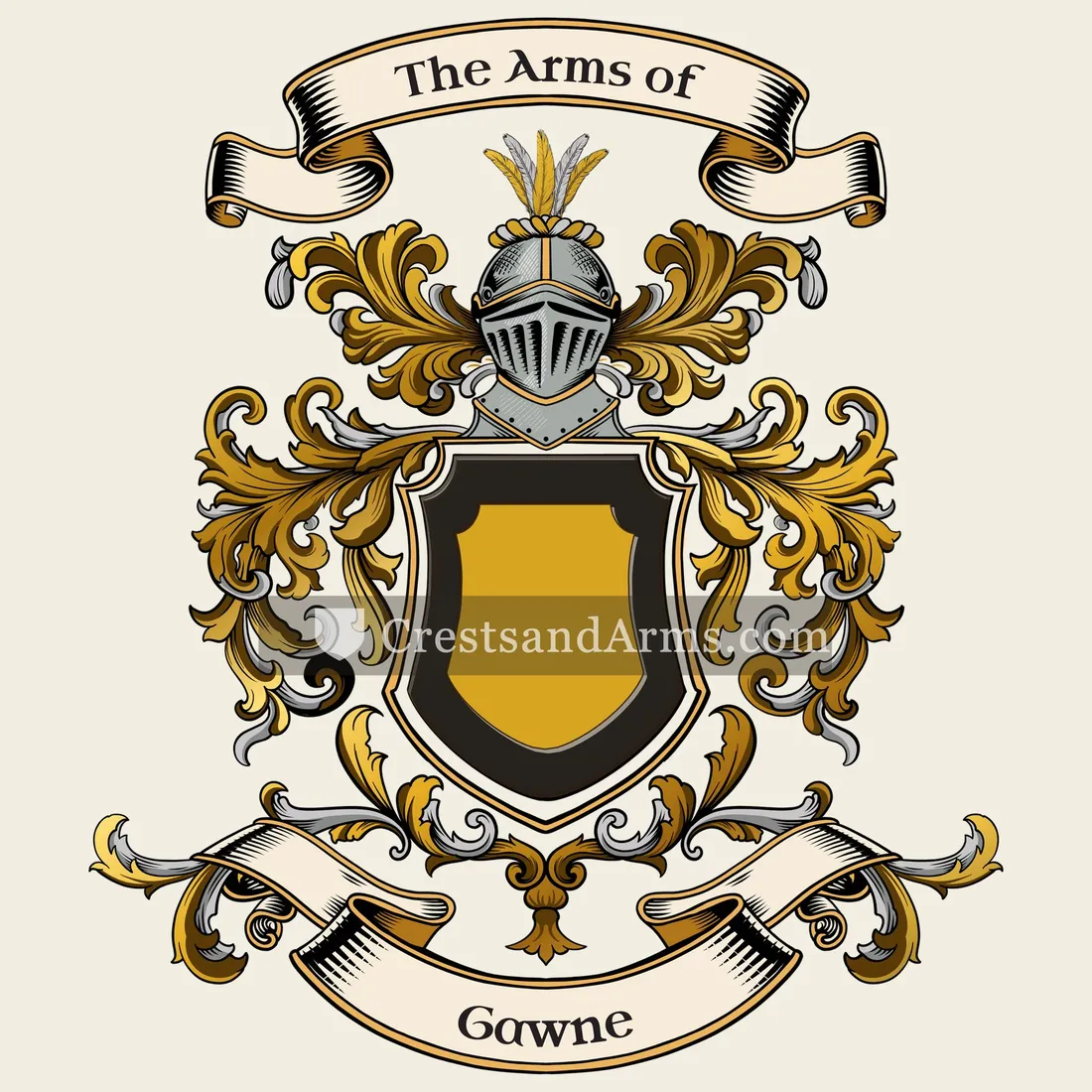
English heraldry allowed arms to be shared by all legitimate descendants of the original owner. These symbols were treated as personal property that moved through the generations to all children. While the eldest son kept the original design, other family members could use the same shield without needing to change it or register their own unique versions.
Granting authority
The College of Arms in London has regulated the use of coats of arms throughout England and Wales since 1484.
How they got arms
Families typically obtained their coats of arms through a formal grant from the Crown or by proving their ancient right to them.
Where arms were recorded
All official coats of arms are recorded in the registers kept at the College of Arms, which date back to the fifteenth century.
The family's standing
Recorded among the armigerous families of Wales.
Origin & History of the Gawne Family in Wales
The surname Gawne has deep roots in the British Isles, with historical evidence placing members of the family in the town of Denbigh by 1647. The name is widely considered to be a variation of the Manx name Gawne, which itself likely evolved from the older Gaelic name Mac Ghabhann. This original Gaelic form translates to son of the smith, suggesting that the earliest ancestors of the family were skilled metalworkers who held an important place in their local communities. As the family moved across the Irish Sea and settled in areas like Denbigh, the spelling of the name adapted to fit the local language and pronunciation. By the mid-seventeenth century, the Gawne family had established a clear presence in North Wales, where they lived and worked during a time of great political and social change in the region.
Gawne Meaning & Related Branches
Root word
Gawain
A legendary knight associated with Arthurian romance and Welsh mythology.
This name
GawneA patronymic surname derived from the medieval personal name Gawain, meaning white hawk.
also spelled
Gwyn
Gwynn
Gwynne
Documented Sources
Sir Bernard Burke, The General Armory of England, Scotland, Ireland and Wales, London: Harrison & Sons, 1884
Kneen, J.J., The Personal Names of the Isle of Man, 1937
Moore, A.W., The Surnames and Place-Names of the Isle of Man, 1890


 bordureA difference between branches of one family
 bordureA difference between branches of one family