Map of France showing where the Gaya arms are recorded
The Gaya arms were recorded in Paris, c. 1663.
This is where the arms were entered in the register. Families often moved to other parts of the country, so the same name can turn up in more than one region.
The body that granted and recorded arms in France in this period.
Louis XIV of France
Sovereign of the period
Louis XIV of France
1643–1715
Reigning in France when the Gaya arms are first recorded.
How Arms Worked in France
In France, a coat of arms was a mark of honor that passed down through the male line to all legitimate descendants. Families often used the same shield without changes to show their shared heritage. If a branch wanted to stand out, they could add a small mark to their shield to show their specific place in the family tree.
Granting authority
The Juge d'armes de France acted as the official authority that regulated and verified coats of arms across the country.
How they got arms
Families typically inherited their arms from ancestors, though they could also receive them through royal grants or by proving their noble status.
Where arms were recorded
Coats of arms were officially recorded in the Armorial Général de France, which began its main collection in the year 1696.
The family's standing
Recorded among the armigerous families of France.
Origin & History of the Gaya Family in France
The family name Gaya carries a history deeply rooted in the social fabric of seventeenth-century France. By 1663, records confirm that members of the Gaya family were firmly established in Paris, a city then serving as the vibrant center of European culture and political power. During this era, the name was associated with individuals who navigated the complex professional circles of the French capital, often participating in the administrative and intellectual life of the kingdom. While the name likely originated from regional roots, its presence in Paris suggests a family that was well-integrated into the urban elite. Over time, the family transitioned from these early Parisian foundations to influence various sectors of society, leaving a legacy that reflects the steady growth and movement of families during the early modern period.
Gaya Meaning & Related Branches
Root word
Gaius
A Latin personal name of uncertain etymology, possibly meaning to rejoice.
This name
GayaA locative surname derived from various places named Gaya or Gaïa in France.
also spelled
Gaias
Related arms
Gaiavariant spelling
Documented Sources
J. B. Rietstap, Armorial Général, Gouda: G. B. van Goor Zonen, 1884–87
Archives Nationales de France, Minutier central des notaires de Paris, Series Etude
Benoist, Luc, Histoire de Paris, 1968
Favier, Jean, Paris au XVe et XVIe siècles, 1974
Digital archive packCoat of arms PNG, gold border print PDF, vector SVG and the certificate of authenticity. Sent to your email in minutes.


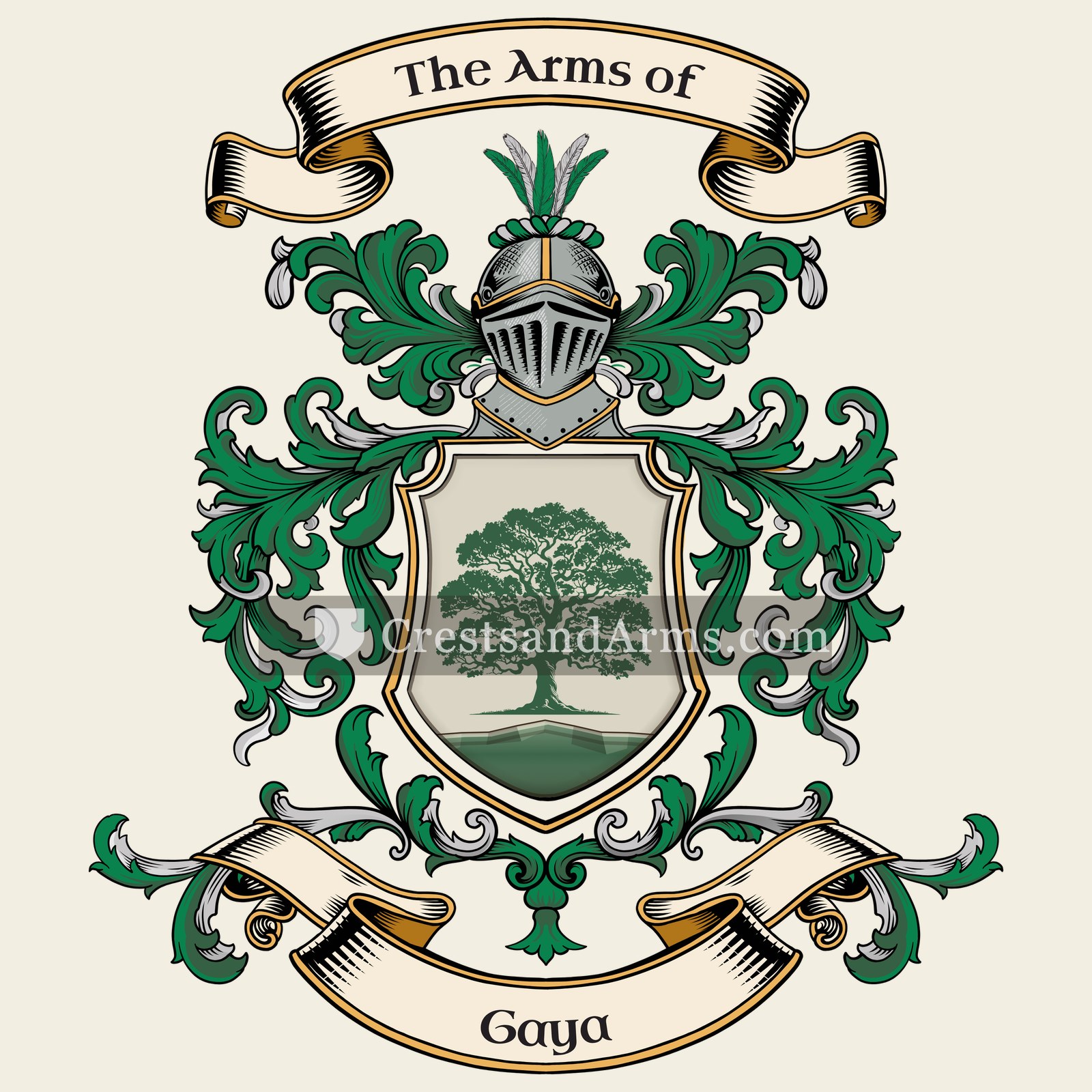
 mountThe ground held, and steadfastness upon it
 treeLife, endurance and deep roots
 mountThe ground held, and steadfastness upon it
 treeLife, endurance and deep roots