Map of Spain showing where the Geel arms are recorded
The Geel arms were recorded in Murcie, c. 1722.
This is where the arms were entered in the register. Families often moved to other parts of the country, so the same name can turn up in more than one region.
The body that granted and recorded arms in Spain in this period.
Philip V of Spain
Sovereign of the period
Philip V of Spain
1714–1724
Reigning in Spain when the Geel arms are first recorded.
How Arms Worked in Spain
In Spain, a coat of arms was considered a form of property that belonged to the entire family line. These arms were passed down from a father to all his children equally. Younger branches of the family usually kept the original design without needing to add any special marks to distinguish their specific line.
Granting authority
The Cronista Rey de Armas was the official body that regulated and granted coats of arms throughout Spain.
How they got arms
Families often obtained their arms through royal grants or by proving their noble status to the official heraldic authority.
Where arms were recorded
Coats of arms were officially recorded in the registers of the Cronista Rey de Armas starting in 1496.
The family's standing
Recorded among the armigerous families of Spain.
Origin & History of the Geel Family in Spain
The family name Geel carries a history deeply rooted in the movement of people across European regions. By the early eighteenth century, records confirm that members of the family were established in the city of Murcia, Spain, by the year 1722. During this period, Murcia served as a significant hub for trade and agriculture, attracting families from various backgrounds who sought new opportunities in the Mediterranean climate. The name itself likely originated from linguistic roots in Northern Europe, specifically relating to the Dutch or Low German word for the color yellow, which was often used as a descriptive nickname for a person with blond hair or a fair complexion. As these early ancestors migrated southward, they integrated into the local Spanish society while maintaining the distinct identity of their surname. This transition reflects the broader patterns of migration that shaped the demographics of the Iberian Peninsula during the Enlightenment era.
Geel Meaning & Related Branches
Root word
Gel
Derived from the Germanic word for yellow or golden color.
This name
GeelA topographic or descriptive surname referring to someone with yellow hair or complexion.
also spelled
Guill
Guile
Guils
Geel
Documented Sources
J. B. Rietstap, Armorial Général, Gouda: G. B. van Goor Zonen, 1884–87
Archivo General de la Región de Murcia, Protocolos Notariales de Murcia, 1722
Moll, Francesc de Borja, Els llinatges catalans: Catalunya, País Valencià i Illes Balears, 1959
Digital archive packCoat of arms PNG, gold border print PDF, vector SVG and the certificate of authenticity. Sent to your email in minutes.


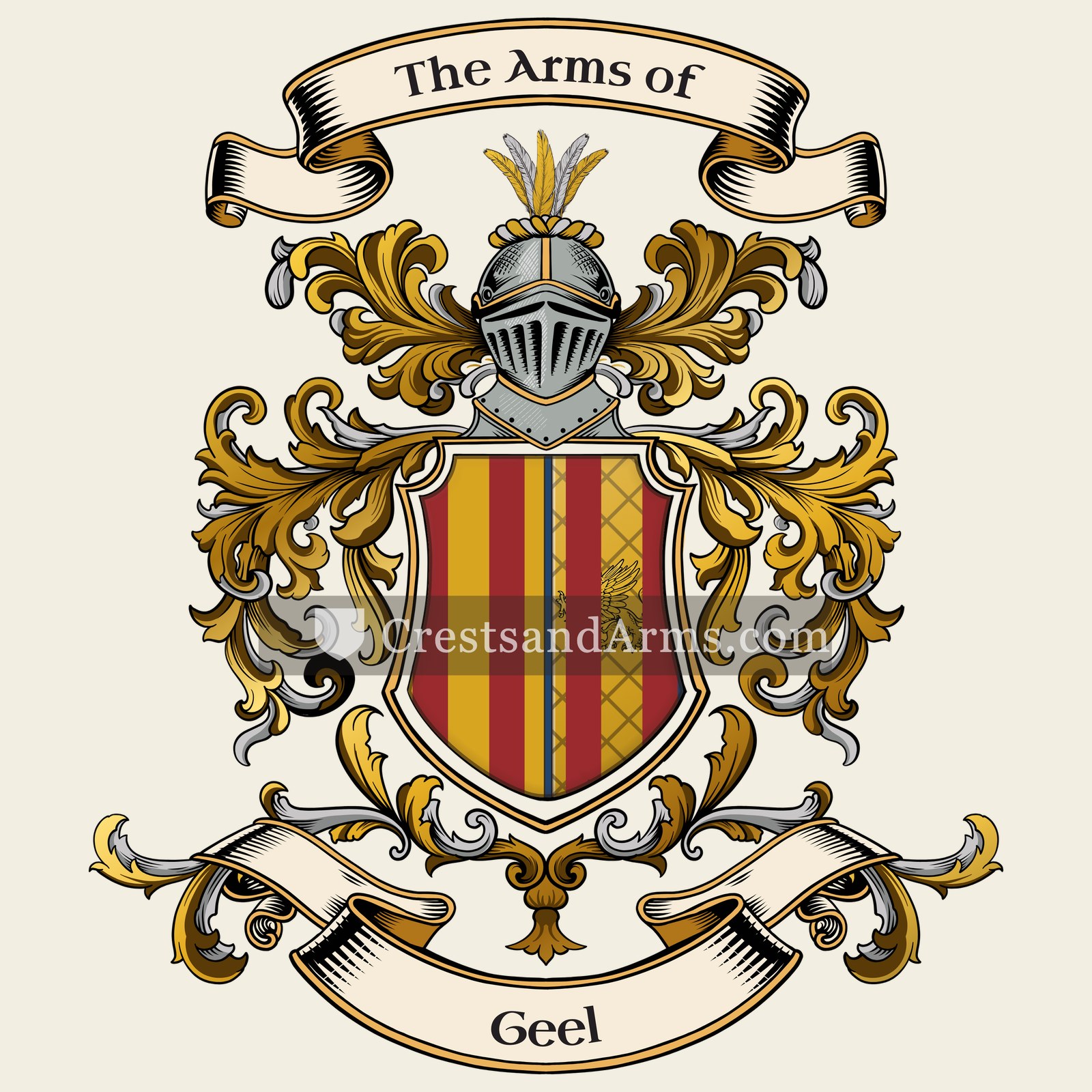
 paleMilitary strength, and a fortified defence
 griffinValour and vigilance, guarding great treasure
 paleMilitary strength, and a fortified defence
 griffinValour and vigilance, guarding great treasure