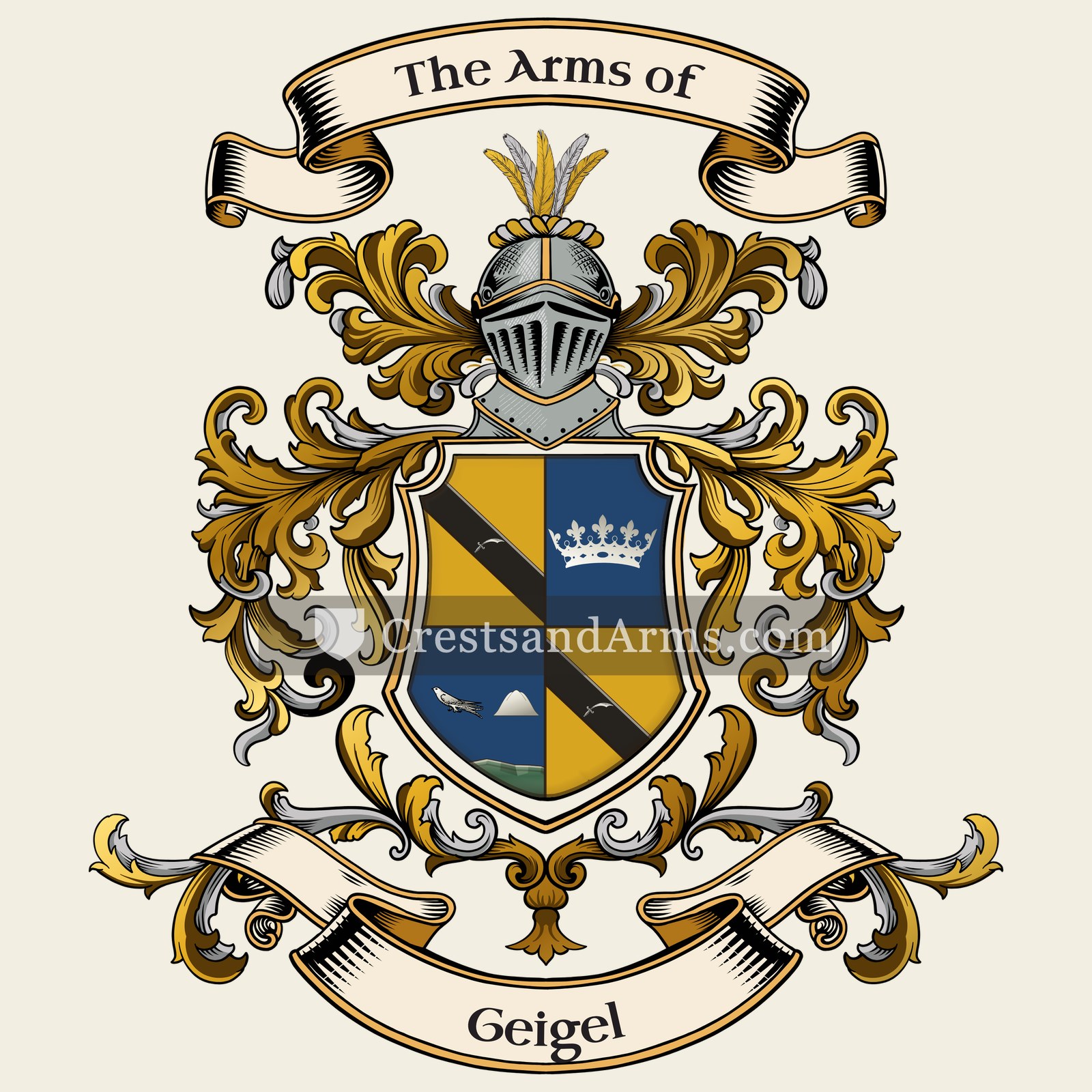
A record of documented arms, meaning and origin, researched for the Geigel family of Russia.
Reg. 6237 · Russian, G–I
Coat of Arms & Family Crest Details
Symbols on this shield
bendDefence, and the scarf of a commander
cantonA mark of honour granted by the sovereign
mountThe ground held, and steadfastness upon it
swordJustice, and military honour
crownSovereignty, authority and just reward
martletA younger son, who must win his own land
Colours
Gold (Or)Means: Generosity
Blue (Azure)Means: Loyalty and truth
Black (Sable)Means: Constancy
Green (Vert)Means: Hope
Silver (Argent)Means: Peace and sincerity
Historical info
Source
J. B. Rietstap, Armorial Général, Gouda: G. B. van Goor Zonen, 1884–87
Blazon (the actual original written record)
“Ec.: aux 1 et 4 d'or à la bande de sa., ch. d'une lame d'épée flamboyante d'arg., celle du 1 mouv. du canton dextre du chef, celle du 4 mouv. du canton sen. de la p.; au 2 d'azur à la couronne impériale de Russie, au nat.; au 3 d'azur à un oiseau cont. d'arg., le vol levé, posé sur une terrasse du même et”
Russiac. 1784
Digital archive packCoat of arms PNG, gold border print PDF, vector SVG and the certificate of authenticity. Sent to your email in minutes.
Map of Russia showing where the Geigel arms are recorded
The Geigel arms were recorded in Russia, c. 1784.
Arms such as these were typically recorded in Moscow.
Moscow held the Russian court, and rank there came from service rather than land. Families who served the Tsar were entered in the registers of nobility, and that entry is where their arms are recorded.
This is where the arms were entered in the register. Families often moved to other parts of the country, so the same name can turn up in more than one region.
The body that granted and recorded arms in Russia in this period.
Catherine II of Russia
Sovereign of the period
Catherine II of Russia
1762–1796
Reigning in Russia when the Geigel arms are first recorded.
How Arms Worked in Russia
Russian heraldry was strictly tied to the nobility and the state service system. Families proved their ancient status or earned new rank to receive an official grant from the Tsar. These symbols were then inherited by all legitimate children of the noble line. If a family lacked proof of their status, they were often excluded from the official records entirely.
Granting authority
The Herald Master's Office acted as the central state body that strictly regulated and verified all noble heraldic symbols.
How they got arms
Families typically received their arms through a formal state grant or by proving their noble status to the government authorities.
Where arms were recorded
All approved coats of arms were officially recorded in the General Armorial of the Noble Families of the Russian Empire starting in 1797.
The family's standing
Recorded among the armigerous families of Russia.
Origin & History of the Geigel Family in Russia
The surname Geigel carries roots that trace back to the German-speaking regions of Europe, where it likely originated as a descriptive nickname or a variation of occupational names common in the Middle Ages. By the late 18th century, members of the family had migrated eastward into the Russian Empire. Historical records confirm their presence in Moscow by 1784, a time when the city was a vibrant center for trade, administration, and cultural exchange. During this period, families with German origins often served in specialized roles within the Russian bureaucracy or as skilled merchants, helping to bridge the gap between Western European expertise and the growing Russian economy. This relocation suggests that the early Geigel family members were part of a larger movement of professionals who sought new opportunities in the rapidly expanding urban landscape of the Russian capital.
Related Branches & Arms
Root word
Geige
A German term for a fiddle or violin.
This name
GeigelAn occupational surname for a person who played the violin or fiddle.
also spelled
Goegele
Goegell
Gegel
Documented Sources
J. B. Rietstap, Armorial Général, Gouda: G. B. van Goor Zonen, 1884–87
Erik Amburger, Die ständige diplomatische Vertretung der kaiserlich russischen Regierung in den Jahren 1700 bis 1917, 1965
State Archive of the Russian Federation (GARF), Fond 123: Records of the Moscow City Police Department, 1784
Digital archive packCoat of arms PNG, gold border print PDF, vector SVG and the certificate of authenticity. Sent to your email in minutes.


 bendDefence, and the scarf of a commander
 cantonA mark of honour granted by the sovereign
 mountThe ground held, and steadfastness upon it
 swordJustice, and military honour
 crownSovereignty, authority and just reward
 martletA younger son, who must win his own land
 bendDefence, and the scarf of a commander
 cantonA mark of honour granted by the sovereign
 mountThe ground held, and steadfastness upon it
 swordJustice, and military honour
 crownSovereignty, authority and just reward
 martletA younger son, who must win his own land