Map of France showing where the Gelber arms are recorded
The Gelber arms were recorded in Alsace, c. 1817.
Alsace lay between France and the German lands and belonged to both at different times. Its families held small estates and served whichever side ruled, and men who served in arms carried arms of their own.
This is where the arms were entered in the register. Families often moved to other parts of the country, so the same name can turn up in more than one region.
The body that granted and recorded arms in France in this period.
How Arms Worked in France
In France, a coat of arms was a mark of honor that passed down through the male line to all legitimate descendants. Families often used the same shield without changes to show their shared heritage. If a branch wanted to stand out, they could add a small mark to their shield to show their specific place in the family tree.
Granting authority
The Juge d'armes de France acted as the official authority that regulated and verified coats of arms across the country.
How they got arms
Families typically inherited their arms from ancestors, though they could also receive them through royal grants or by proving their noble status.
Where arms were recorded
Coats of arms were officially recorded in the Armorial Général de France, which began its main collection in the year 1696.
The family's standing
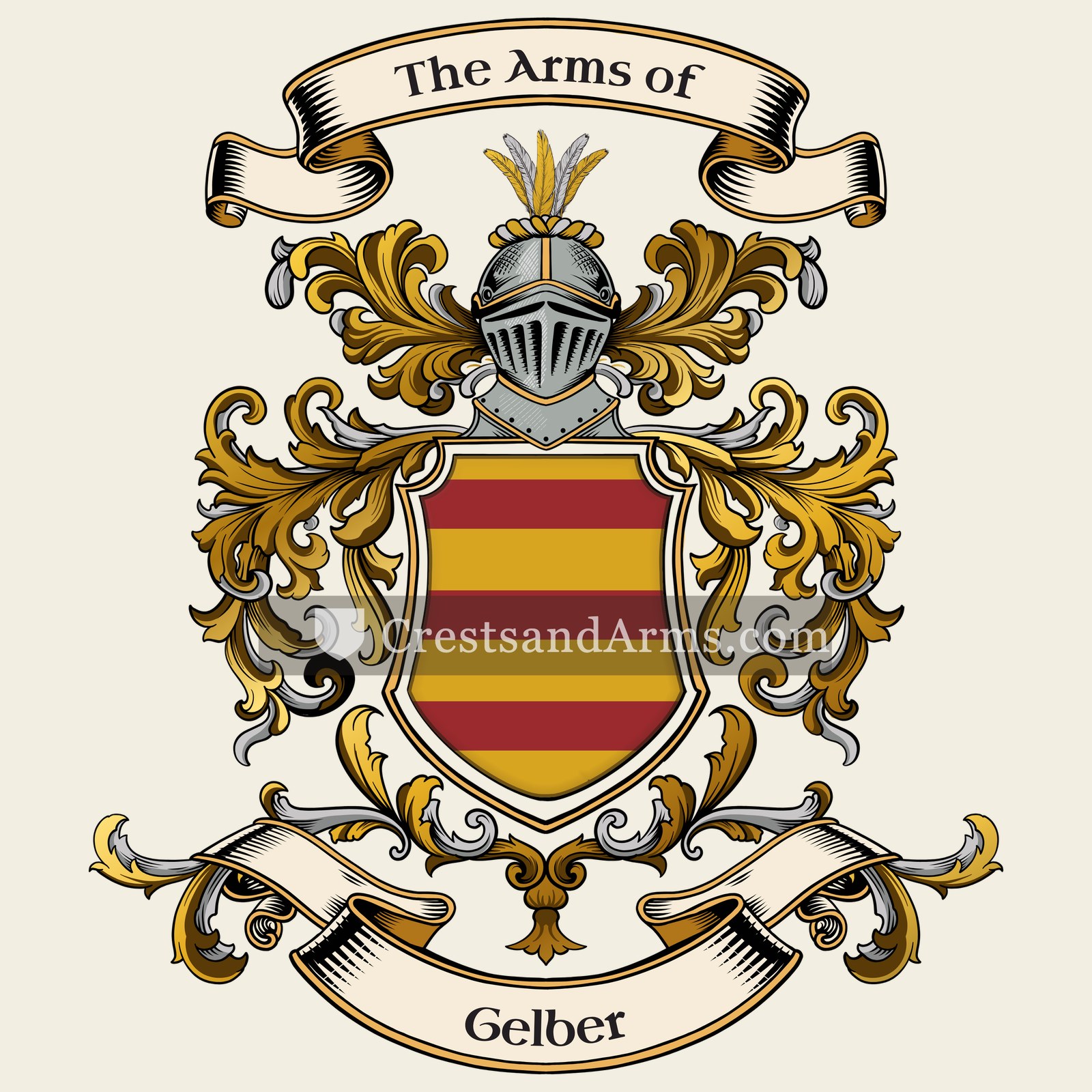
Recorded among the armigerous families of Alsace.
Origin & History of the Gelber Family in France
The surname Gelber is a descriptive name that originated in German-speaking regions, derived from the Middle High German word "gel" or "gelb," which means yellow. Historically, this name was often used as a nickname for someone with blond hair or a fair complexion. By the early 19th century, the Gelber family was well-established in the Alsace region, which sits on the border between France and Germany. During this period, the area experienced frequent shifts in political control, and families often held onto their Germanic roots while living under French administration. Records from 1817 confirm that members of the family were living in this culturally diverse area, where they likely worked in trades or agriculture typical of the Rhine Valley. The name remains a reflection of the family's deep connection to the linguistic and social traditions of Central Europe.
Gelber Meaning & Related Branches
Root word
Gelb
A Germanic word meaning the color yellow.
This name
GelberAn occupational or descriptive surname for someone with yellow hair or a fair complexion.
also spelled
Gelbe
Gellb
Gelber
Documented Sources
J. B. Rietstap, Armorial Général, Gouda: G. B. van Goor Zonen, 1884–87
Bahlow, Hans, Deutsches Namenlexikon: Familien- und Vornamen nach Ursprung und Sinn erklärt, 1967
Heintze, Albert, Die deutschen Familiennamen: geschichtlich, geographisch, sprachlich, 1903
Archives départementales du Bas-Rhin, État civil de 1817
Digital archive packCoat of arms PNG, gold border print PDF, vector SVG and the certificate of authenticity. Sent to your email in minutes.