A record of documented arms, meaning and origin, researched for the Geng family lines. Documented in 2 countries.
Reg. 4420 · Polish, G–I
Meaning of the Geng family crest colors & symbols
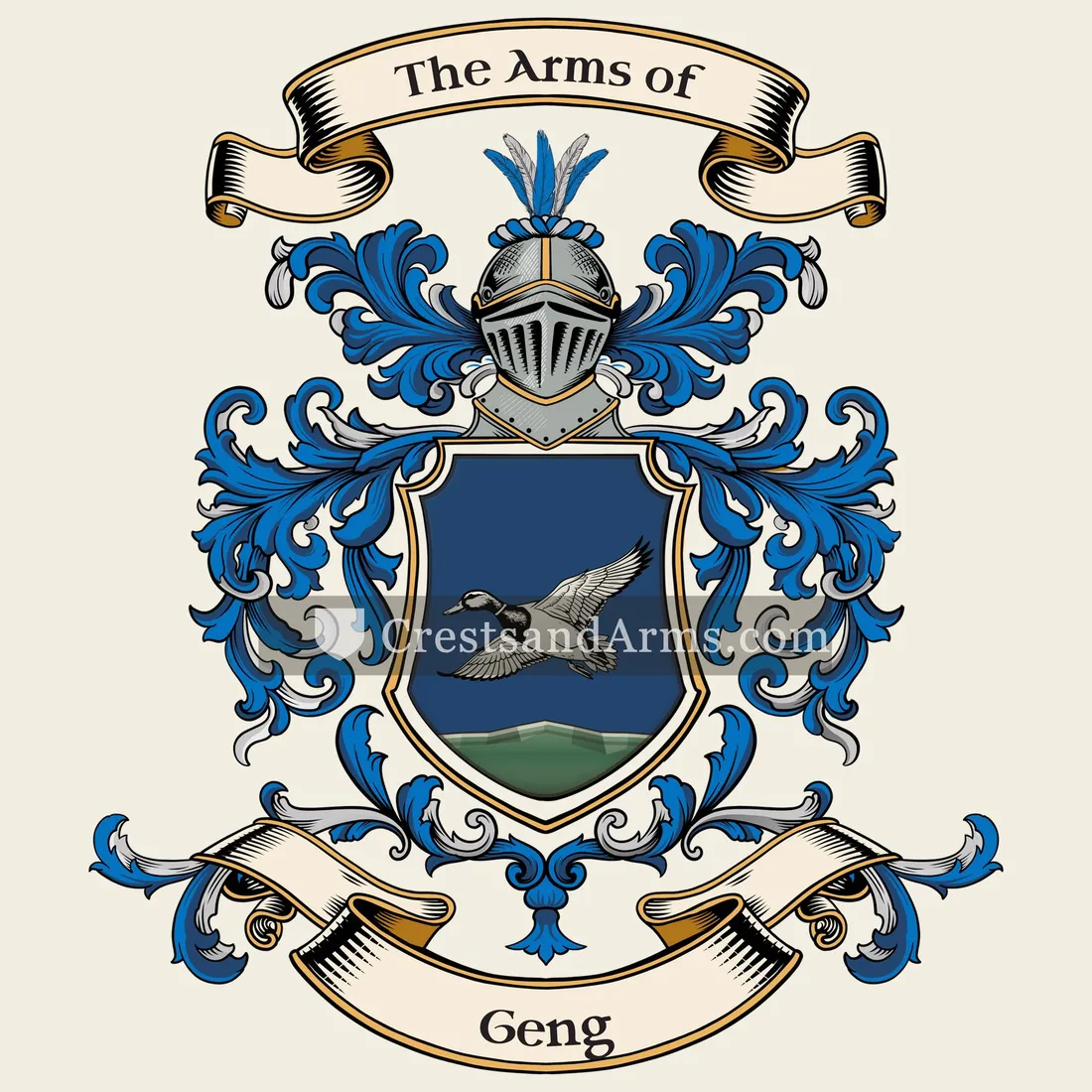
Symbols on this shield
mountThe ground held, and steadfastness upon it
duckResourcefulness on land and water
Colours
Blue (Azure)Means: Loyalty and truth
Green (Vert)Means: Hope
Silver (Argent)Means: Peace and sincerity
Historical info
Source
J. B. Rietstap, Armorial Général, Gouda: G. B. van Goor Zonen, 1884–87
Blazon (the actual original written record)
“D'azur à une oie d'arg., sur une terrasse de sin. Cq. cour. C.: cinq pl. d'aut - Ou: De gu. à un canard nageant dans une eau, le tout au nat. Cq. cour. C.: trois pl. d'aut.”
Polandc. 1772
Digital archive packCoat of arms PNG, gold border print PDF, vector SVG and the certificate of authenticity. Sent to your email in minutes.
Map of Poland showing where the Geng arms are recorded
The Geng arms were recorded in Poland, c. 1772.
Arms such as these were typically recorded in Mazovia.
Mazovia held Warsaw, the Polish court and the assemblies where the szlachta met. Poland's nobles were unusually numerous and every one of them bore arms, and Warsaw is where those arms were argued over and recorded.
This is where the arms were entered in the register. Families often moved to other parts of the country, so the same name can turn up in more than one region.
Region
Mazovia
First recorded
1772
Granting Authority for the Geng Arms
Ennoblement by the Sejm
Author: Olek Remesz · CC BY-SA 3.0
The body that granted and recorded arms in Poland in this period.
Stanisław August Poniatowski
Sovereign of the period
Stanisław August Poniatowski
1764–1795
Reigning in Poland when the Geng arms are first recorded.
How Arms Worked in Poland
Polish noble families shared a single coat of arms across many different surnames, creating large clans rather than individual designs. These symbols were held collectively by all members of the clan regardless of their specific family name. When a new family joined the nobility, they were adopted into an existing clan and began using that group's established shield.
Granting authority
The Sejm, which was the Polish parliament, held the power to grant noble status and the right to bear arms.
How they got arms
Families typically received their coat of arms through a formal act of ennoblement granted by the Sejm for distinguished service.
Where arms were recorded
These grants were officially recorded in the Crown Metrica, which served as the central archive for state documents starting in the sixteenth century.
The family's standing
Recorded among the armigerous families of Poland.
Origin & History of the Geng Family in Poland
The history of the Geng family in Poland is deeply rooted in the historical region of Mazovia, where records confirm their presence as early as 1772. During the late eighteenth century, Mazovia was a central hub of Polish social and agricultural life, characterized by a mix of small noble estates and independent farming communities. Families with this surname likely integrated into the local administrative and parish systems during this period, which was a time of significant political transition for the Polish-Lithuanian Commonwealth. Because Mazovia served as a gateway between eastern and western trade routes, the Geng family would have lived through the challenges of the partitions while maintaining their ties to the local land. Their presence in these early parish registers suggests that they were established members of the community who participated in the regional traditions and economic activities that defined the Mazovian landscape before the turn of the nineteenth century.
Meaning of the Geng family crest colors & symbols
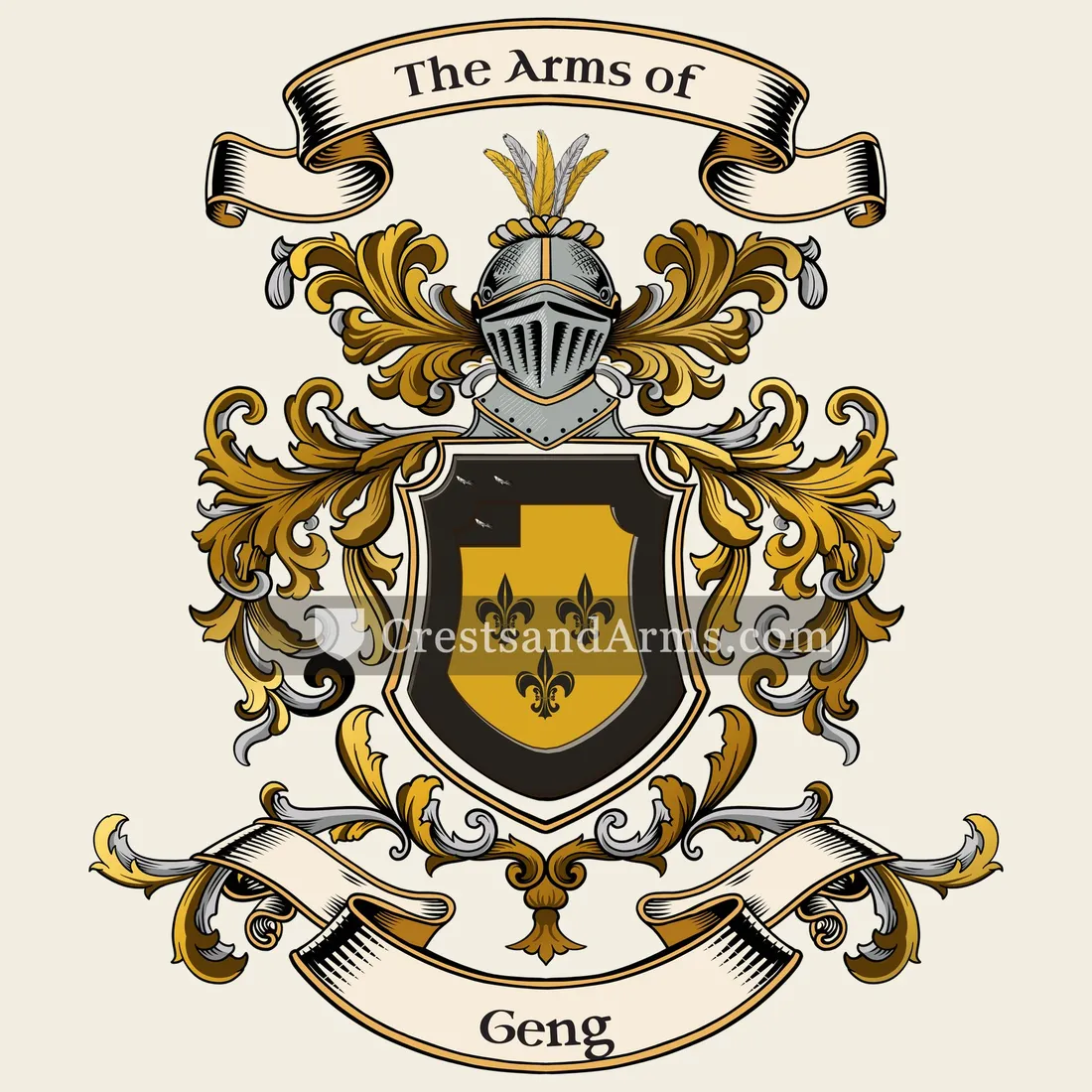
Symbols on this shield
cantonA mark of honour granted by the sovereign
bordureA difference between branches of one family
fleur de lisPurity, light, and the sixth son
martletA younger son, who must win his own land
Colours
Gold (Or)Means: Generosity
Black (Sable)Means: Constancy
Silver (Argent)Means: Peace and sincerity
Historical info
Source
Sir Bernard Burke, The General Armory of England, Scotland, Ireland and Wales, London: Harrison & Sons, 1884
Blazon (the actual original written record)
“Or, three fleurs-de-lis sa. on a canton of the last three martlets ar. a border of the first”
EnglandAntwerp, c. 1568
Digital archive packCoat of arms PNG, gold border print PDF, vector SVG and the certificate of authenticity. Sent to your email in minutes.
Map of England showing where the Geng arms are recorded
The Geng arms were recorded in Antwerp, c. 1568.
Arms such as these were typically recorded in York.
Yorkshire is the largest of the English counties, and it held more gentry families than any other. Land there was split among a great many households rather than a few, so a great many of them carried arms.
This is where the arms were entered in the register. Families often moved to other parts of the country, so the same name can turn up in more than one region.
The body that granted and recorded arms in England in this period.
Elizabeth I of England
Sovereign of the period
Elizabeth I of England
1558–1603
Reigning in Poland when the Geng arms are first recorded.
How Arms Worked in England
English heraldry allowed arms to be shared by all legitimate descendants of the original owner. These symbols were treated as personal property that moved through the generations to all children. While the eldest son kept the original design, other family members could use the same shield without needing to change it or register their own unique versions.
Granting authority
The College of Arms in London has regulated the use of coats of arms throughout England and Wales since 1484.
How they got arms
Families typically obtained their coats of arms through a formal grant from the Crown or by proving their ancient right to them.
Where arms were recorded
All official coats of arms are recorded in the registers kept at the College of Arms, which date back to the fifteenth century.
The family's standing
Recorded among the armigerous families of England.
Origin & History of the Geng Family in England
The history of the Geng family in England begins with documented records of individuals living in the city of York as early as 1568. During the sixteenth century, York was a bustling center of trade and religious transition, making it a significant place for families to establish roots. The name likely emerged during a period when surnames were becoming more fixed in English society, often reflecting a person’s occupation, location, or a unique family trait. While the name is relatively rare in historical English texts, its presence in Northern England suggests that the family was part of the local community during the reign of Queen Elizabeth I. By settling in a major administrative and ecclesiastical hub like York, these early ancestors were positioned within a society that valued trade, craftsmanship, and civic participation. Over time, the family name persisted through generations, marking the Geng lineage as a long-standing part of the regional history of Yorkshire.
Geng Meaning & Related Branches
Root word
Geng
Derived from the Middle High German word for a goer or walker.
This name
GengAn occupational or descriptive surname referring to a person who travels frequently or walks often.
also spelled
Gens-de
Gens-von
Gense
Genz
Documented Sources
J. B. Rietstap, Armorial Général, Gouda: G. B. van Goor Zonen, 1884–87
Archiwum Główne Akt Dawnych (AGAD), Księgi metrykalne parafii rzymskokatolickich z terenu Mazowsza
Dworzaczek, Włodzimierz, Teki Dworzaczka: Materiały historyczno-genealogiczne do dziejów szlachty wielkopolskiej XV-XX wieku, 1995
Guldon, Zenon, Podziały administracyjne Kujaw i ziemi dobrzyńskiej w XIII-XIV wieku, 1974
Digital archive packCoat of arms PNG, gold border print PDF, vector SVG and the certificate of authenticity. Sent to your email in minutes.


 mountThe ground held, and steadfastness upon it
 duckResourcefulness on land and water
 mountThe ground held, and steadfastness upon it
 duckResourcefulness on land and water


 cantonA mark of honour granted by the sovereign
 bordureA difference between branches of one family
 fleur de lisPurity, light, and the sixth son
 martletA younger son, who must win his own land