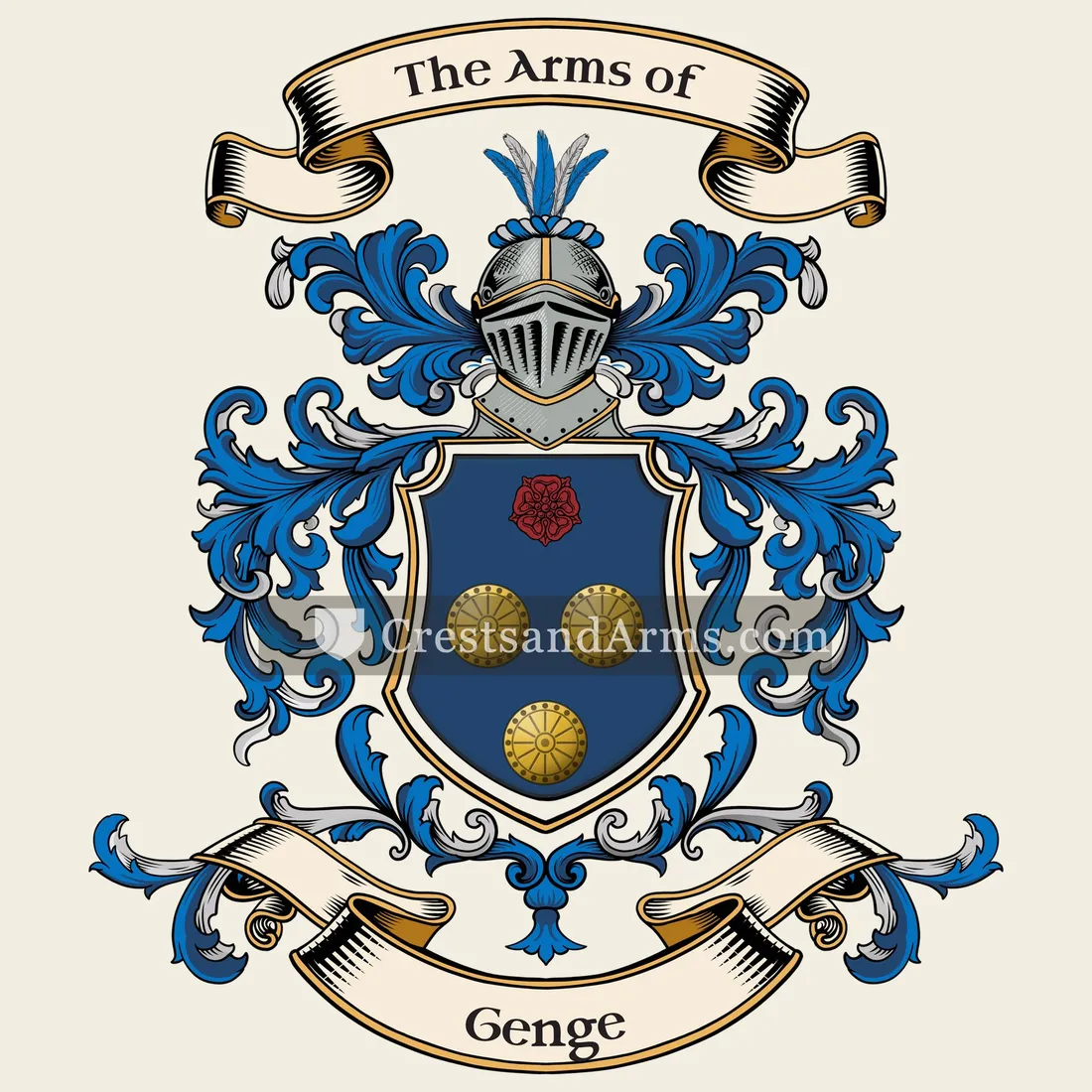
A record of documented arms, meaning and origin, researched for the Genge family of Denmark.
Reg. 6091 · Danish, G–I
Meaning of the Genge family crest colors & symbols
Symbols on this shield
roseThe seventh son, and beauty with grace
roundelA coin, and one who has been to the crusades
Colours
Blue (Azure)Means: Loyalty and truth
Red (Gules)Means: Military strength
Gold (Or)Means: Generosity
Historical info
Source
J. B. Rietstap, Armorial Général, Gouda: G. B. van Goor Zonen, 1884–87
Blazon (the actual original written record)
“D'azur à deux mousquets d'arg., passés en saut., acc. en chef d'une rose de gu. et aux flancs et en p. d'une boule d'or. C.: un mousquetaire iss., tenant son mousquet.”
Denmarkc. 1722
Digital archive packCoat of arms PNG, gold border print PDF, vector SVG and the certificate of authenticity. Sent to your email in minutes.
Map of Denmark showing where the Genge arms are recorded
The Genge arms were recorded in Denmark, c. 1722.
Arms such as these were typically recorded in Sjaælland.
Zealand held the Danish court, the crown's offices and Copenhagen itself. Families who served the king kept estates within reach of it, and royal service was the ordinary route to a coat of arms.
This is where the arms were entered in the register. Families often moved to other parts of the country, so the same name can turn up in more than one region.
The body that granted and recorded arms in Denmark in this period.
Frederik IV of Denmark
Sovereign of the period
Frederik IV of Denmark
1699–1730
Reigning in Denmark when the Genge arms are first recorded.
How Arms Worked in Denmark
Danish heraldry during this period was closely tied to noble status and royal favor rather than being open to all citizens. Arms were typically granted by the monarch to individuals, and these symbols were then shared by all members of the noble house. If a family line died out, the right to use those specific arms ended with them.
Granting authority
The Danish royal chancery held the power to issue and regulate official coats of arms for the kingdom.
How they got arms
Families usually received their arms through a formal royal grant that confirmed their noble status and rights.
Where arms were recorded
These grants were officially recorded in the Danish Royal Chancery records starting in the sixteenth century.
The family's standing
Recorded among the armigerous families of Denmark.
Origin & History of the Genge Family in Denmark
The family name Genge has deep roots in the island of Sjælland, where records confirm members of the family were living as early as 1722. During the eighteenth century, Denmark followed a system where surnames were often based on a father’s first name, but families living in specific rural parishes often began to adopt stable, inherited names to distinguish themselves from neighbors. The Genge name likely emerged during this period of transition as the family established a presence in the local agricultural community. Life in Sjælland at that time centered around small village clusters and manorial estates, where families often stayed on the same land for generations. By settling in this region, the early Genge ancestors became part of the long history of Danish rural life, contributing to the local economy and the social fabric of their parish.
Genge Meaning & Related Branches
Root word
Geng
A Germanic term referring to a person who goes or walks.
This name
GengeA topographic or occupational name for a traveler, wanderer, or frequent walker.
also spelled
Ginge
Yunge
Documented Sources
J. B. Rietstap, Armorial Général, Gouda: G. B. van Goor Zonen, 1884–87
Rigsarkivet (Danish National Archives), Kirkebøger for Sjællands Stift (Parish registers for the Diocese of Sjælland)
Rigsarkivet (Danish National Archives), Folketællinger (Census records)
Hansen, J. V., Danske slægtsnavne: Deres oprindelse og udbredelse, 1984
Jensen, K. E., Landboliv på Sjælland i det 18. århundrede, 1992
Digital archive packCoat of arms PNG, gold border print PDF, vector SVG and the certificate of authenticity. Sent to your email in minutes.


 roseThe seventh son, and beauty with grace
 roundelA coin, and one who has been to the crusades
 roseThe seventh son, and beauty with grace
 roundelA coin, and one who has been to the crusades