Map of France showing where the Genton arms are recorded
The Genton arms were recorded in Dauphine, c. 1663.
Dauphine lay in the mountains of south-eastern France, a country of small estates and scattered valleys. Its gentry were many and mostly modest, and even a small landholding was enough to justify arms.
This is where the arms were entered in the register. Families often moved to other parts of the country, so the same name can turn up in more than one region.
The body that granted and recorded arms in France in this period.
Louis XIV of France
Sovereign of the period
Louis XIV of France
1643–1715
Reigning in France when the Genton arms are first recorded.
How Arms Worked in France
In France, a coat of arms was a mark of honor that passed down through the male line to all legitimate descendants. Families often used the same shield without changes to show their shared heritage. If a branch wanted to stand out, they could add a small mark to their shield to show their specific place in the family tree.
Granting authority
The Juge d'armes de France acted as the official authority that regulated and verified coats of arms across the country.
How they got arms
Families typically inherited their arms from ancestors, though they could also receive them through royal grants or by proving their noble status.
Where arms were recorded
Coats of arms were officially recorded in the Armorial Général de France, which began its main collection in the year 1696.
The family's standing
Recorded among the armigerous families of Dauphine.
Origin & History of the Genton Family in France
The family name Genton is deeply rooted in the historical region of Dauphiné, a mountainous area in southeastern France that served as a vital crossroads between the Alps and the Rhône Valley. By the mid-seventeenth century, records confirm that the Genton family was well-established within this territory, living amidst a society shaped by complex feudal traditions and the influence of the local nobility. During this period, the people of Dauphiné were known for their resilience and their role in regional governance, often serving as local officials or landowners who helped manage the rugged landscape. The name itself likely evolved from older linguistic roots common to the region, reflecting the way families were identified by their neighbors or their specific place of residence. As the family grew, they became part of the social fabric of the province, navigating the transition from the late Renaissance into the era of absolute monarchy that defined the reign of Louis XIV. Their presence in 1663 marks them as a family that had already put down deep roots in the French countryside, contributing to the local culture and economy long before the modern era.
Coat of Arms & Family Crest Details
Symbols on this shield
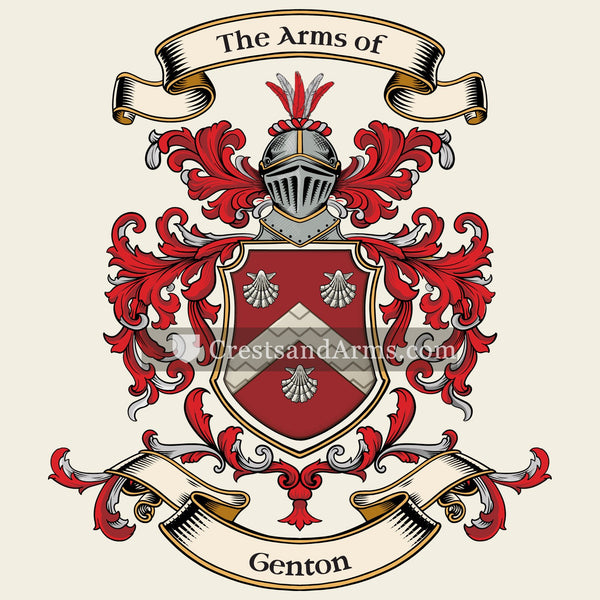
chevronProtection, and faithful service completed
escallopThe pilgrim's shell, and a long journey made
Colours
Red (Gules)Means: Military strength
Silver (Argent)Means: Peace and sincerity
Historical info
Source
Sir Bernard Burke, The General Armory of England, Scotland, Ireland and Wales, London: Harrison & Sons, 1884
Blazon (the actual original written record)
“Gu. a chev. betw. three escallops ar”
CumberlandCumberland, c. 1620
Digital archive packCoat of arms PNG, gold border print PDF, vector SVG and the certificate of authenticity. Sent to your email in minutes.
Map of England showing where the Genton arms are recorded
The Genton arms were recorded in Cumberland, c. 1620.
Cumberland was rough border country in the north-west, facing Scotland across a disputed line. Its families held land in return for keeping it defended, and men who fought carried shields of their own.
This is where the arms were entered in the register. Families often moved to other parts of the country, so the same name can turn up in more than one region.
The body that granted and recorded arms in England in this period.
James VI and I
Sovereign of the period
James VI and I
1603–1625
Reigning in France when the Genton arms are first recorded.
How Arms Worked in England
English heraldry allowed arms to be shared by all legitimate descendants of the original owner. These symbols were treated as personal property that moved through the generations to all children. While the eldest son kept the original design, other family members could use the same shield without needing to change it or register their own unique versions.
Granting authority
The College of Arms in London has regulated the use of coats of arms throughout England and Wales since 1484.
How they got arms
Families typically obtained their coats of arms through a formal grant from the Crown or by proving their ancient right to them.
Where arms were recorded
All official coats of arms are recorded in the registers kept at the College of Arms, which date back to the fifteenth century.
The family's standing
Recorded among the armigerous families of Cumberland.
Origin & History of the Genton Family in England
The history of the Genton family in England is deeply rooted in the rugged landscape of the northern borderlands. By the year 1620, records confirm that members of the family were firmly established in the county of Cumberland. This region was historically defined by its proximity to Scotland and a culture shaped by the constant movement of people across the border. Families living in Cumberland during the early seventeenth century often worked as small-scale farmers or laborers who navigated the challenges of a harsh climate and a changing political landscape. While the name Genton is not as common as others, its presence in these northern parishes suggests that the family was part of the local community for generations. They likely lived in small villages where they contributed to the agricultural life of the region, leaving behind a quiet but enduring legacy in the historical records of the north.
Genton Meaning & Related Branches
Root word
Gent
Derived from the Latin word gentilis meaning of a noble family.
This name
GentonA topographic or habitational name referring to someone from the city of Ghent.
also spelled
Jenton
Gentone
Gentonnet
Gentoun
Genten
Documented Sources
J. B. Rietstap, Armorial Général, Gouda: G. B. van Goor Zonen, 1884–87
Archives Départementales de l’Isère, Collection des registres paroissiaux de l’ancien diocèse de Grenoble, 1663
Borel d'Hauterive, André, Annuaire de la noblesse de France et des maisons souveraines de l'Europe, 1855
Chorier, Nicolas, Histoire générale de Dauphiné, 1661
Digital archive packCoat of arms PNG, gold border print PDF, vector SVG and the certificate of authenticity. Sent to your email in minutes.


 bendDefence, and the scarf of a commander
 wingSwiftness, and protection under a raised wing
 bendDefence, and the scarf of a commander
 wingSwiftness, and protection under a raised wing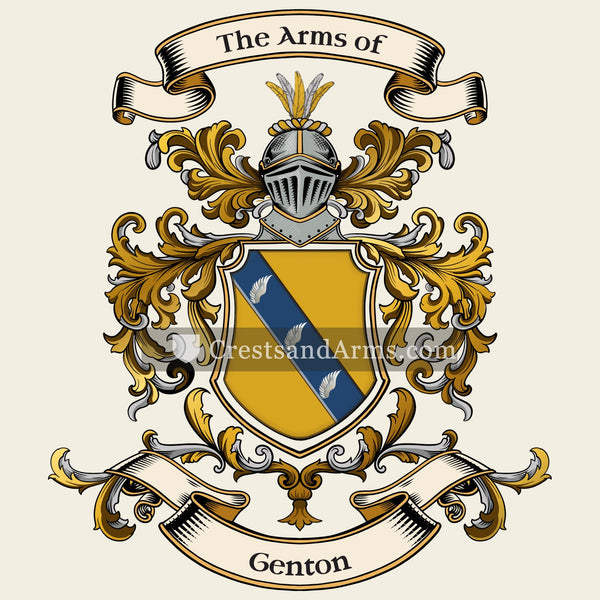


 chevronProtection, and faithful service completed
 escallopThe pilgrim's shell, and a long journey made