A record of documented arms, meaning and origin, researched for the Genus family lines. Documented in 2 countries.
Reg. 8250 · Polish, G–I
Coat of Arms & Family Crest Details
Symbols on this shield
mountThe ground held, and steadfastness upon it
duckResourcefulness on land and water
Colours
Blue (Azure)Means: Loyalty and truth
Green (Vert)Means: Hope
Silver (Argent)Means: Peace and sincerity
Historical info
Source
J. B. Rietstap, Armorial Général, Gouda: G. B. van Goor Zonen, 1884–87
Blazon (the actual original written record)
“D'azur à une oie d'arg., sur une terrasse de sin. Cq. cour. C.: cinq pl. d'aut - Ou: De gu. à un canard nageant dans une eau, le tout au nat. Cq. cour. C.: trois pl. d'aut.”
Polandc. 1772
Digital archive packCoat of arms PNG, gold border print PDF, vector SVG and the certificate of authenticity. Sent to your email in minutes.
Map of Poland showing where the Genus arms are recorded
The Genus arms were recorded in Poland, c. 1772.
Arms such as these were typically recorded in Mazovia.
Mazovia held Warsaw, the Polish court and the assemblies where the szlachta met. Poland's nobles were unusually numerous and every one of them bore arms, and Warsaw is where those arms were argued over and recorded.
This is where the arms were entered in the register. Families often moved to other parts of the country, so the same name can turn up in more than one region.
Region
Mazovia
First recorded
1772
Granting Authority for the Genus Arms
Ennoblement by the Sejm
Author: Olek Remesz · CC BY-SA 3.0
The body that granted and recorded arms in Poland in this period.
Stanisław August Poniatowski
Sovereign of the period
Stanisław August Poniatowski
1764–1795
Reigning in Poland when the Genus arms are first recorded.
How Arms Worked in Poland
Polish noble families shared a single coat of arms across many different surnames, creating large clans rather than individual designs. These symbols were held collectively by all members of the clan regardless of their specific family name. When a new family joined the nobility, they were adopted into an existing clan and began using that group's established shield.
Granting authority
The Sejm, which was the Polish parliament, held the power to grant noble status and the right to bear arms.
How they got arms
Families typically received their coat of arms through a formal act of ennoblement granted by the Sejm for distinguished service.
Where arms were recorded
These grants were officially recorded in the Crown Metrica, which served as the central archive for state documents starting in the sixteenth century.
The family's standing
Recorded among the armigerous families of Poland.
Origin & History of the Genus Family in Poland
The history of the Genus family in Poland is deeply rooted in the historical region of Mazovia, where records confirm their presence by 1772. During the late eighteenth century, Mazovia was a landscape defined by its agricultural traditions and a complex social structure that placed great value on land ownership and local community ties. Families like the Genus line often lived in rural parishes where they contributed to the local economy and maintained close connections to the land. Because the name Genus is relatively rare, it is likely that early family members were part of a tight-knit network of settlers who navigated the political shifts of the Polish-Lithuanian Commonwealth. As the region faced significant changes during the partitions of Poland, the family remained part of the local fabric, enduring the challenges of the era while preserving their identity within the Mazovian heartland.
Coat of Arms & Family Crest Details
Symbols on this shield
cantonA mark of honour granted by the sovereign
bordureA difference between branches of one family
fleur de lisPurity, light, and the sixth son
martletA younger son, who must win his own land
Colours
Gold (Or)Means: Generosity
Black (Sable)Means: Constancy
Silver (Argent)Means: Peace and sincerity
Historical info
Source
Sir Bernard Burke, The General Armory of England, Scotland, Ireland and Wales, London: Harrison & Sons, 1884
Blazon (the actual original written record)
“Or, three fleurs-de-lis sa. on a canton of the last three martlets ar. a border of the first”
EnglandAntwerp, c. 1568
Digital archive packCoat of arms PNG, gold border print PDF, vector SVG and the certificate of authenticity. Sent to your email in minutes.
Map of England showing where the Genus arms are recorded
The Genus arms were recorded in Antwerp, c. 1568.
Arms such as these were typically recorded in York.
Yorkshire is the largest of the English counties, and it held more gentry families than any other. Land there was split among a great many households rather than a few, so a great many of them carried arms.
This is where the arms were entered in the register. Families often moved to other parts of the country, so the same name can turn up in more than one region.
The body that granted and recorded arms in England in this period.
Elizabeth I of England
Sovereign of the period
Elizabeth I of England
1558–1603
Reigning in Poland when the Genus arms are first recorded.
How Arms Worked in England
English heraldry allowed arms to be shared by all legitimate descendants of the original owner. These symbols were treated as personal property that moved through the generations to all children. While the eldest son kept the original design, other family members could use the same shield without needing to change it or register their own unique versions.
Granting authority
The College of Arms in London has regulated the use of coats of arms throughout England and Wales since 1484.
How they got arms
Families typically obtained their coats of arms through a formal grant from the Crown or by proving their ancient right to them.
Where arms were recorded
All official coats of arms are recorded in the registers kept at the College of Arms, which date back to the fifteenth century.
The family's standing
Recorded among the armigerous families of England.
Origin & History of the Genus Family in England
The history of the Genus family in England begins in the historic city of York, where records confirm their presence as early as 1568. During the sixteenth century, York was a bustling center for trade and religious life, and families like the Genuses often lived near the city’s ancient stone walls or within the shadow of the great cathedral. At this time, the English language was undergoing significant changes, and surnames were becoming more permanent as the government kept better track of local residents for tax and legal purposes. Members of the Genus family likely worked in the local wool or leather industries, which were the backbone of the York economy during the Elizabethan era. By settling in such a prominent northern city, the family became part of the long and complex story of England’s urban development. Their early residence in York suggests they were established citizens who contributed to the daily life and growth of one of the most important cities in the north of England.
Related Branches & Arms
Root word
genus
Latin term meaning birth, descent, origin, or race.
This name
GenusRefers to a person of noble birth, lineage, or specific ancestral origin.
also spelled
Gens-de
Gens-von
Gense
Genz
Documented Sources
J. B. Rietstap, Armorial Général, Gouda: G. B. van Goor Zonen, 1884–87
Archiwum Główne Akt Dawnych (AGAD), Księgi metrykalne parafii rzymskokatolickich z terenu Mazowsza
Guldon, Zenon, Osadnictwo i demografia Mazowsza w XVIII wieku, 1990
Kuklo, Cezary, Demografia Rzeczypospolitej przedrozbiorowej, 2009
Digital archive packCoat of arms PNG, gold border print PDF, vector SVG and the certificate of authenticity. Sent to your email in minutes.


 mountThe ground held, and steadfastness upon it
 duckResourcefulness on land and water
 mountThe ground held, and steadfastness upon it
 duckResourcefulness on land and water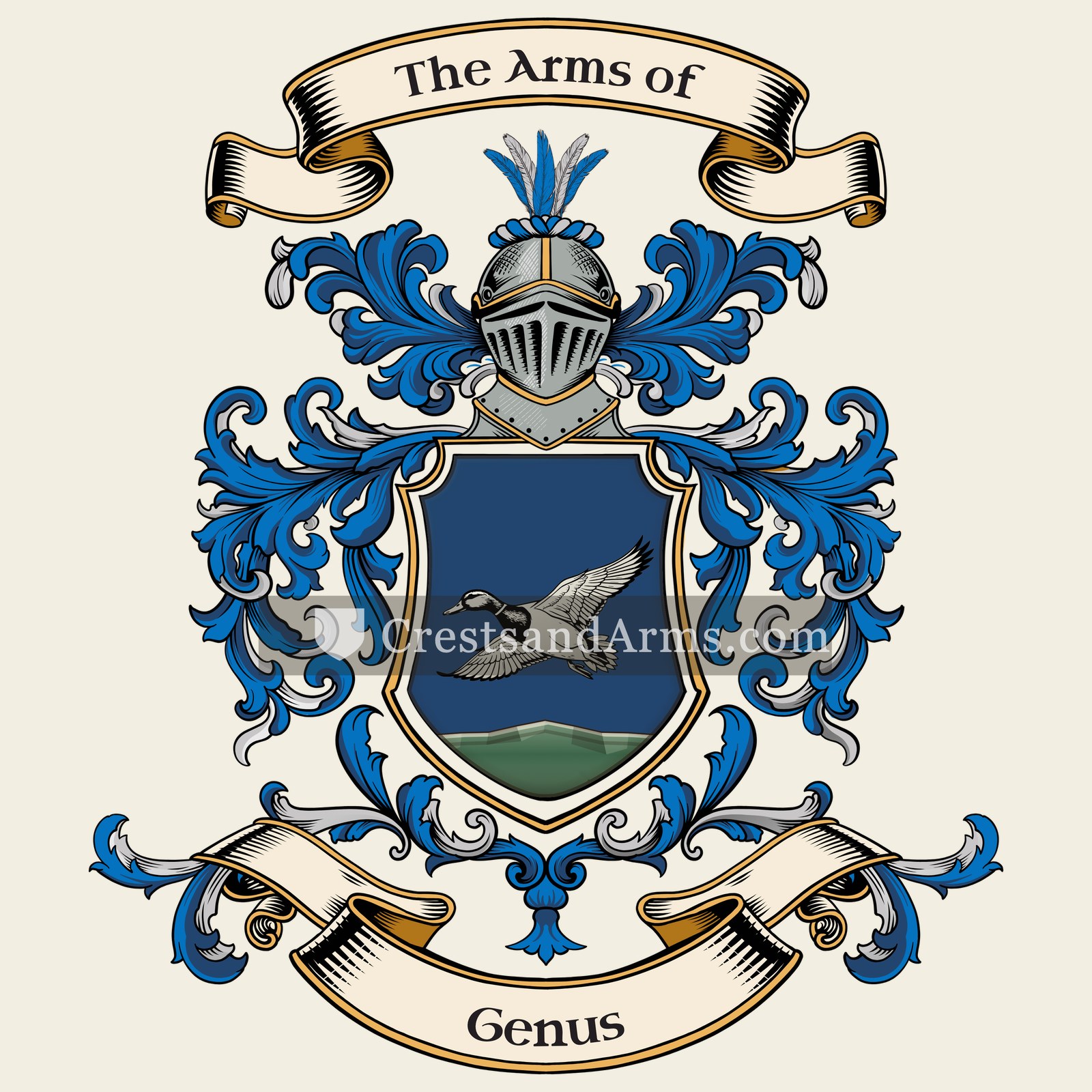


 cantonA mark of honour granted by the sovereign
 bordureA difference between branches of one family
 fleur de lisPurity, light, and the sixth son
 martletA younger son, who must win his own land