A record of documented arms, meaning and origin, researched for the Gerace family lines. Documented in 3 countries.
Reg. 4017 · French, G–I
Meaning of the Gerace family crest colors & symbols
Symbols on this shield
lionCourage, strength and royalty
Colours
Red (Gules)Means: Military strength
Gold (Or)Means: Generosity
Silver (Argent)Means: Peace and sincerity
Historical info
Source
J. B. Rietstap, Armorial Général, Gouda: G. B. van Goor Zonen, 1884–87
Blazon (the actual original written record)
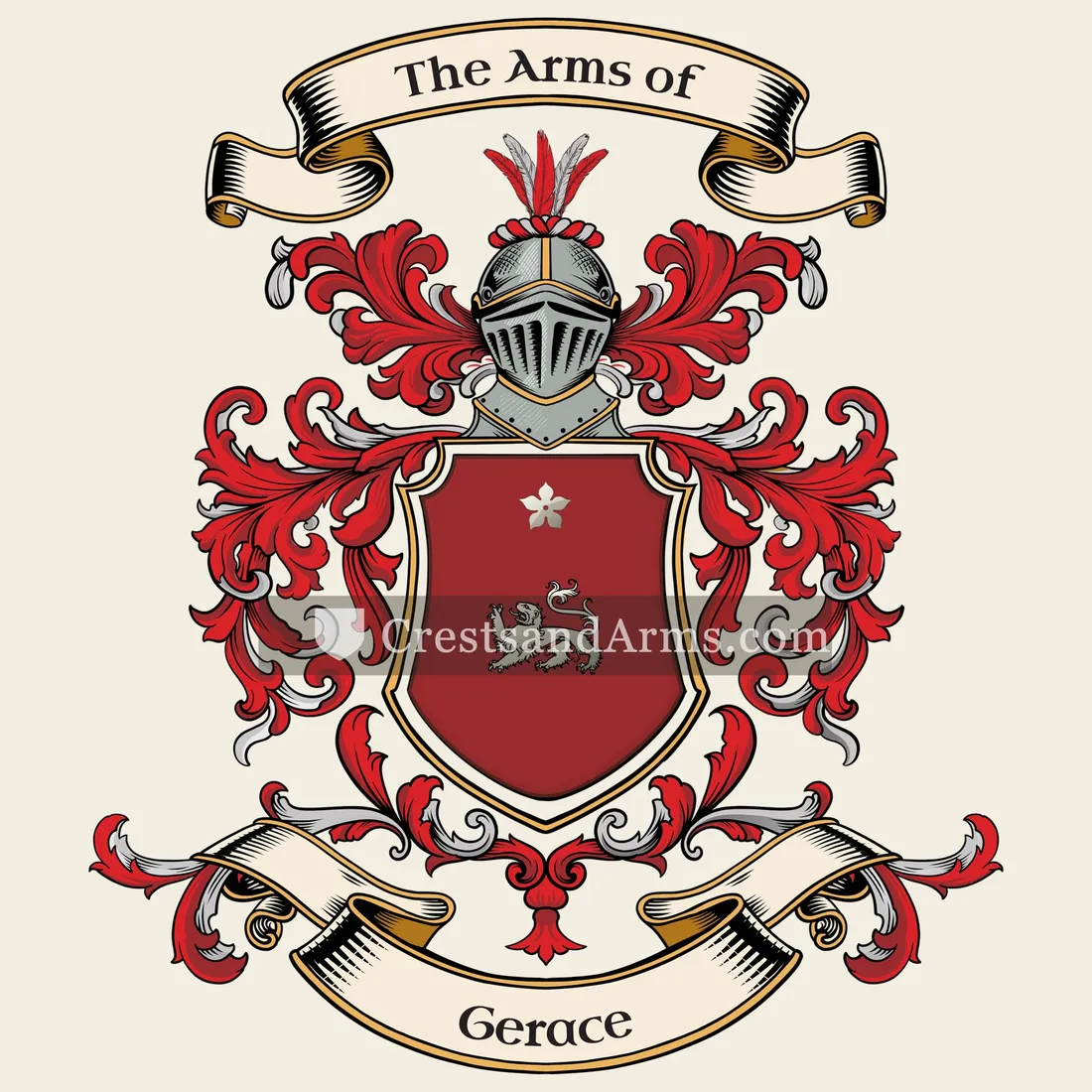
“De gu. au lion coupé d'arg. sur or. C.: un lion iss. d'arg. S.: à dextre un lion au nat.; à sen. un sanglier d'or. D.: 1° EN GRÂCE AFFIE; 2° CONCORDANT NOMINE FACTA.”
Francec. 1764
Digital archive packCoat of arms PNG, gold border print PDF, vector SVG and the certificate of authenticity. Sent to your email in minutes.
Map of France showing where the Gerace arms are recorded
The Gerace arms were recorded in France, c. 1764.
Arms such as these were typically recorded in Bretagne.
More families held coats of arms in Bretagne than anywhere else in France. The land was divided into many small estates rather than a few large ones, so far more households counted as gentry, and each needed a shield of its own to be told apart.
This is where the arms were entered in the register. Families often moved to other parts of the country, so the same name can turn up in more than one region.
The body that granted and recorded arms in France in this period.
Louis XV of France
Sovereign of the period
Louis XV of France
1715–1774
Reigning in France when the Gerace arms are first recorded.
How Arms Worked in France
In France, a coat of arms was a mark of honor that passed down through the male line to all legitimate descendants. Families often used the same shield without changes to show their shared heritage. If a branch wanted to stand out, they could add a small mark to their shield to show their specific place in the family tree.
Granting authority
The Juge d'armes de France acted as the official authority that regulated and verified coats of arms across the country.
How they got arms
Families typically inherited their arms from ancestors, though they could also receive them through royal grants or by proving their noble status.
Where arms were recorded
Coats of arms were officially recorded in the Armorial Général de France, which began its main collection in the year 1696.
The family's standing
Recorded among the armigerous families of France.
Origin & History of the Gerace Family in France
The history of the Gerace family in France is deeply tied to the coastal region of Bretagne, where records confirm their presence by 1764. During this period, families in the Breton countryside were often defined by their connection to the land and the local parish communities. The name itself suggests a connection to the Mediterranean, likely originating from the town of Gerace in the Calabria region of Italy. It is probable that ancestors migrated northward through Europe, eventually settling in the rugged landscape of western France. By the mid-18th century, these individuals had integrated into the social fabric of their new home, participating in the agricultural and maritime traditions that characterized life in Bretagne. Their transition from southern origins to the northern coast reflects the broader patterns of movement and cultural exchange that shaped French society before the revolution.
Meaning of the Gerace family crest colors & symbols
Symbols on this shield
lionCourage, strength and royalty
Colours
Red (Gules)Means: Military strength
Silver (Argent)Means: Peace and sincerity
Historical info
Source
Sir Bernard Burke, The General Armory of England, Scotland, Ireland and Wales, London: Harrison & Sons, 1884
Blazon (the actual original written record)
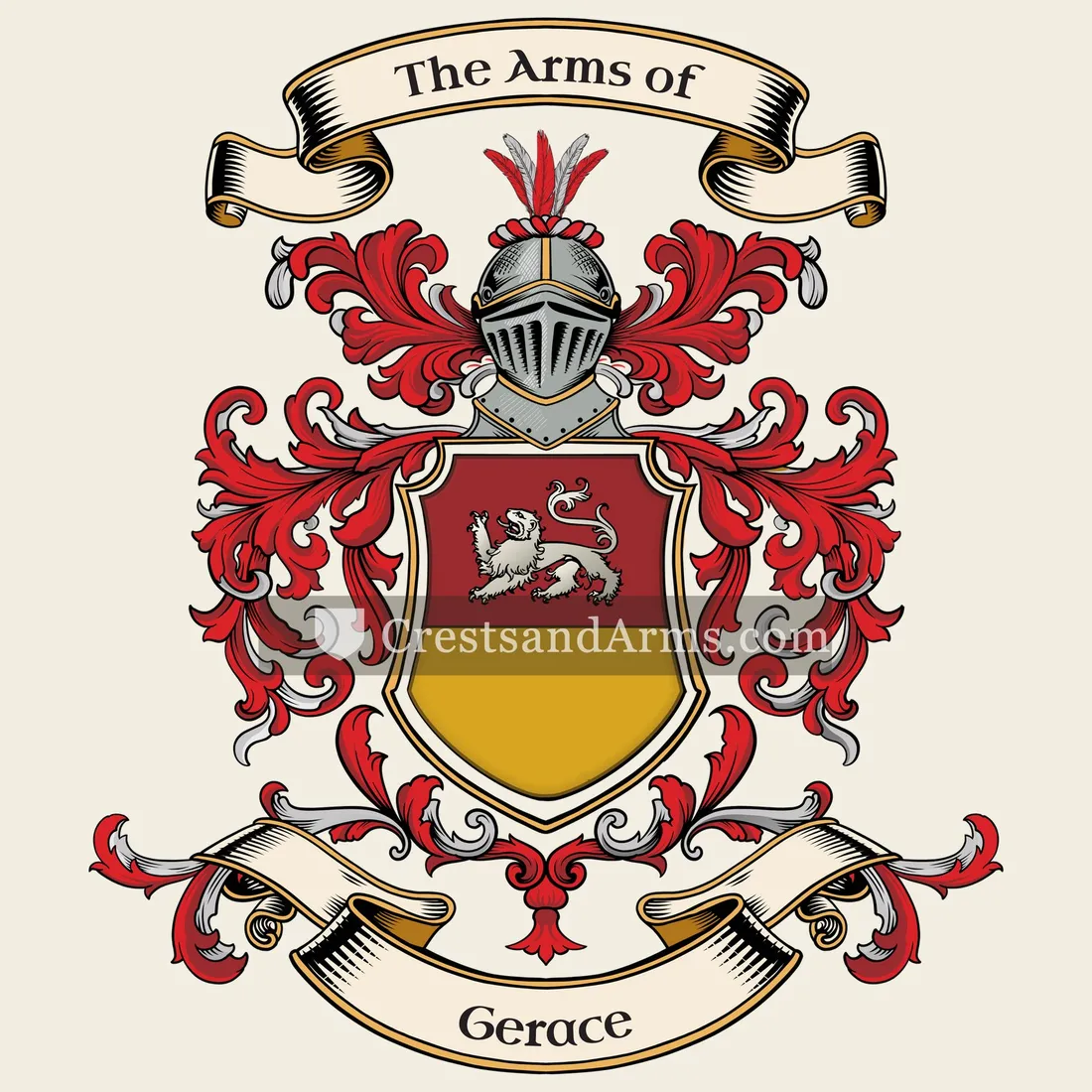
“Gu. a lion ramp. per fesse ar. and or”
KilkennyBarons · Kilkenny, c. 1645
Digital archive packCoat of arms PNG, gold border print PDF, vector SVG and the certificate of authenticity. Sent to your email in minutes.
Map of Ireland showing where the Gerace arms are recorded
The Gerace arms were recorded in Kilkenny, c. 1645.
Kilkenny was rich farming country in south-eastern Ireland, held by Norman families who settled early and stayed. Long holding of good land is exactly what puts a name into the heraldic records.
This is where the arms were entered in the register. Families often moved to other parts of the country, so the same name can turn up in more than one region.
The body that granted and recorded arms in Ireland in this period.
Charles I of England
Sovereign of the period
Charles I of England
1625–1649
Reigning in France when the Gerace arms are first recorded.
How Arms Worked in Ireland
The Ulster King of Arms granted coats of arms to individuals who proved their social standing and good character. These symbols were typically inherited by all legitimate descendants of the original holder. If a family branch wanted a unique look, they could apply for a specific change to their design through the office to ensure their identity remained distinct.
Granting authority
The Ulster King of Arms acted as the official body that regulated and issued all coats of arms throughout Ireland.
How they got arms
Families obtained their arms through formal grants issued by the office after proving their eligibility and paying the required fees.
Where arms were recorded
All official grants were recorded in the registers held by the Ulster King of Arms starting from the year 1552.
The family's standing
Recorded among the armigerous families of Kilkenny.
Origin & History of the Gerace Family in Ireland
The family name Gerace is primarily associated with southern Italy, but historical records confirm that members of the family were established in County Kilkenny, Ireland, by 1645. During this period, Ireland was experiencing significant political upheaval due to the Irish Confederate Wars, which forced many families to navigate shifting loyalties and land ownership disputes. The presence of the Gerace name in Kilkenny suggests that these individuals were likely part of the broader movement of merchants, soldiers, or displaced continental Europeans who integrated into Irish society during the seventeenth century. While the name remains rare in Irish records, its appearance in the mid-1600s highlights the diverse origins of families living in the region during a time of intense social change. These early settlers likely adapted to the local customs and economic life of Kilkenny, embedding their lineage into the complex history of the Irish midlands.
Meaning of the Gerace family crest colors & symbols
Symbols on this shield
lionCourage, strength and royalty
cinquefoilHope and joy
Colours
Red (Gules)Means: Military strength
Silver (Argent)Means: Peace and sincerity
Historical info
Source
Sir Bernard Burke, The General Armory of England, Scotland, Ireland and Wales, London: Harrison & Sons, 1884
Blazon (the actual original written record)
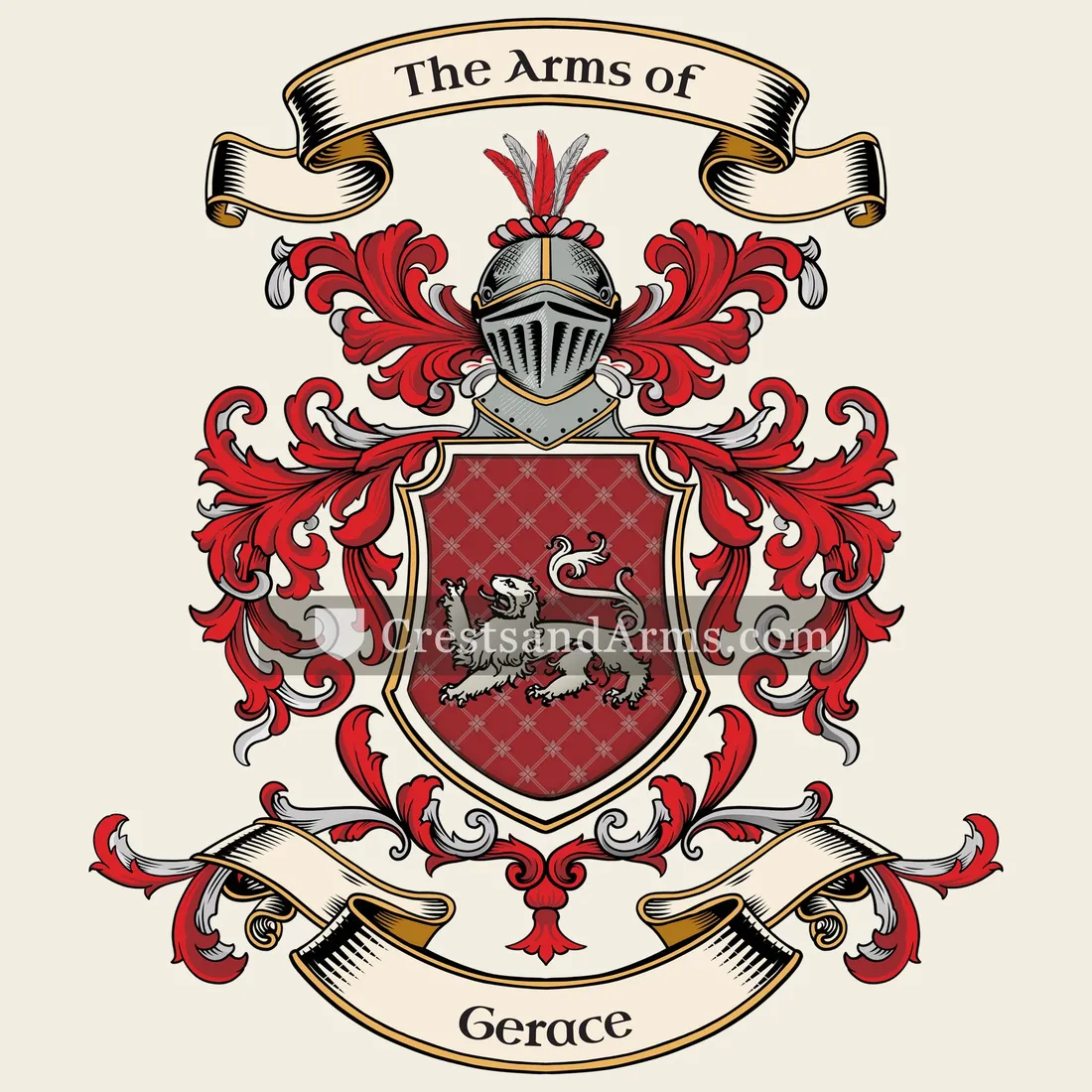
“Gu. semée of cinquefoils, a lion ramp. ar”
EnglandLondon, c. 1620
Digital archive packCoat of arms PNG, gold border print PDF, vector SVG and the certificate of authenticity. Sent to your email in minutes.
Map of England showing where the Gerace arms are recorded
The Gerace arms were recorded in London, c. 1620.
This is where the arms were entered in the register. Families often moved to other parts of the country, so the same name can turn up in more than one region.
The body that granted and recorded arms in England in this period.
James VI and I
Sovereign of the period
James VI and I
1603–1625
Reigning in France when the Gerace arms are first recorded.
How Arms Worked in England
English heraldry allowed arms to be shared by all legitimate descendants of the original owner. These symbols were treated as personal property that moved through the generations to all children. While the eldest son kept the original design, other family members could use the same shield without needing to change it or register their own unique versions.
Granting authority
The College of Arms in London has regulated the use of coats of arms throughout England and Wales since 1484.
How they got arms
Families typically obtained their coats of arms through a formal grant from the Crown or by proving their ancient right to them.
Where arms were recorded
All official coats of arms are recorded in the registers kept at the College of Arms, which date back to the fifteenth century.
The family's standing
Recorded among the armigerous families of England.
Origin & History of the Gerace Family in England
The family name Gerace carries a history that reflects the movement of people across Europe toward the bustling trade hubs of the seventeenth century. While the name possesses deep roots in the Mediterranean region, records confirm that members of the family were established in London by 1620. During this period, London was a rapidly expanding center for international commerce, attracting merchants and skilled laborers from across the continent who sought new opportunities in the capital. These early settlers likely integrated into the city’s diverse social fabric by participating in the local guilds or the growing mercantile networks that defined the era. By settling in London, the family became part of the wave of migration that helped shape the city into a global center for trade and cultural exchange. Their presence in the city during the early 1600s suggests they were part of a mobile class of people who navigated the complex political and economic landscapes of early modern Europe to build new lives in England.
Gerace Meaning & Related Branches
Root word
Hieracium
Derived from the Greek word for hawk.
This name
GeraceRefers to a person from the town of Gerace in Italy.
also spelled
Grase
Gracce
Gracie
Gracey
Documented Sources
J. B. Rietstap, Armorial Général, Gouda: G. B. van Goor Zonen, 1884–87
Archives départementales du Finistère, Registres paroissiaux et d'état civil, 1764
Le Moyne de La Borderie, Arthur, Histoire de Bretagne, 1896
Pitre-Chevalier, François, La Bretagne ancienne et moderne, 1844
Digital archive packCoat of arms PNG, gold border print PDF, vector SVG and the certificate of authenticity. Sent to your email in minutes.


 lionCourage, strength and royalty
 lionCourage, strength and royalty




 cinquefoilHope and joy