Map of Germany showing where the Gerde arms are recorded
The Gerde arms were recorded in Lubeck, c. 1765.
This is where the arms were entered in the register. Families often moved to other parts of the country, so the same name can turn up in more than one region.
The body that granted and recorded arms in Germany in this period.
Francis I, Holy Roman Emperor
Sovereign of the period
Francis I, Holy Roman Emperor
1745–1765
Reigning in Germany when the Gerde arms are first recorded.
How Arms Worked in Germany
In the Holy Roman Empire, coats of arms were often granted to individuals by the Emperor or his representatives. These arms were then passed down through the generations to all legitimate descendants of the original holder. Younger branches of a family usually kept the same shield design without needing to change it, as the arms belonged to the entire lineage.
Granting authority
The Holy Roman Emperor held the sole power to grant new coats of arms throughout his vast imperial territories.
How they got arms
Families typically obtained their coats of arms through a formal imperial grant or by proving their noble status to the authorities.
Where arms were recorded
These grants were officially recorded in the Imperial Chancery registers, which began keeping formal records of such honors during the Middle Ages.
The family's standing
Recorded among the armigerous families of Germany.
Origin & History of the Gerde Family in Germany
The family name Gerde has deep roots in the northern German region, with documented evidence placing members of the family in the historic Hanseatic city of Lübeck by 1765. During this period, Lübeck served as a major center for trade and maritime commerce, which likely influenced the lives and occupations of early family members. The name itself is thought to be derived from regional linguistic roots, potentially linked to the Low German word for a spear or a pointed tool, which was a common naming convention for people associated with craftsmanship or military service in the Middle Ages. As residents of a prominent merchant city, the early Gerde family would have lived through a time of significant economic transition as Lübeck maintained its status as a gateway to the Baltic Sea. By settling in such a well-recorded urban environment, the family became part of a long tradition of civic life that defined the social structure of Northern Germany during the eighteenth century.
Gerde Meaning & Related Branches
Root word
Gerhard
Derived from the Germanic elements for spear and hardy or brave.
This name
GerdeA patronymic form indicating a descendant of someone named Gerhard, meaning spear-brave.
also spelled
Gerdess
Gerde
Documented Sources
J. B. Rietstap, Armorial Général, Gouda: G. B. van Goor Zonen, 1884–87
Archiv der Hansestadt Lübeck, Bürgerbücher der Hansestadt Lübeck (1765)
Bahlow, Hans, Deutsches Namenlexikon: Familien- und Vornamen nach Ursprung und Sinn erklärt (1967)
Zoder, Rudolf, Familiennamen in Ostfalen (1968)
Digital archive packCoat of arms PNG, gold border print PDF, vector SVG and the certificate of authenticity. Sent to your email in minutes.


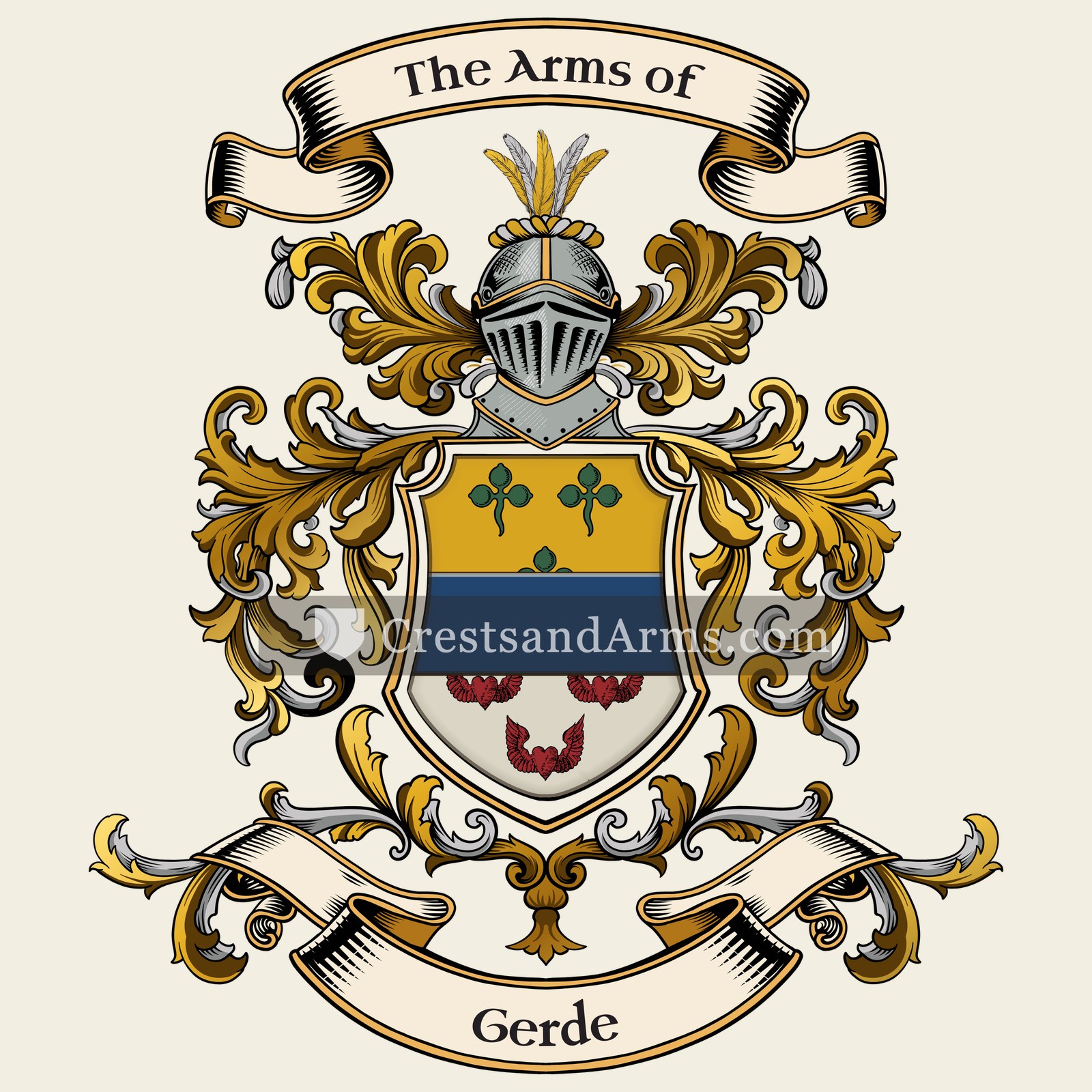
 fessThe military belt, and readiness to serve
 trefoilPerpetuity, and the Trinity
 heartSincerity, charity and true affection
 fessThe military belt, and readiness to serve
 trefoilPerpetuity, and the Trinity
 heartSincerity, charity and true affection