A record of documented arms, meaning and origin, researched for the Gerring family lines. Documented in 3 countries.
Reg. 1227 · German, G–I
Coat of Arms & Family Crest Details
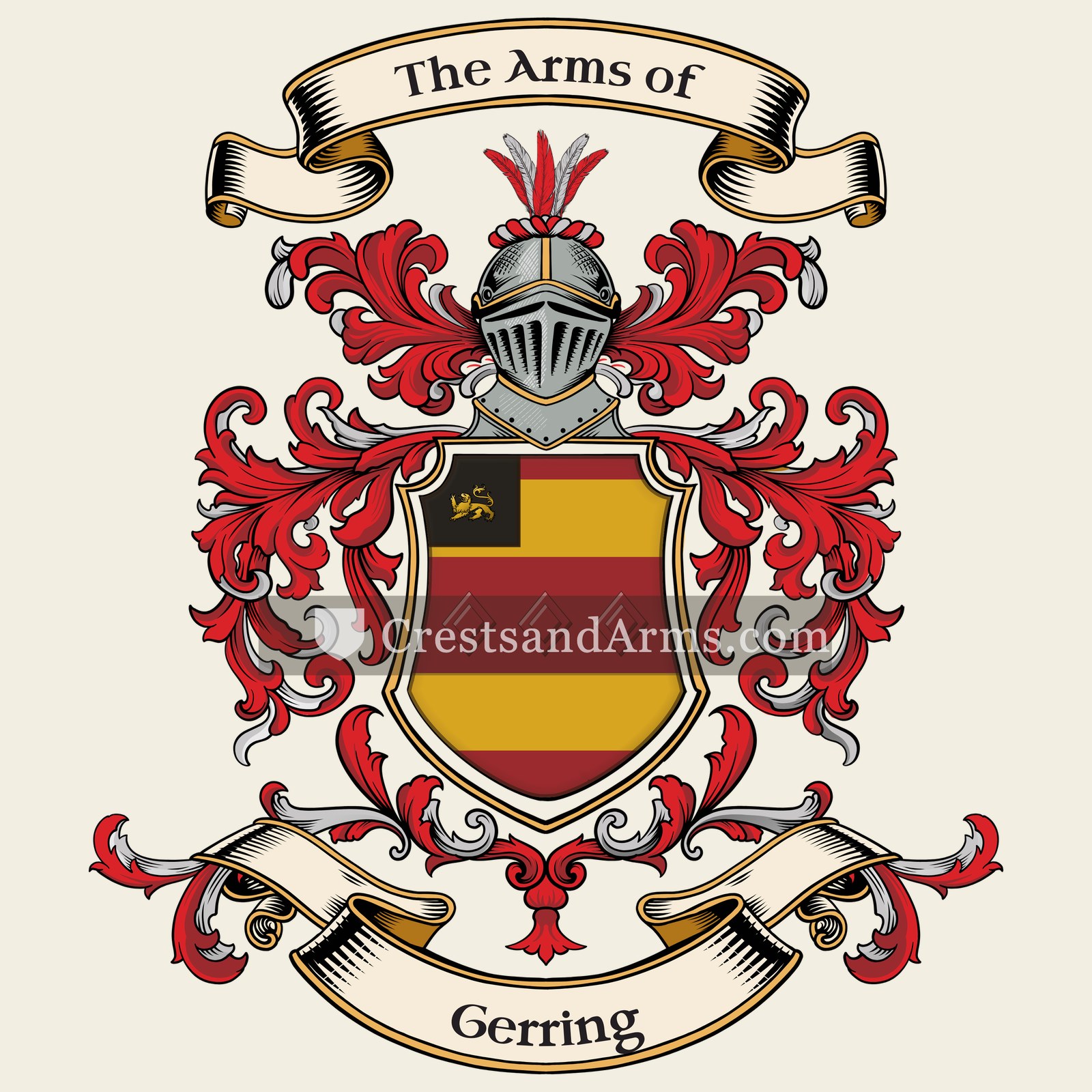
Symbols on this shield
knightChivalry and service in arms
Colours
Gold (Or)Means: Generosity
Black (Sable)Means: Constancy
Historical info
Source
J. B. Rietstap, Armorial Général, Gouda: G. B. van Goor Zonen, 1884–87
Blazon (the actual original written record)
“D'or à un homme iss., posé de profil, hab. de sa., coiffé d'un bonnet pointu du même, tenant une tige de trois roses de gu., feuillée de sin. C.: l'homme iss. L. d'or et de sa.”
GermanyNördlingen Bav, c. 1765
Digital archive packCoat of arms PNG, gold border print PDF, vector SVG and the certificate of authenticity. Sent to your email in minutes.
Map of Germany showing where the Gerring arms are recorded
The Gerring arms were recorded in Nördlingen Bav, c. 1765.
This is where the arms were entered in the register. Families often moved to other parts of the country, so the same name can turn up in more than one region.
The body that granted and recorded arms in Germany in this period.
Francis I, Holy Roman Emperor
Sovereign of the period
Francis I, Holy Roman Emperor
1745–1765
Reigning in Germany when the Gerring arms are first recorded.
How Arms Worked in Germany
In the Holy Roman Empire, coats of arms were often granted to individuals by the Emperor or his representatives. These arms were then passed down through the generations to all legitimate descendants of the original holder. Younger branches of a family usually kept the same shield design without needing to change it, as the arms belonged to the entire lineage.
Granting authority
The Holy Roman Emperor held the sole power to grant new coats of arms throughout his vast imperial territories.
How they got arms
Families typically obtained their coats of arms through a formal imperial grant or by proving their noble status to the authorities.
Where arms were recorded
These grants were officially recorded in the Imperial Chancery registers, which began keeping formal records of such honors during the Middle Ages.
The family's standing
Recorded among the armigerous families of Germany.
Origin & History of the Gerring Family in Germany
The name Gerring finds its roots in the southern German regions, where it evolved as a descriptive or occupational surname. By the mid-eighteenth century, historical records confirm that members of the Gerring family were established residents of Nördlingen. This city was a significant center of trade and craftsmanship during the Holy Roman Empire, providing a stable environment for families to settle and grow. The name likely stems from Middle High German linguistic patterns, where such identifiers were often linked to a person’s place of origin or a specific personal trait. Living in a walled city like Nördlingen suggests that these early ancestors were likely integrated into the local guild system or the urban merchant class, which defined the social and economic life of the region during the 1700s. As the family moved through these generations, they contributed to the local culture of Swabia, leaving behind a legacy tied to the development of this historic Bavarian town.
Coat of Arms & Family Crest Details
Symbols on this shield
mountThe ground held, and steadfastness upon it
Colours
Red (Gules)Means: Military strength
Gold (Or)Means: Generosity
Historical info
Source
J. B. Rietstap, Armorial Général, Gouda: G. B. van Goor Zonen, 1884–87
Blazon (the actual original written record)
“De gu. à trois socs de charrue d'arg., les pointes en bas, soutenus des trois coupeaux d'un tertre d'or.”
SwitzerlandBerne, c. 1745
Digital archive packCoat of arms PNG, gold border print PDF, vector SVG and the certificate of authenticity. Sent to your email in minutes.
Map of Switzerland showing where the Gerring arms are recorded
The Gerring arms were recorded in Berne, c. 1745.
This is where the arms were entered in the register. Families often moved to other parts of the country, so the same name can turn up in more than one region.
The body that granted and recorded arms in Switzerland in this period.
How Arms Worked in Switzerland
In Switzerland, coats of arms were not restricted to the nobility and were often adopted by common citizens and families. These symbols were passed down through generations to show family identity. When branches of a family grew, they often changed small details of the design to distinguish their own line from the original group.
Granting authority
Cantonal and civic authorities managed the use of coats of arms within their specific regions and local jurisdictions.
How they got arms
Families typically assumed their own coats of arms based on local custom rather than receiving them from a central monarch.
Where arms were recorded
Arms were recorded in various cantonal and civic registers starting from the fourteenth century throughout the Swiss region.
The family's standing
Recorded among the armigerous families of Switzerland.
Origin & History of the Gerring Family in Switzerland
The Gerring family name has deep roots in the Swiss canton of Berne, where records confirm their presence as early as 1745. During this period, the region was governed by a strict social structure that required families to hold official citizenship in specific towns to gain legal rights and property. Families like the Gerrings were often part of the local agrarian or artisan classes, contributing to the steady growth of the Swiss confederation through trade and community service. Life in eighteenth-century Berne was defined by the influence of the Reformed Church, which meticulously recorded births, marriages, and deaths in parish registers. These documents show that the Gerring name was tied to the local landscape and the evolving administrative systems of the Swiss cantons. By maintaining a consistent presence in Berne, the family became part of the long-standing demographic fabric that shaped the region before the major political shifts of the nineteenth century.
Coat of Arms & Family Crest Details
Symbols on this shield
cantonA mark of honour granted by the sovereign
masclePersuasion and the mail of a knight's coat
lionCourage, strength and royalty
Colours
Red (Gules)Means: Military strength
Gold (Or)Means: Generosity
Black (Sable)Means: Constancy
Historical info
Source
Sir Bernard Burke, The General Armory of England, Scotland, Ireland and Wales, London: Harrison & Sons, 1884
Blazon (the actual original written record)
“Gu. two bars or, each charged with three mascles of the field, on a canton sa. a leopard's face of the second”
LincolnWinterton · Lincoln, c. 1620
Digital archive packCoat of arms PNG, gold border print PDF, vector SVG and the certificate of authenticity. Sent to your email in minutes.
Map of England showing where the Gerring arms are recorded
The Gerring arms were recorded in Lincoln, c. 1620.
Lincolnshire was rich farming country, and its wealth was spread across many middling families. Households of that size bought land and took arms, and the county holds a large share of English names.
This is where the arms were entered in the register. Families often moved to other parts of the country, so the same name can turn up in more than one region.
The body that granted and recorded arms in England in this period.
James VI and I
Sovereign of the period
James VI and I
1603–1625
Reigning in Germany when the Gerring arms are first recorded.
How Arms Worked in England
English heraldry allowed arms to be shared by all legitimate descendants of the original owner. These symbols were treated as personal property that moved through the generations to all children. While the eldest son kept the original design, other family members could use the same shield without needing to change it or register their own unique versions.
Granting authority
The College of Arms in London has regulated the use of coats of arms throughout England and Wales since 1484.
How they got arms
Families typically obtained their coats of arms through a formal grant from the Crown or by proving their ancient right to them.
Where arms were recorded
All official coats of arms are recorded in the registers kept at the College of Arms, which date back to the fifteenth century.
The family's standing
Recorded among the armigerous families of Lincoln.
Origin & History of the Gerring Family in England
The family name Gerring has deep roots in the English landscape, with historical evidence placing members of the family in the city of Lincoln by the year 1620. During this period, the name likely emerged as a patronymic or a locational identifier, reflecting the way surnames were commonly adopted by families to distinguish themselves within growing urban centers. In the early seventeenth century, Lincoln served as a significant hub for trade and administration, which suggests that the Gerring family were likely engaged in the local commerce or craft industries that defined life in the East Midlands. As the family established their presence in this historic cathedral city, they became part of the social fabric of England during a time of great transition. Their early residence in Lincoln indicates that they were settled members of the community, contributing to the local economy and the evolving identity of the region long before the name spread to other parts of the country.
Related Branches & Arms
Root word
Ger
Old High German word meaning spear or lance.
This name
GerringA patronymic surname derived from a spear-wielder or a warrior.
also spelled
Geringe
Geringh
Geryng
Documented Sources
J. B. Rietstap, Armorial Général, Gouda: G. B. van Goor Zonen, 1884–87
Stadtarchiv Nördlingen, Bürgerbuch der Stadt Nördlingen, 1765
Bahlow, Hans, Deutsches Namenlexikon: Familien- und Vornamen nach Ursprung und Sinn erklärt, 1972
Kohlheim, Rosa and Volker, Duden Familiennamen: Herkunft und Bedeutung von 20.000 Nachnamen, 2005
Digital archive packCoat of arms PNG, gold border print PDF, vector SVG and the certificate of authenticity. Sent to your email in minutes.


 knightChivalry and service in arms
 knightChivalry and service in arms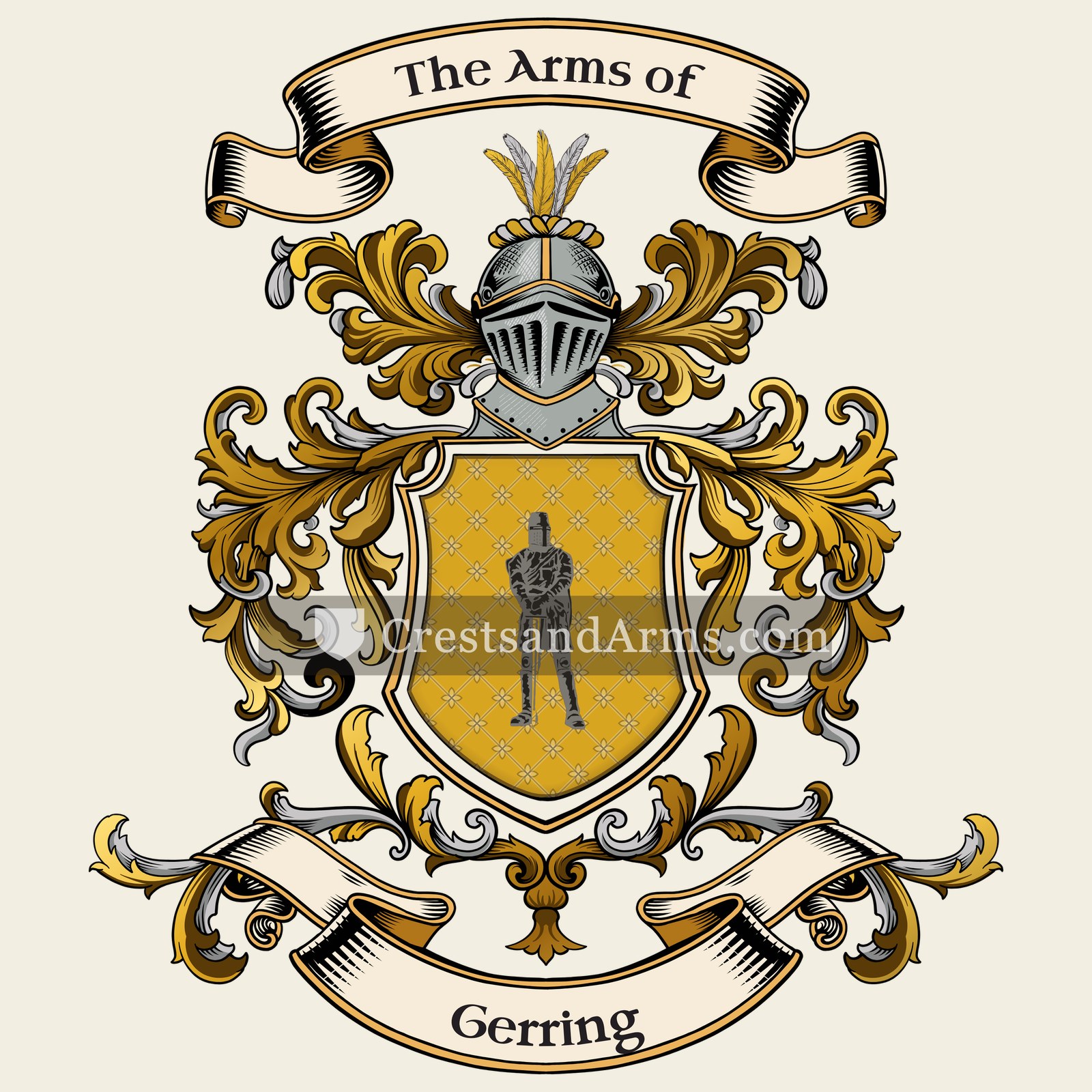


 mountThe ground held, and steadfastness upon it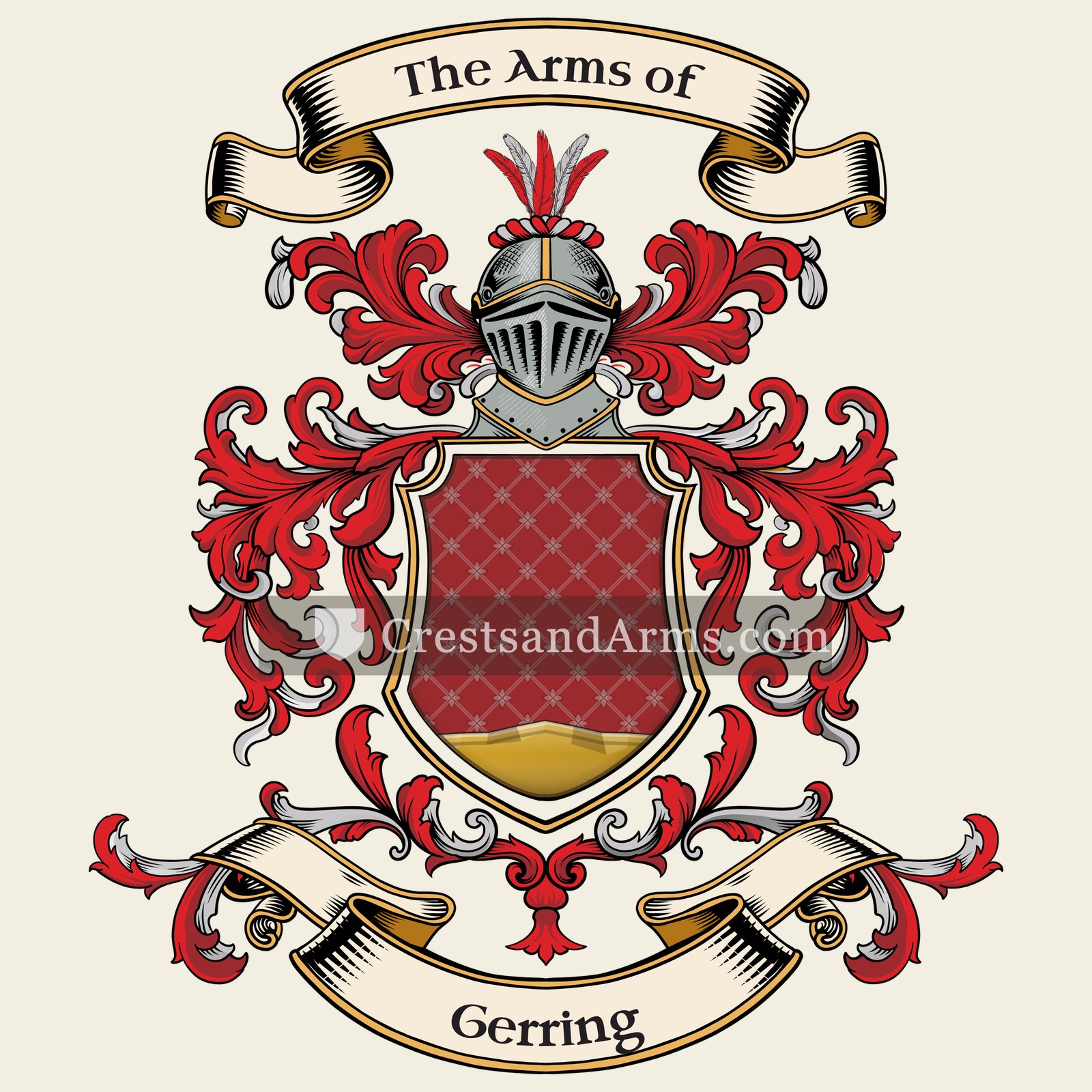

 cantonA mark of honour granted by the sovereign
 masclePersuasion and the mail of a knight's coat
 lionCourage, strength and royalty