A record of documented arms, meaning and origin, researched for the Gerstner family lines. Documented in 2 countries.
Reg. 0857 · Austrian, G–I
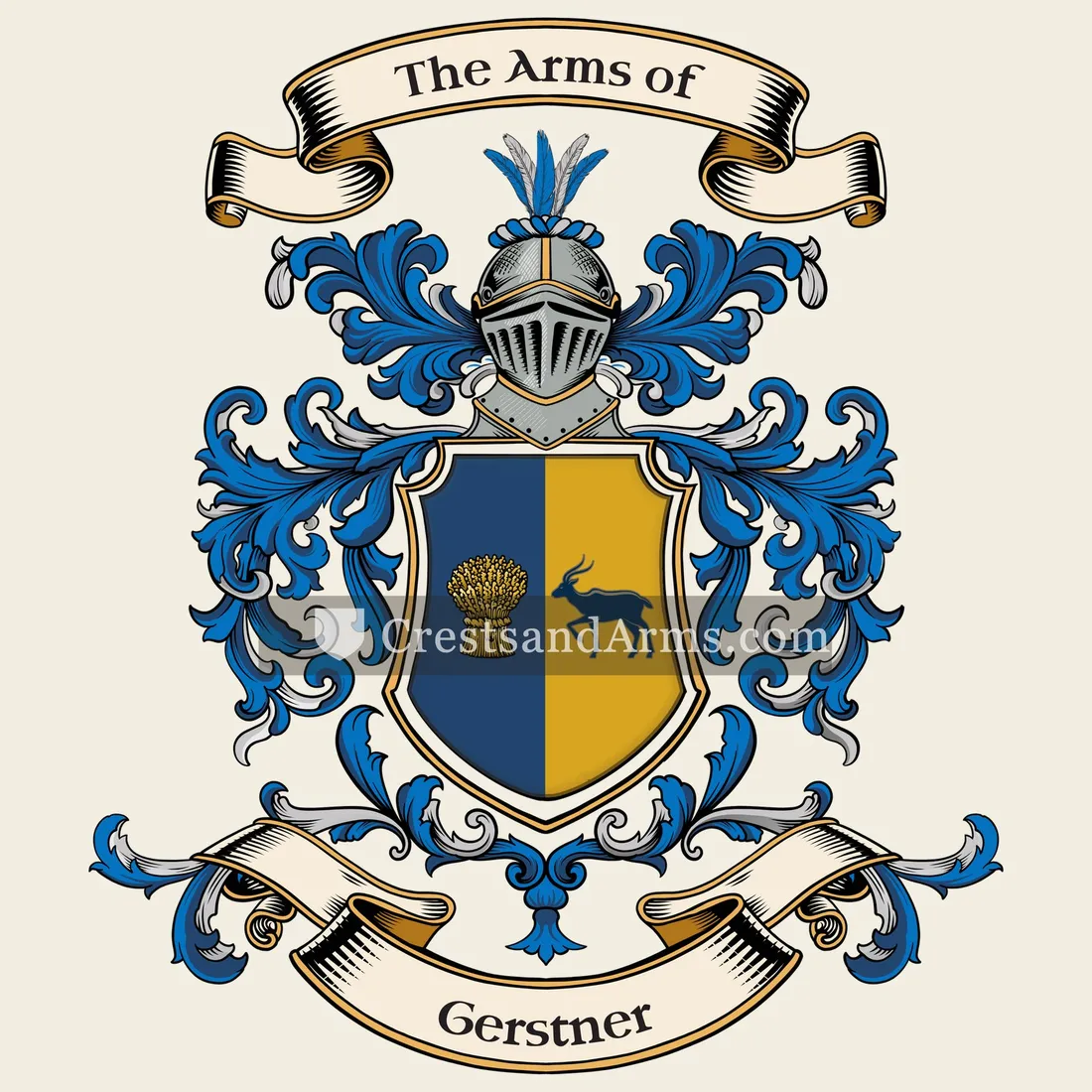
Meaning of the Gerstner family crest colors & symbols
Symbols on this shield
wheatsheafPlenty, and the harvest of one's own labour
antelopeHarmony, polity and peace
Colours
Blue (Azure)Means: Loyalty and truth
Gold (Or)Means: Generosity
Historical info
Source
J. B. Rietstap, Armorial Général, Gouda: G. B. van Goor Zonen, 1884–87
Blazon (the actual original written record)
“Parti: au 1 d'azur à une gerbe d'or; au 2 d'or à un chamois ramp. au nat. C.: le chamois, iss.; entre deux prob., d'azur et de gu., ornées chacune dans son embouchure de trois épis d'or. L. d'or et d'azur.”
StyriaStyria, c. 1772
Digital archive packCoat of arms PNG, gold border print PDF, vector SVG and the certificate of authenticity. Sent to your email in minutes.
Map of Austria showing where the Gerstner arms are recorded
The Gerstner arms were recorded in Styria, c. 1772.
Styria was mountain and forest country in southern Austria, with iron in its hills. Mining and landholding both made money, and families who held either kind of property took arms to seal their papers with.
This is where the arms were entered in the register. Families often moved to other parts of the country, so the same name can turn up in more than one region.
Region
Styria
First recorded
1772
Granting Authority for the Gerstner Arms
Imperial and Royal chancery
Sodacan · CC BY-SA 3.0
The body that granted and recorded arms in Austria in this period.
Joseph II, Holy Roman Emperor
Sovereign of the period
Joseph II, Holy Roman Emperor
1765–1790
Reigning in Austria when the Gerstner arms are first recorded.
How Arms Worked in Austria
Austrian coats of arms were often linked directly to noble titles granted by the Emperor. These symbols belonged to the entire family line rather than just one individual. When a family grew, new branches kept the original design without needing to change it. This system allowed all members of a noble house to share the same identity across many generations.
Granting authority
The Imperial and Royal chancery managed all heraldic matters and controlled the official granting of arms throughout the Austrian lands.
How they got arms
Families typically received their arms through a formal imperial decree that often accompanied the elevation of a person to noble status.
Where arms were recorded
Official records of these grants were kept in the Imperial Register of Nobility which began its formal documentation process in 1453.
The family's standing
Recorded among the armigerous families of Styria.
Origin & History of the Gerstner Family in Austria
The family name Gerstner has deep roots in the Austrian region of Styria, where records confirm members of the family were established by 1772. The name itself is derived from the Middle High German word *gerste*, which means barley. This suggests that the earliest ancestors were likely farmers or merchants who dealt in the trade of this essential grain. During the eighteenth century, Styria was a vital agricultural hub within the Habsburg Empire, and families like the Gerstners were often tied to the land or local village economies. As the family grew, they became part of the social fabric of the Styrian countryside, contributing to the development of local communities through their agricultural work and trade. Over time, the name became a permanent fixture in the region, reflecting a long history of labor and connection to the fertile Austrian landscape.
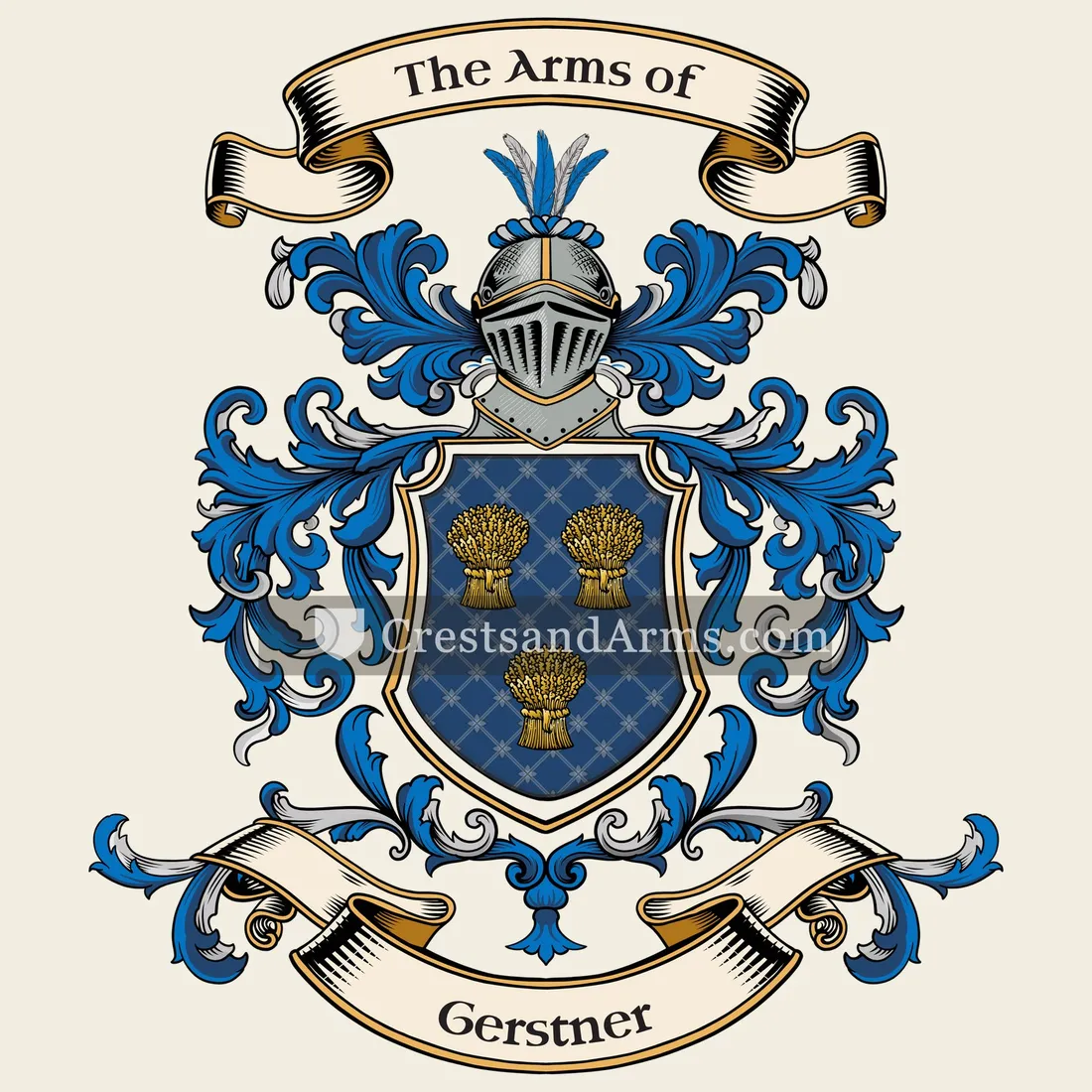
Meaning of the Gerstner family crest colors & symbols
Symbols on this shield
wheatsheafPlenty, and the harvest of one's own labour
Colours
Blue (Azure)Means: Loyalty and truth
Gold (Or)Means: Generosity
Historical info
Source
J. B. Rietstap, Armorial Général, Gouda: G. B. van Goor Zonen, 1884–87
Blazon (the actual original written record)
“D'azur à trois épis d'orge d'or, feuillés du même, mouv. d'une même tige, iss. de la p. de l'écu. C.: un jeune homme iss., hab. d'azur, ceint d'or, au rabat du même, coiffé d'un bonnet albanais d'azur, retr. d'or; tenant les épis de sa main dextre.”
GermanyNuremberg, c. 1765
Digital archive packCoat of arms PNG, gold border print PDF, vector SVG and the certificate of authenticity. Sent to your email in minutes.
Map of Germany showing where the Gerstner arms are recorded
The Gerstner arms were recorded in Nuremberg, c. 1765.
This is where the arms were entered in the register. Families often moved to other parts of the country, so the same name can turn up in more than one region.
The body that granted and recorded arms in Germany in this period.
Francis I, Holy Roman Emperor
Sovereign of the period
Francis I, Holy Roman Emperor
1745–1765
Reigning in Austria when the Gerstner arms are first recorded.
How Arms Worked in Germany
In the Holy Roman Empire, coats of arms were often granted to individuals by the Emperor or his representatives. These arms were then passed down through the generations to all legitimate descendants of the original holder. Younger branches of a family usually kept the same shield design without needing to change it, as the arms belonged to the entire lineage.
Granting authority
The Holy Roman Emperor held the sole power to grant new coats of arms throughout his vast imperial territories.
How they got arms
Families typically obtained their coats of arms through a formal imperial grant or by proving their noble status to the authorities.
Where arms were recorded
These grants were officially recorded in the Imperial Chancery registers, which began keeping formal records of such honors during the Middle Ages.
The family's standing
Recorded among the armigerous families of Germany.
Origin & History of the Gerstner Family in Germany
The family name Gerstner traces its roots to the German language, where it functioned as an occupational surname for individuals involved in the grain trade. The name is derived from the Middle High German word "gerste," which means barley. During the medieval period, people often received surnames based on their daily work, so a Gerstner was likely a farmer, a merchant, or a miller who specialized in barley production. By the middle of the eighteenth century, the family had established a notable presence in the city of Nuremberg. As a major center for trade and craftsmanship in the Holy Roman Empire, Nuremberg provided a stable environment for families like the Gerstners to grow their influence. Records from 1765 confirm that members of the family were active participants in the local economy of this bustling urban hub. Their presence in such a significant city suggests that they were well-integrated into the social and professional life of the region during the Enlightenment era.
Gerstner Meaning & Related Branches
Root word
Gerst
A Germanic term referring to barley or a grain-related crop.
This name
GerstnerAn occupational surname for a person who grew, harvested, or traded in barley.
also spelled
Gerstnere
Gerstnerr
Documented Sources
J. B. Rietstap, Armorial Général, Gouda: G. B. van Goor Zonen, 1884–87
Steiermärkisches Landesarchiv, Steiermärkische Steuerkataster und Grundbücher
Diözesanarchiv Graz-Seckau, Matriken der Pfarreien in der Steiermark
Kranzmayer, Eberhard, Ortsnamenbuch von Kärnten und der Steiermark, 1956
Zoder, Rudolf, Familiennamen in Ostösterreich, 1971
Digital archive packCoat of arms PNG, gold border print PDF, vector SVG and the certificate of authenticity. Sent to your email in minutes.


 wheatsheafPlenty, and the harvest of one's own labour
 antelopeHarmony, polity and peace
 wheatsheafPlenty, and the harvest of one's own labour
 antelopeHarmony, polity and peace