Map of Switzerland showing where the Gessler arms are recorded
The Gessler arms were recorded in Bâle, c. 1745.
This is where the arms were entered in the register. Families often moved to other parts of the country, so the same name can turn up in more than one region.
The body that granted and recorded arms in Switzerland in this period.
How Arms Worked in Switzerland
In Switzerland, coats of arms were not restricted to the nobility and were often adopted by common citizens and families. These symbols were passed down through generations to show family identity. When branches of a family grew, they often changed small details of the design to distinguish their own line from the original group.
Granting authority
Cantonal and civic authorities managed the use of coats of arms within their specific regions and local jurisdictions.
How they got arms
Families typically assumed their own coats of arms based on local custom rather than receiving them from a central monarch.
Where arms were recorded
Arms were recorded in various cantonal and civic registers starting from the fourteenth century throughout the Swiss region.
The family's standing
Recorded among the armigerous families of Switzerland.
Origin & History of the Gessler Family in Switzerland
The Gessler family name holds a significant place in the history of the Swiss region, with deep roots that connect to the social and political landscape of the eighteenth century. By 1745, records confirm that members of the family were established in the city of Bâle, which was a major center for trade and intellectual exchange at the time. The name itself is thought to have originated from older Germanic terms related to specific occupations or local geographic features, reflecting the way many families identified themselves within their communities during the Middle Ages. As the family settled in Bâle, they became part of the urban fabric of Switzerland, participating in the civic life and economic growth that defined the city during the Enlightenment. Their presence in this region highlights the movement and stability of families who helped shape the cultural identity of the Swiss cantons over several centuries.
Coat of Arms & Family Crest Details
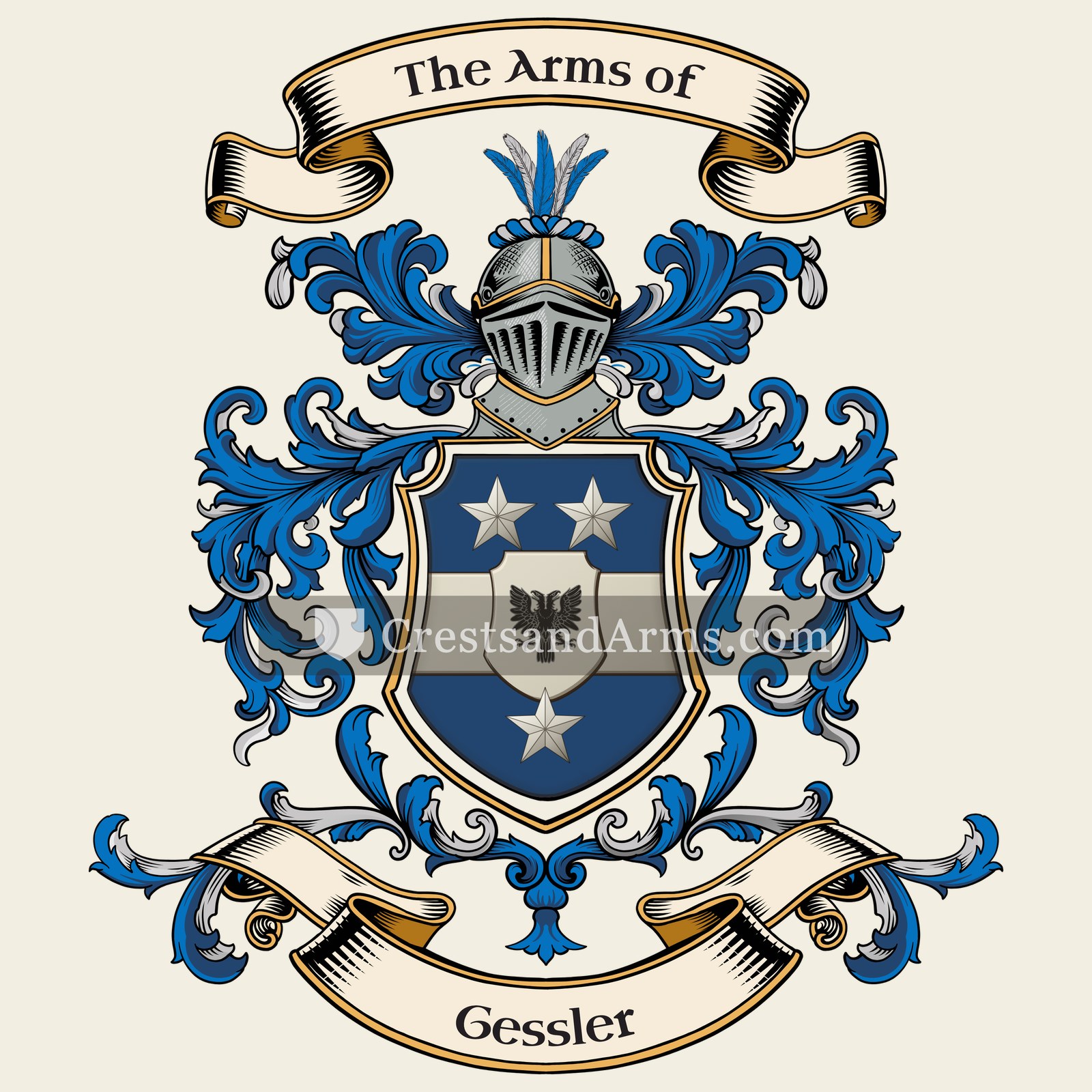
Symbols on this shield
fessThe military belt, and readiness to serve
mulletThe third son, and a divine quality from above
eagleNobility, strength and a keen mind
Colours
Blue (Azure)Means: Loyalty and truth
Silver (Argent)Means: Peace and sincerity
Black (Sable)Means: Constancy
Historical info
Source
J. B. Rietstap, Armorial Général, Gouda: G. B. van Goor Zonen, 1884–87
Blazon (the actual original written record)
“D'azur à la fasce d'arg., acc. de trois étoiles du même. Sur le tout un écusson d'arg., timbré d'une couronne à cinq perles et ch. d'une aigle de Prusse, tenant sceptre et globe. Trois cq. cour. C.: 1º un drapeau de gu., ch. d'un écusson ovale d'arg. surch. du chiffre 20; 2º une tête et col de paon au nat.; 3º un drapeau de sin., ch. d'un écusson ovale d'arg. surch. du chiffre 67. L. de sa., d'arg. et d'azur. S.: deux lions reg. au nat.”
SilesiaSilesia, c. 1745
Digital archive packCoat of arms PNG, gold border print PDF, vector SVG and the certificate of authenticity. Sent to your email in minutes.
Map of Germany showing where the Gessler arms are recorded
The Gessler arms were recorded in Silesia, c. 1745.
Silesia was farming country in the east of the German lands, held in large estates by families who stayed put for generations. Owning land was what entitled a family to arms, so the region fills a good deal of the register.
This is where the arms were entered in the register. Families often moved to other parts of the country, so the same name can turn up in more than one region.
The body that granted and recorded arms in Germany in this period.
Charles VII, Holy Roman Emperor
Sovereign of the period
Charles VII, Holy Roman Emperor
1742–1745
Reigning in Switzerland when the Gessler arms are first recorded.
How Arms Worked in Germany
In the Holy Roman Empire, coats of arms were often granted to individuals by the Emperor or his representatives. These arms were then passed down through the generations to all legitimate descendants of the original holder. Younger branches of a family usually kept the same shield design without needing to change it, as the arms belonged to the entire lineage.
Granting authority
The Holy Roman Emperor held the sole power to grant new coats of arms throughout his vast imperial territories.
How they got arms
Families typically obtained their coats of arms through a formal imperial grant or by proving their noble status to the authorities.
Where arms were recorded
These grants were officially recorded in the Imperial Chancery registers, which began keeping formal records of such honors during the Middle Ages.
The family's standing
Recorded among the armigerous families of Silesia.
Origin & History of the Gessler Family in Germany
The Gessler family name is deeply rooted in the historical landscape of the German-speaking regions of Central Europe. By the mid-18th century, records confirm that members of the family were well-established in the province of Silesia, which was then a significant territory under the Prussian crown. The name itself is thought to be an occupational or descriptive surname, likely derived from Middle High German terms related to specific trades or local nicknames common in that era. As the family lived in Silesia during the 1745 period, they were part of a complex society defined by shifting political borders and the expansion of Prussian influence. Families like the Gesslers often moved across these German lands to seek new opportunities in agriculture or administration during this time of regional growth. Their presence in Silesia reflects the broader movement of people who helped shape the cultural and social identity of the region before the major industrial changes of the following century.
Gessler Meaning & Related Branches
Root word
Gesseler
Derived from a topographic feature or a specific settlement location.
This name
GesslerRefers to an inhabitant of a place called Gesseln or a person from a specific valley region.
also spelled
Gesler
Gezzler
Gesseler
Related arms
Geslervariant spelling
Goesslervariant spelling
Documented Sources
J. B. Rietstap, Armorial Général, Gouda: G. B. van Goor Zonen, 1884–87
Historisches Lexikon der Schweiz, Gessler, 2007
Staatsarchiv Basel-Stadt, Bürgerverzeichnisse und Einwohnerregister, 1745
Digital archive packCoat of arms PNG, gold border print PDF, vector SVG and the certificate of authenticity. Sent to your email in minutes.


 fessThe military belt, and readiness to serve
 mulletThe third son, and a divine quality from above
 fessThe military belt, and readiness to serve
 mulletThe third son, and a divine quality from above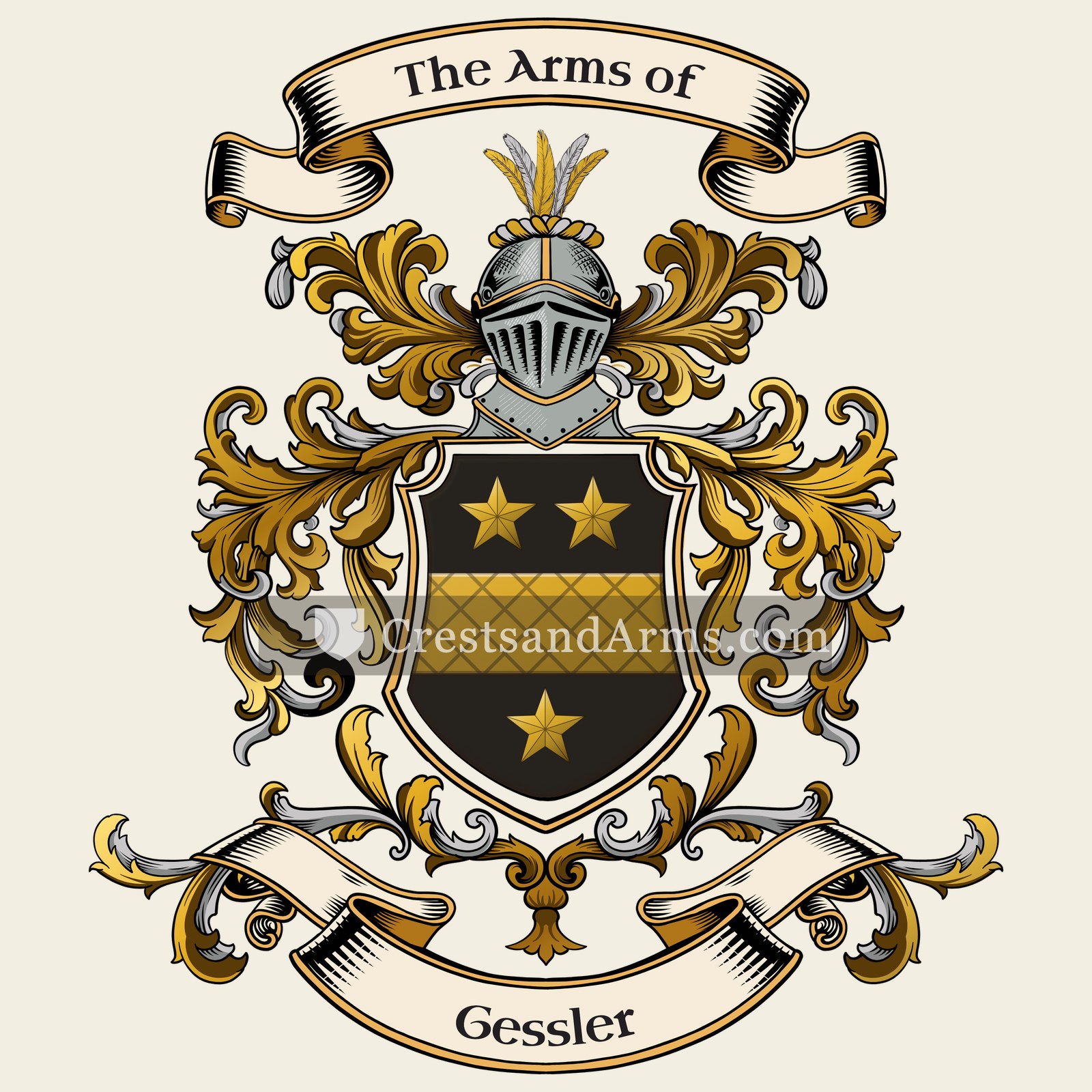

 eagleNobility, strength and a keen mind