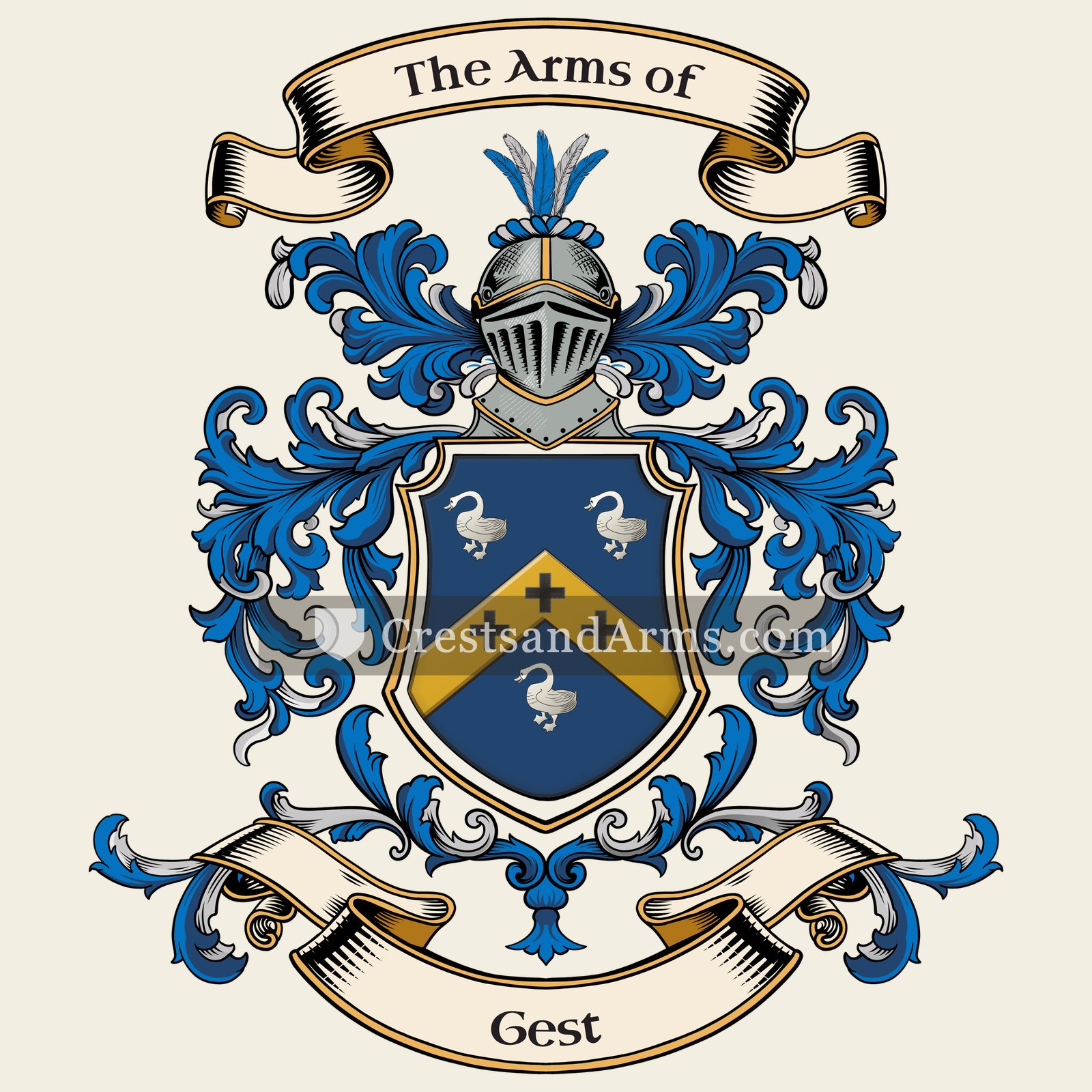
A record of documented arms, meaning and origin, researched for the Gest family of France.
Reg. 0719 · French, G–I
Coat of Arms & Family Crest Details
Symbols on this shield
chevronProtection, and faithful service completed
cross symbolChristian faith and service
swanGrace, light and the poet's art
Colours
Blue (Azure)Means: Loyalty and truth
Gold (Or)Means: Generosity
Black (Sable)Means: Constancy
Silver (Argent)Means: Peace and sincerity
Historical info
Source
J. B. Rietstap, Armorial Général, Gouda: G. B. van Goor Zonen, 1884–87
Blazon (the actual original written record)
“D'azur au chev. d'or, ch. de trois croix ancrées de sa. et acc. de trois têtes et cols de cygne d'arg. C.: une tête et col de cygne d'arg., coll. d'or, ch. au-dessous du collier d'une croix ancrée de sa.; le tout entre deux pl. d'aut. d'or. T.: deux hommes de carn., revêtus d'un tablier de cuir, placés chacun devant une enclume et appuyant la main sur le manche d'un marteau de forgeron. D.: FERRO, NON GLADIO.”
Francec. 1838
Digital archive packCoat of arms PNG, gold border print PDF, vector SVG and the certificate of authenticity. Sent to your email in minutes.
Map of France showing where the Gest arms are recorded
The Gest arms were recorded in France, c. 1838.
Arms such as these were typically recorded in Bretagne.
More families held coats of arms in Bretagne than anywhere else in France. The land was divided into many small estates rather than a few large ones, so far more households counted as gentry, and each needed a shield of its own to be told apart.
This is where the arms were entered in the register. Families often moved to other parts of the country, so the same name can turn up in more than one region.
The body that granted and recorded arms in France in this period.
How Arms Worked in France
In France, a coat of arms was a mark of honor that passed down through the male line to all legitimate descendants. Families often used the same shield without changes to show their shared heritage. If a branch wanted to stand out, they could add a small mark to their shield to show their specific place in the family tree.
Granting authority
The Juge d'armes de France acted as the official authority that regulated and verified coats of arms across the country.
How they got arms
Families typically inherited their arms from ancestors, though they could also receive them through royal grants or by proving their noble status.
Where arms were recorded
Coats of arms were officially recorded in the Armorial Général de France, which began its main collection in the year 1696.
The family's standing
Recorded among the armigerous families of France.
Origin & History of the Gest Family in France
The family name Gest has deep roots in the Brittany region of France, where records confirm the presence of family members as early as 1838. The name is believed to be linked to the Old French word geste, which historically referred to a narrative of heroic deeds or a chronicle of family history. In the social structure of nineteenth-century Bretagne, families with this name were often integrated into the local agricultural and maritime communities that defined the coastal landscape. As the region underwent significant social changes during the mid-1800s, the Gest family likely participated in the traditional trades and village life that characterized the area. By tracing these early records, we see a family deeply connected to the cultural identity and the evolving history of the Breton people.
Gest Meaning & Related Branches
Root word
Geste
Old French term for a story, deed, or heroic exploit.
This name
GestA nickname for a person who was a storyteller or a performer of heroic tales.
also spelled
Gest
Geste
Geast
Gist
Documented Sources
J. B. Rietstap, Armorial Général, Gouda: G. B. van Goor Zonen, 1884–87
Archives départementales du Morbihan, État civil, 1838
Le Dû, Jean, Le nom de famille en Bretagne, 1990
Morfaux, Louis-Marie, Dictionnaire étymologique des noms de famille bretons, 1982
Digital archive packCoat of arms PNG, gold border print PDF, vector SVG and the certificate of authenticity. Sent to your email in minutes.


 chevronProtection, and faithful service completed
 cross symbolChristian faith and service
 swanGrace, light and the poet's art
 chevronProtection, and faithful service completed
 cross symbolChristian faith and service
 swanGrace, light and the poet's art