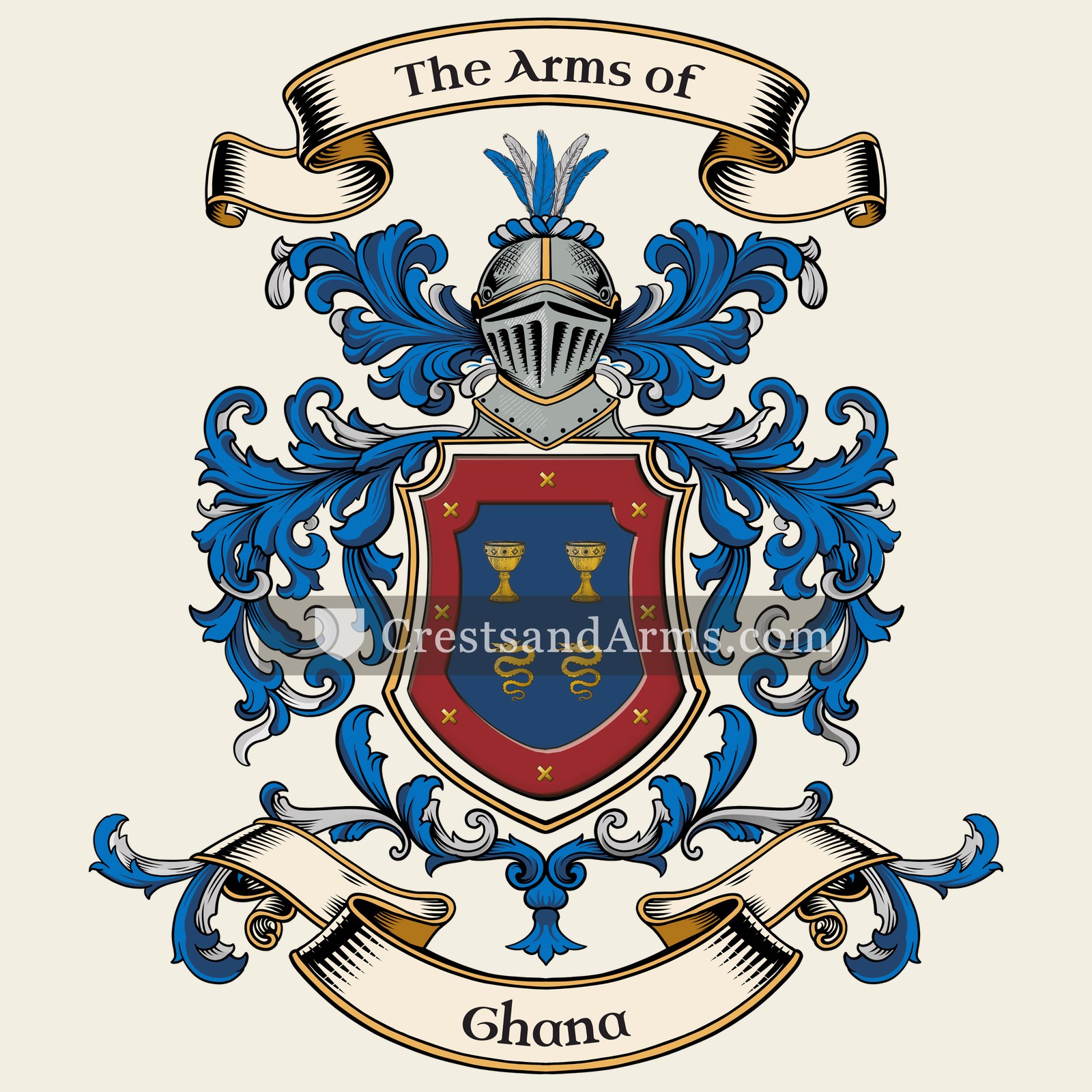
A record of documented arms, meaning and origin, researched for the Ghana family of Spain.
Reg. 0280 · Spanish, G–I
Coat of Arms & Family Crest Details
Symbols on this shield
cupFaith, office, and a trust discharged
serpentWisdom, healing and prudence
saltire coupedResolution, and the cross of St Andrew
Colours
Blue (Azure)Means: Loyalty and truth
Red (Gules)Means: Military strength
Gold (Or)Means: Generosity
Historical info
Source
J. B. Rietstap, Armorial Général, Gouda: G. B. van Goor Zonen, 1884–87
Blazon (the actual original written record)
“D'azur à deux chaudières d'or, l'une sur l'autre, avec plusieurs serpents du même iss. de chaque chaudière près des attaches des cornières; à la bord. de gu., ch. de huit flanchis d'or.”
SpainBiscaye, c. 1722
Digital archive packCoat of arms PNG, gold border print PDF, vector SVG and the certificate of authenticity. Sent to your email in minutes.
Map of Spain showing where the Ghana arms are recorded
The Ghana arms were recorded in Biscaye, c. 1722.
This is where the arms were entered in the register. Families often moved to other parts of the country, so the same name can turn up in more than one region.
The body that granted and recorded arms in Spain in this period.
Philip V of Spain
Sovereign of the period
Philip V of Spain
1714–1724
Reigning in Spain when the Ghana arms are first recorded.
How Arms Worked in Spain
In Spain, a coat of arms was considered a form of property that belonged to the entire family line. These arms were passed down from a father to all his children equally. Younger branches of the family usually kept the original design without needing to add any special marks to distinguish their specific line.
Granting authority
The Cronista Rey de Armas was the official body that regulated and granted coats of arms throughout Spain.
How they got arms
Families often obtained their arms through royal grants or by proving their noble status to the official heraldic authority.
Where arms were recorded
Coats of arms were officially recorded in the registers of the Cronista Rey de Armas starting in 1496.
The family's standing
Recorded among the armigerous families of Spain.
Origin & History of the Ghana Family in Spain
The family name Ghana has deep roots in the Biscay region of northern Spain, where records confirm members of the family were living as early as 1722. During this period, Biscay was a hub of maritime activity and iron production, which shaped the lives of families residing in the coastal towns and mountainous interior. The name likely evolved from local Basque dialects or regional linguistic patterns common to the area at the time. Families in this part of Spain often held strong ties to their local parishes, where birth, marriage, and death records were meticulously kept by the church. As the family grew, they became part of the social fabric of the Basque Country, contributing to the agricultural and trade traditions that defined the region during the eighteenth century.
Ghana Meaning & Related Branches
Root word
Gana
Derived from the Latin word ganum meaning a gain or profit.
This name
GhanaA topographic or habitational surname referring to someone living near a productive area or gainful land.
also spelled
Gaon
Gaonas
Documented Sources
J. B. Rietstap, Armorial Général, Gouda: G. B. van Goor Zonen, 1884–87
Archivo Histórico Eclesiástico de Bizkaia, Libros Sacramentales de la Diócesis de Bilbao
Juaristi, Jon, El linaje de Aitor: La invención de la tradición vasca, 1987
Caro Baroja, Julio, Los vascos, 1971
Digital archive packCoat of arms PNG, gold border print PDF, vector SVG and the certificate of authenticity. Sent to your email in minutes.


 cupFaith, office, and a trust discharged
 serpentWisdom, healing and prudence
 saltire coupedResolution, and the cross of St Andrew
 cupFaith, office, and a trust discharged
 serpentWisdom, healing and prudence
 saltire coupedResolution, and the cross of St Andrew