Map of Italy showing where the Gianna arms are recorded
The Gianna arms were recorded in Provence, c. 1775.
Provence was old country, with towns dating to the Romans and families who traced their land back nearly as far. Its gentry were many and long-settled, and long settlement is what fills a register.
This is where the arms were entered in the register. Families often moved to other parts of the country, so the same name can turn up in more than one region.
The body that granted and recorded arms in Italy in this period.
Alvise Giovanni Mocenigo
Sovereign of the period
Alvise Giovanni Mocenigo
1763–1778
Reigning in Italy when the Gianna arms are first recorded.
How Arms Worked in Italy
In the Italian states, coats of arms were often used by noble families to show their status and history. These symbols were passed down through the generations to all legitimate male descendants. Younger branches of a family usually kept the original design but sometimes added small changes to distinguish their specific line from the main branch.
Granting authority
Various local rulers and city governments controlled the use of coats of arms across the different Italian states.
How they got arms
Families often assumed their own arms or received them as official grants from local lords, popes, or city councils.
Where arms were recorded
Arms were recorded in local city archives or private family books rather than in one single national register.
The family's standing
Recorded among the armigerous families of Provence.
Origin & History of the Gianna Family in Italy
The name Gianna originates from the Italian version of the name John, which carries the meaning of God is gracious. While the name is deeply rooted in Italian culture, the family established a firm presence in the Provence region of France by 1775. During this period, Provence was a hub of agricultural trade and cultural exchange, and families with Italian origins often moved across the border to seek new opportunities in the Mediterranean climate. Living in this area during the late eighteenth century meant that the family likely experienced the social shifts leading up to the French Revolution. They were part of a long tradition of families who integrated their Mediterranean heritage into the local customs of southern France. By maintaining their name throughout these generations, the family preserved a connection to their linguistic roots while becoming an established part of the Provençal community.
Gianna Meaning & Related Branches
Root word
Yochanan
Hebrew for God is gracious
This name
GiannaA feminine Italian diminutive form meaning God is gracious.
also spelled
Gianny
Jani
Documented Sources
J. B. Rietstap, Armorial Général, Gouda: G. B. van Goor Zonen, 1884–87
Dauzat, Albert, Dictionnaire étymologique des noms et prénoms de France, 1951
Archives départementales des Bouches-du-Rhône, Registres paroissiaux et d'état civil de Provence, 1775
Morlet, Marie-Thérèse, Dictionnaire étymologique des noms de famille, 1991
Digital archive packCoat of arms PNG, gold border print PDF, vector SVG and the certificate of authenticity. Sent to your email in minutes.


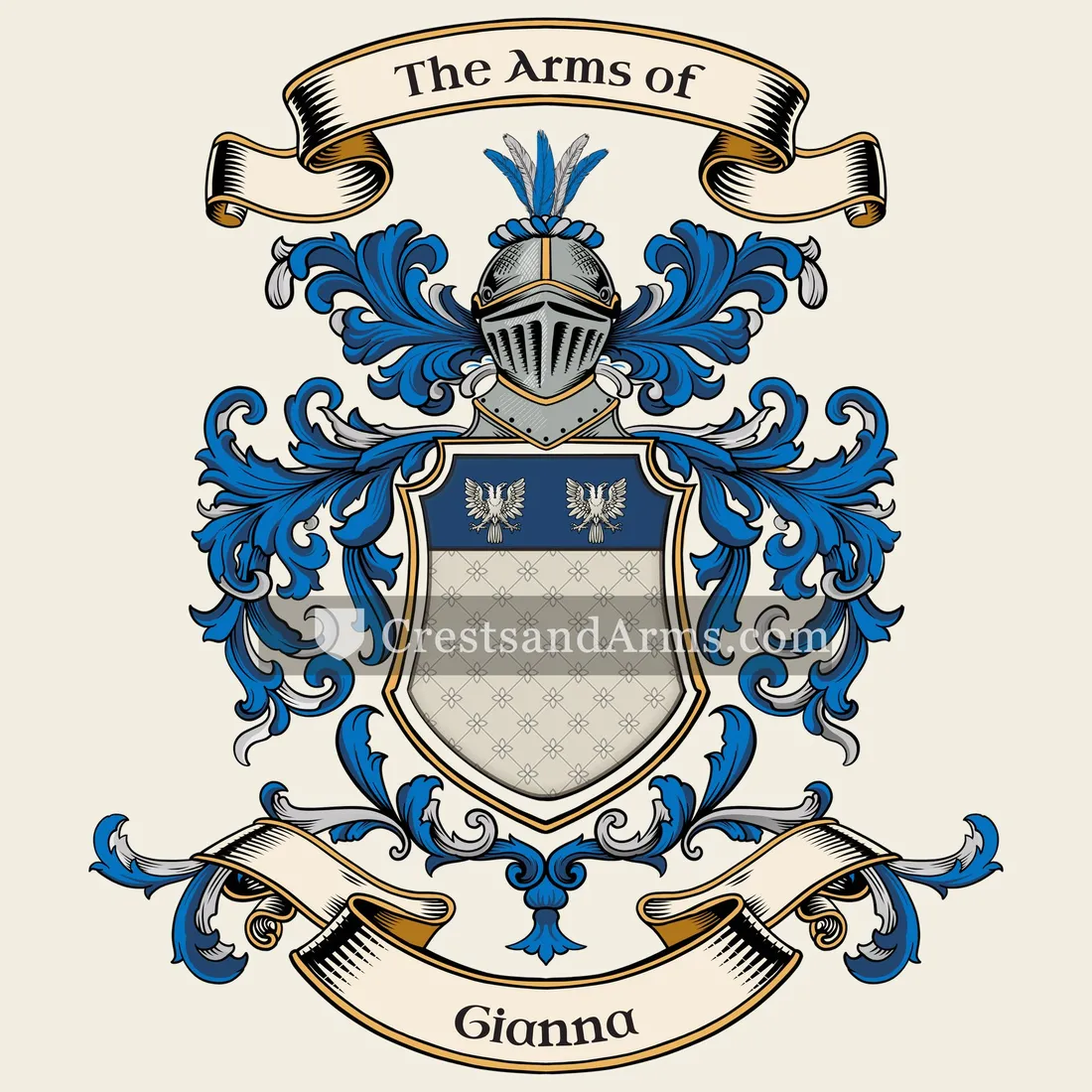
 chiefAuthority, wisdom and dominion
 eagleNobility, strength and a keen mind
 chiefAuthority, wisdom and dominion
 eagleNobility, strength and a keen mind