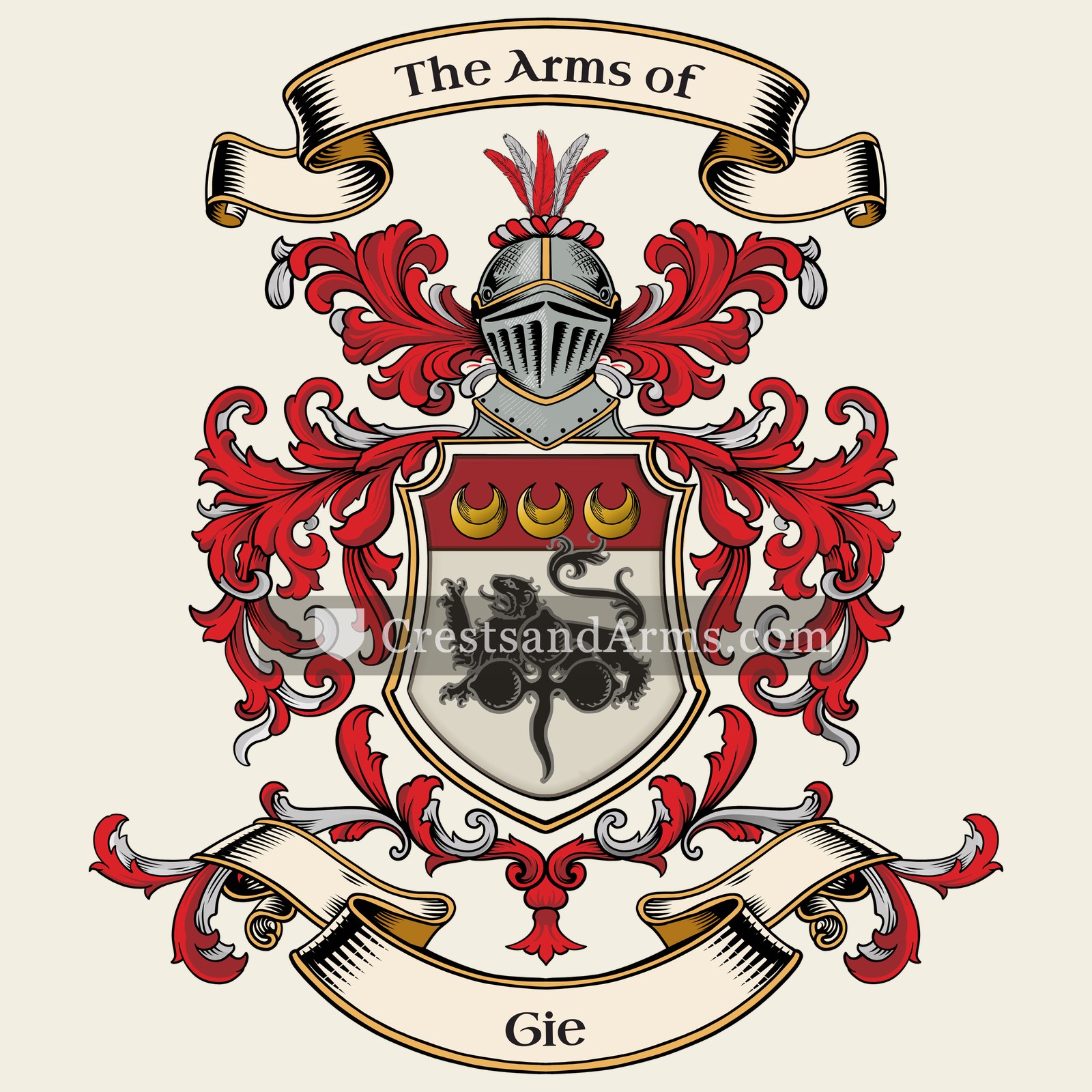
A record of documented arms, meaning and origin, researched for the Gie family of Belgium.
Reg. 2827 · Belgian, G–I
Coat of Arms & Family Crest Details
Symbols on this shield
chiefAuthority, wisdom and dominion
lionCourage, strength and royalty
trefoilPerpetuity, and the Trinity
crescentHonour by the sovereign, and the second son
Colours
Silver (Argent)Means: Peace and sincerity
Red (Gules)Means: Military strength
Black (Sable)Means: Constancy
Gold (Or)Means: Generosity
Historical info
Source
J. B. Rietstap, Armorial Général, Gouda: G. B. van Goor Zonen, 1884–87
Blazon (the actual original written record)
“D'arg. semé de trèfles de sa.; au lion du même, arm. et lamp. de gu., br. sur le tout; au chef de gu., ch. de trois croiss. d'or. Cq. cour. C.: un griffon iss. de sa., arm. et lamp. de gu. L. d'or et de sa. S.: deux griffons d'or, arm. et lamp. de gu. D.: QUI S'Y FROTTE S'Y PIQUE.”
BelgiumGand, c. 1857
Digital archive packCoat of arms PNG, gold border print PDF, vector SVG and the certificate of authenticity. Sent to your email in minutes.
Map of Belgium showing where the Gie arms are recorded
The Gie arms were recorded in Gand, c. 1857.
This is where the arms were entered in the register. Families often moved to other parts of the country, so the same name can turn up in more than one region.
The body that granted and recorded arms in Belgium in this period.
Leopold I of Belgium
Sovereign of the period
Leopold I of Belgium
1831–1865
Reigning in Belgium when the Gie arms are first recorded.
How Arms Worked in Belgium
In Belgium, a coat of arms is considered personal property that is passed down through the male line to legitimate descendants. Families often use the same shield design across generations to show their shared heritage. If a branch of the family wants to change the design, they must apply for an official update to their specific version of the arms.
Granting authority
The Conseil héraldique is the official body that regulates and approves all coats of arms in Belgium.
How they got arms
Families obtain their coats of arms through formal royal grants or by confirming their historical right to use existing designs.
Where arms were recorded
All approved coats of arms are officially recorded in the public registers of the Conseil héraldique since 1844.
The family's standing
Recorded among the armigerous families of Belgium.
Origin & History of the Gie Family in Belgium
The family name Gie carries a history deeply rooted in the urban landscape of nineteenth-century Belgium. By 1857, records confirm that members of the Gie family were established residents of Ghent, a city known for its significant industrial growth and textile production during that era. The name likely evolved as a localized identifier, serving to distinguish families within the dense social fabric of the Flemish region. As the city underwent rapid expansion, individuals bearing the Gie name participated in the daily life of this bustling trade hub, contributing to the local community through their work and civic engagement. While the name remains relatively rare, its presence in Ghent during the mid-1800s highlights a long-standing connection to the cultural and economic development of the area.
Gie Meaning & Related Branches
Root word
Giles
Derived from the Greek word for a young goat or shield.
This name
GieA shortened form of names like Egidius, signifying a protector or young goat.
also spelled
Gie
Gee
Documented Sources
J. B. Rietstap, Armorial Général, Gouda: G. B. van Goor Zonen, 1884–87
Stadsarchief Gent, Bevolkingsregister 1857
Vandenbroeke, C., Sociale geschiedenis van het Vlaamse volk, 1981
Digital archive packCoat of arms PNG, gold border print PDF, vector SVG and the certificate of authenticity. Sent to your email in minutes.


 chiefAuthority, wisdom and dominion
 lionCourage, strength and royalty
 trefoilPerpetuity, and the Trinity
 crescentHonour by the sovereign, and the second son
 chiefAuthority, wisdom and dominion
 lionCourage, strength and royalty
 trefoilPerpetuity, and the Trinity
 crescentHonour by the sovereign, and the second son