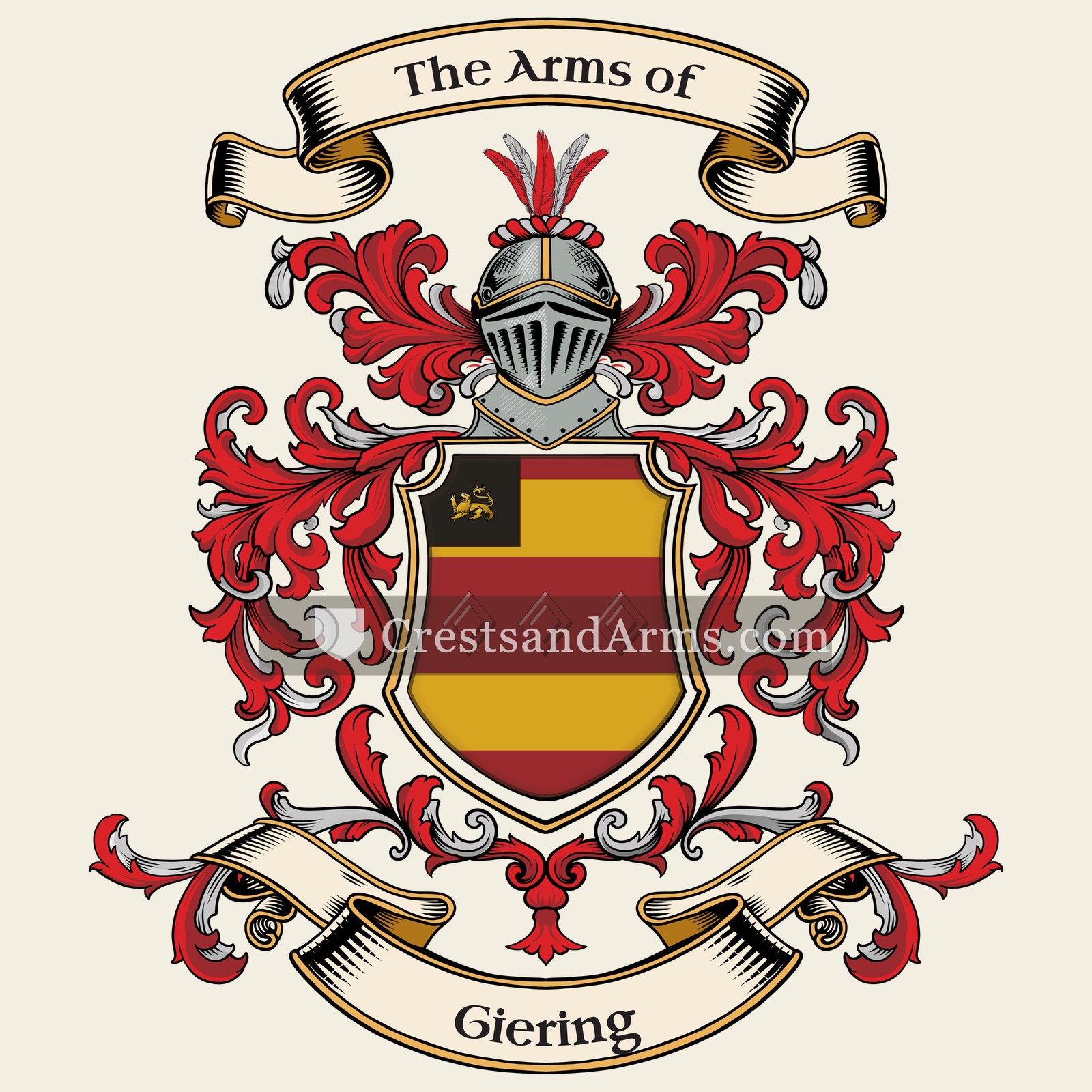
A record of documented arms, meaning and origin, researched for the Giering family lines. Documented in 3 countries.
Reg. 2260 · German, G–I
Coat of Arms & Family Crest Details
Symbols on this shield
knightChivalry and service in arms
Colours
Gold (Or)Means: Generosity
Black (Sable)Means: Constancy
Historical info
Source
J. B. Rietstap, Armorial Général, Gouda: G. B. van Goor Zonen, 1884–87
Blazon (the actual original written record)
“D'or à un homme iss., posé de profil, hab. de sa., coiffé d'un bonnet pointu du même, tenant une tige de trois roses de gu., feuillée de sin. C.: l'homme iss. L. d'or et de sa.”
GermanyNördlingen Bav, c. 1765
Digital archive packCoat of arms PNG, gold border print PDF, vector SVG and the certificate of authenticity. Sent to your email in minutes.
Map of Germany showing where the Giering arms are recorded
The Giering arms were recorded in Nördlingen Bav, c. 1765.
This is where the arms were entered in the register. Families often moved to other parts of the country, so the same name can turn up in more than one region.
The body that granted and recorded arms in Germany in this period.
Francis I, Holy Roman Emperor
Sovereign of the period
Francis I, Holy Roman Emperor
1745–1765
Reigning in Germany when the Giering arms are first recorded.
How Arms Worked in Germany
In the Holy Roman Empire, coats of arms were often granted to individuals by the Emperor or his representatives. These arms were then passed down through the generations to all legitimate descendants of the original holder. Younger branches of a family usually kept the same shield design without needing to change it, as the arms belonged to the entire lineage.
Granting authority
The Holy Roman Emperor held the sole power to grant new coats of arms throughout his vast imperial territories.
How they got arms
Families typically obtained their coats of arms through a formal imperial grant or by proving their noble status to the authorities.
Where arms were recorded
These grants were officially recorded in the Imperial Chancery registers, which began keeping formal records of such honors during the Middle Ages.
The family's standing
Recorded among the armigerous families of Germany.
Origin & History of the Giering Family in Germany
The surname Giering is deeply rooted in the history of southern Germany, particularly within the Swabian region. By the mid-18th century, the family established a notable presence in the free imperial city of Nördlingen. During this period, Nördlingen was a significant center for trade and craftsmanship, and families like the Gierings often integrated into the local guild systems that defined urban life. The name itself likely evolved from regional dialects, possibly relating to a person’s temperament or a specific geographic location near a farm or stream. As residents of a city that had survived the turmoil of the Thirty Years' War, the Gierings of 1765 were part of a resilient population that helped rebuild the social and economic foundations of the region. Their presence in the city archives suggests they were part of the hardworking middle class that kept the local economy moving through the late 1700s.
Coat of Arms & Family Crest Details
Symbols on this shield
mountThe ground held, and steadfastness upon it
Colours
Red (Gules)Means: Military strength
Gold (Or)Means: Generosity
Historical info
Source
J. B. Rietstap, Armorial Général, Gouda: G. B. van Goor Zonen, 1884–87
Blazon (the actual original written record)
“De gu. à trois socs de charrue d'arg., les pointes en bas, soutenus des trois coupeaux d'un tertre d'or.”
SwitzerlandBerne, c. 1745
Digital archive packCoat of arms PNG, gold border print PDF, vector SVG and the certificate of authenticity. Sent to your email in minutes.
Map of Switzerland showing where the Giering arms are recorded
The Giering arms were recorded in Berne, c. 1745.
This is where the arms were entered in the register. Families often moved to other parts of the country, so the same name can turn up in more than one region.
The body that granted and recorded arms in Switzerland in this period.
How Arms Worked in Switzerland
In Switzerland, coats of arms were not restricted to the nobility and were often adopted by common citizens and families. These symbols were passed down through generations to show family identity. When branches of a family grew, they often changed small details of the design to distinguish their own line from the original group.
Granting authority
Cantonal and civic authorities managed the use of coats of arms within their specific regions and local jurisdictions.
How they got arms
Families typically assumed their own coats of arms based on local custom rather than receiving them from a central monarch.
Where arms were recorded
Arms were recorded in various cantonal and civic registers starting from the fourteenth century throughout the Swiss region.
The family's standing
Recorded among the armigerous families of Switzerland.
Origin & History of the Giering Family in Switzerland
The family name Giering finds its historical roots in the German-speaking regions of Switzerland, with documented evidence placing the family in the city of Berne by the year 1745. During this period, Berne was a powerful city-state, and families living within its borders were often involved in the complex social and economic structures of the Old Swiss Confederacy. The name itself likely evolved from regional dialects, possibly relating to occupational descriptions or geographic identifiers common among the local population. As residents of a major administrative center, the Giering family would have participated in the daily life of a city known for its strict governance and deep-rooted traditions. Over time, the family became part of the fabric of Swiss society, contributing to the local community while navigating the political shifts that defined the eighteenth century in the region.
Coat of Arms & Family Crest Details
Symbols on this shield
cantonA mark of honour granted by the sovereign
masclePersuasion and the mail of a knight's coat
lionCourage, strength and royalty
Colours
Red (Gules)Means: Military strength
Gold (Or)Means: Generosity
Black (Sable)Means: Constancy
Historical info
Source
Sir Bernard Burke, The General Armory of England, Scotland, Ireland and Wales, London: Harrison & Sons, 1884
Blazon (the actual original written record)
“Gu. two bars or, each charged with three mascles of the field, on a canton sa. a leopard's face of the second”
LincolnWinterton · Lincoln, c. 1620
Digital archive packCoat of arms PNG, gold border print PDF, vector SVG and the certificate of authenticity. Sent to your email in minutes.
Map of England showing where the Giering arms are recorded
The Giering arms were recorded in Lincoln, c. 1620.
Lincolnshire was rich farming country, and its wealth was spread across many middling families. Households of that size bought land and took arms, and the county holds a large share of English names.
This is where the arms were entered in the register. Families often moved to other parts of the country, so the same name can turn up in more than one region.
The body that granted and recorded arms in England in this period.
James VI and I
Sovereign of the period
James VI and I
1603–1625
Reigning in Germany when the Giering arms are first recorded.
How Arms Worked in England
English heraldry allowed arms to be shared by all legitimate descendants of the original owner. These symbols were treated as personal property that moved through the generations to all children. While the eldest son kept the original design, other family members could use the same shield without needing to change it or register their own unique versions.
Granting authority
The College of Arms in London has regulated the use of coats of arms throughout England and Wales since 1484.
How they got arms
Families typically obtained their coats of arms through a formal grant from the Crown or by proving their ancient right to them.
Where arms were recorded
All official coats of arms are recorded in the registers kept at the College of Arms, which date back to the fifteenth century.
The family's standing
Recorded among the armigerous families of Lincoln.
Origin & History of the Giering Family in England
The history of the Giering name in England is deeply rooted in the social and economic landscape of the early seventeenth century. By 1620, records confirm that members of the family were established in the city of Lincoln, a location that served as a vital hub for trade and administration in the East Midlands. During this period, families with this surname were likely part of the growing class of merchants or skilled tradespeople who helped sustain the local economy. The name itself suggests a connection to continental European roots, likely migrating across the North Sea through established trade routes that linked Lincolnshire to the Low Countries and German-speaking regions. As these families settled into English life, they integrated into the local parish systems, which were the primary way of recording births, marriages, and deaths at the time. Their presence in Lincoln reflects the broader movement of people who sought new opportunities in English urban centers during the reign of King James I.
Related Branches & Arms
Root word
Gier
Derived from the Middle High German word for greed or desire.
This name
GieringA descriptive occupational or nickname for a greedy or covetous individual.
also spelled
Geringe
Geringh
Geryng
Documented Sources
J. B. Rietstap, Armorial Général, Gouda: G. B. van Goor Zonen, 1884–87
Stadtarchiv Nördlingen, Bürgerbuch der Stadt Nördlingen (1765)
Bahlow, Hans, Deutsches Namenlexikon: Familien- und Vornamen nach Ursprung und Sinn erklärt (1967)
Heintze, Albert, Die deutschen Familien-Namen: geschichtlich, geographisch, sprachlich (1903)
Digital archive packCoat of arms PNG, gold border print PDF, vector SVG and the certificate of authenticity. Sent to your email in minutes.


 knightChivalry and service in arms
 knightChivalry and service in arms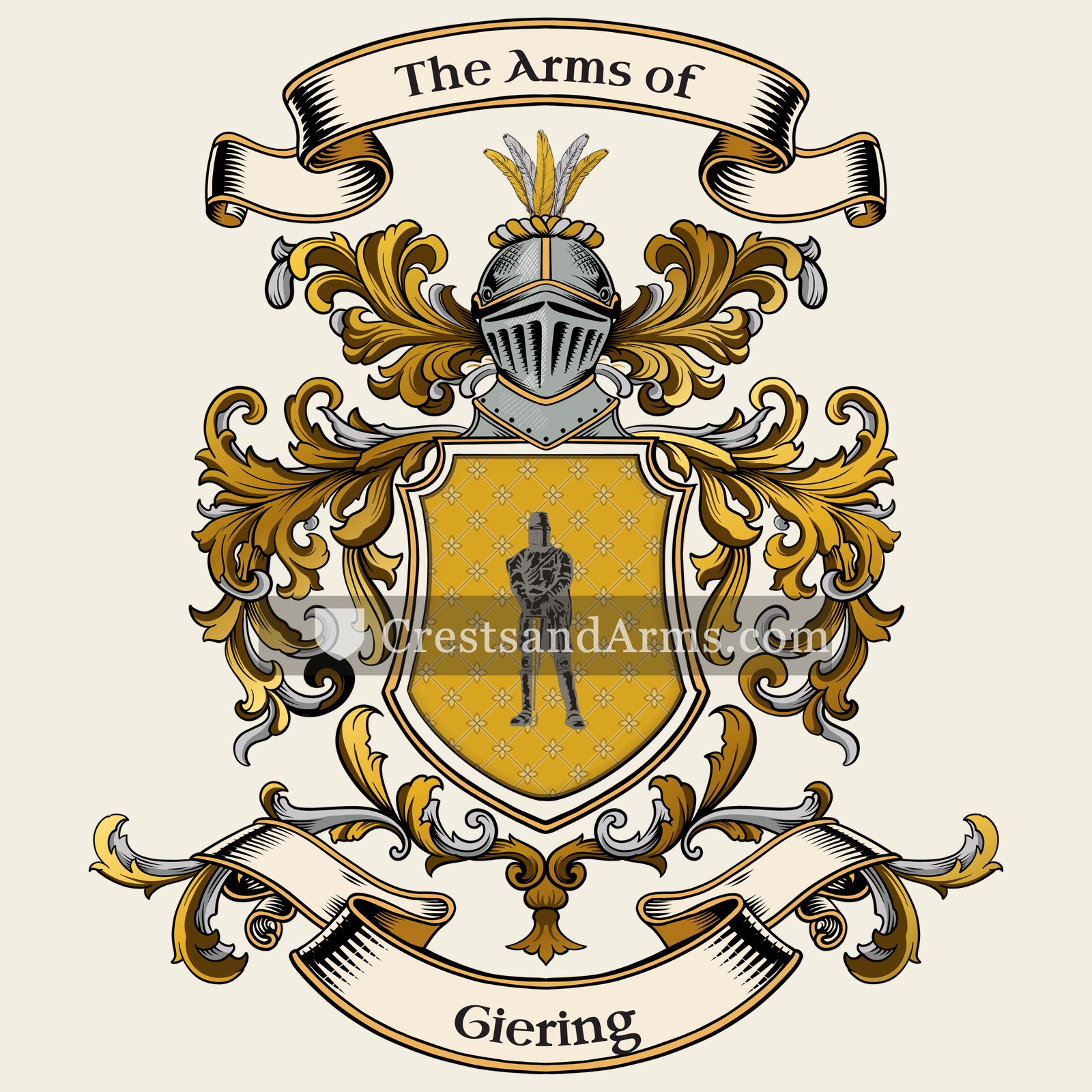


 mountThe ground held, and steadfastness upon it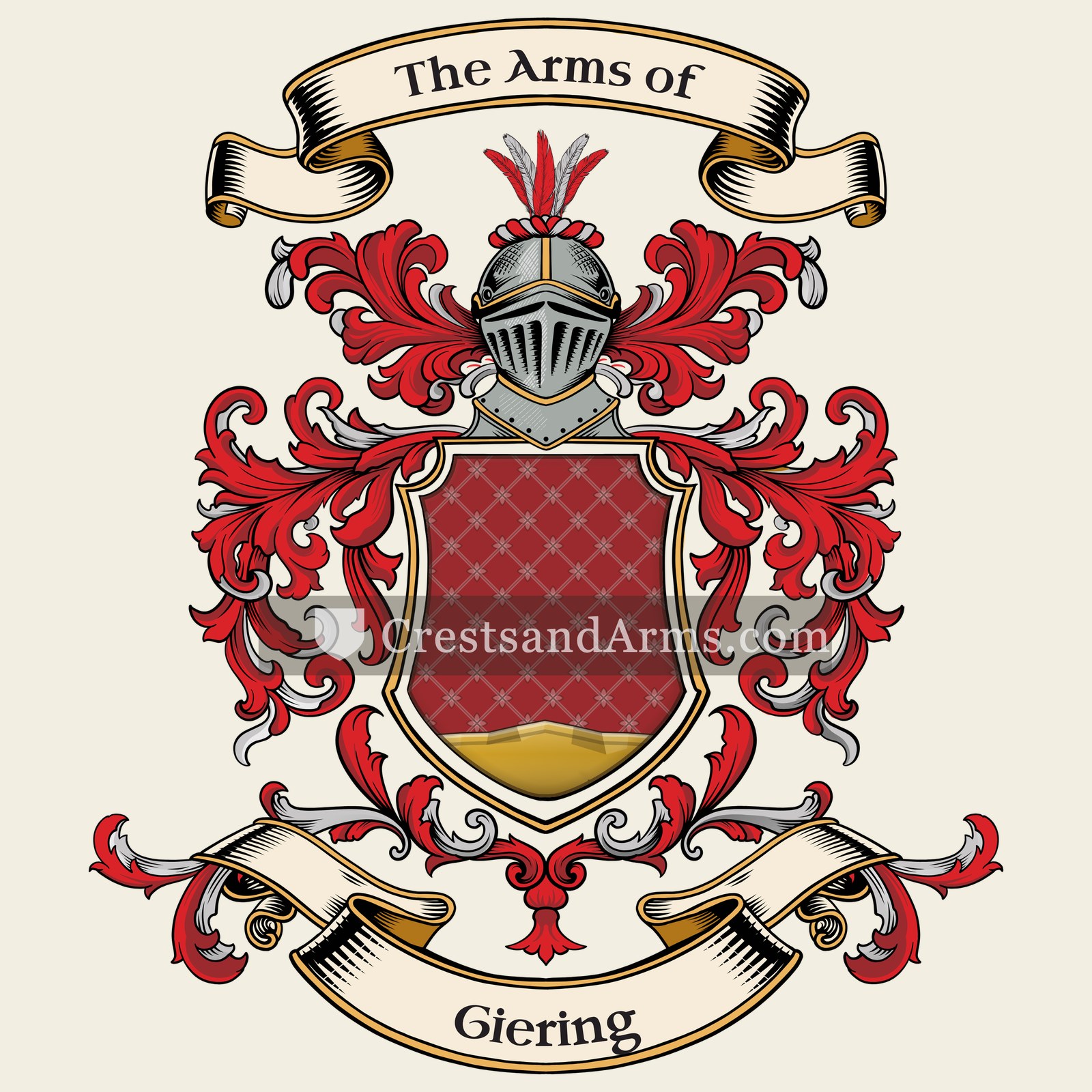

 cantonA mark of honour granted by the sovereign
 masclePersuasion and the mail of a knight's coat
 lionCourage, strength and royalty