Map of Britain showing where the Giffard arms are recorded
The Giffard arms were recorded in Britain, c. 1700.
Arms such as these were typically recorded in Kent.
Kent sits between London and the short crossing to Europe, and the trade passing through made it wealthy. Merchant families bought land with that money, and it was landowners who took coats of arms.
This is where the arms were entered in the register. Families often moved to other parts of the country, so the same name can turn up in more than one region.
The body that granted and recorded arms in Britain in this period.
William III of England
Sovereign of the period
William III of England
1694–1702
Reigning in Britain when the Giffard arms are first recorded.
How Arms Worked in Britain
English heraldry allowed arms to be shared by all legitimate descendants of the original owner. These symbols were treated as personal property that moved through the generations to all children. While the eldest son kept the original design, other family members could use the same shield without needing to change it or register their own unique versions.
Granting authority
The College of Arms in London has regulated the use of coats of arms throughout England and Wales since 1484.
How they got arms
Families typically obtained their coats of arms through a formal grant from the Crown or by proving their ancient right to them.
Where arms were recorded
All official coats of arms are recorded in the registers kept at the College of Arms, which date back to the fifteenth century.
The family's standing
Recorded among the armigerous families of Britain.
Origin & History of the Giffard Family in Britain
The name Giffard has deep roots in the history of Britain, originating as a nickname derived from the Old French word for someone with chubby cheeks or a generous nature. While the family name is most famously associated with the Norman Conquest of 1066, when followers of William the Conqueror established themselves across the English landscape, the Giffards eventually spread into various regions including the county of Kent. By the year 1700, records show that members of the family were well-established in Kentish communities, where they lived as landowners and local citizens. The name evolved over several centuries as it moved from the royal courts of the medieval period into the everyday lives of families living in the English countryside. This transition reflects the broader movement of surnames as they became fixed identities for families across Britain during the early modern era.
Coat of Arms & Family Crest Details
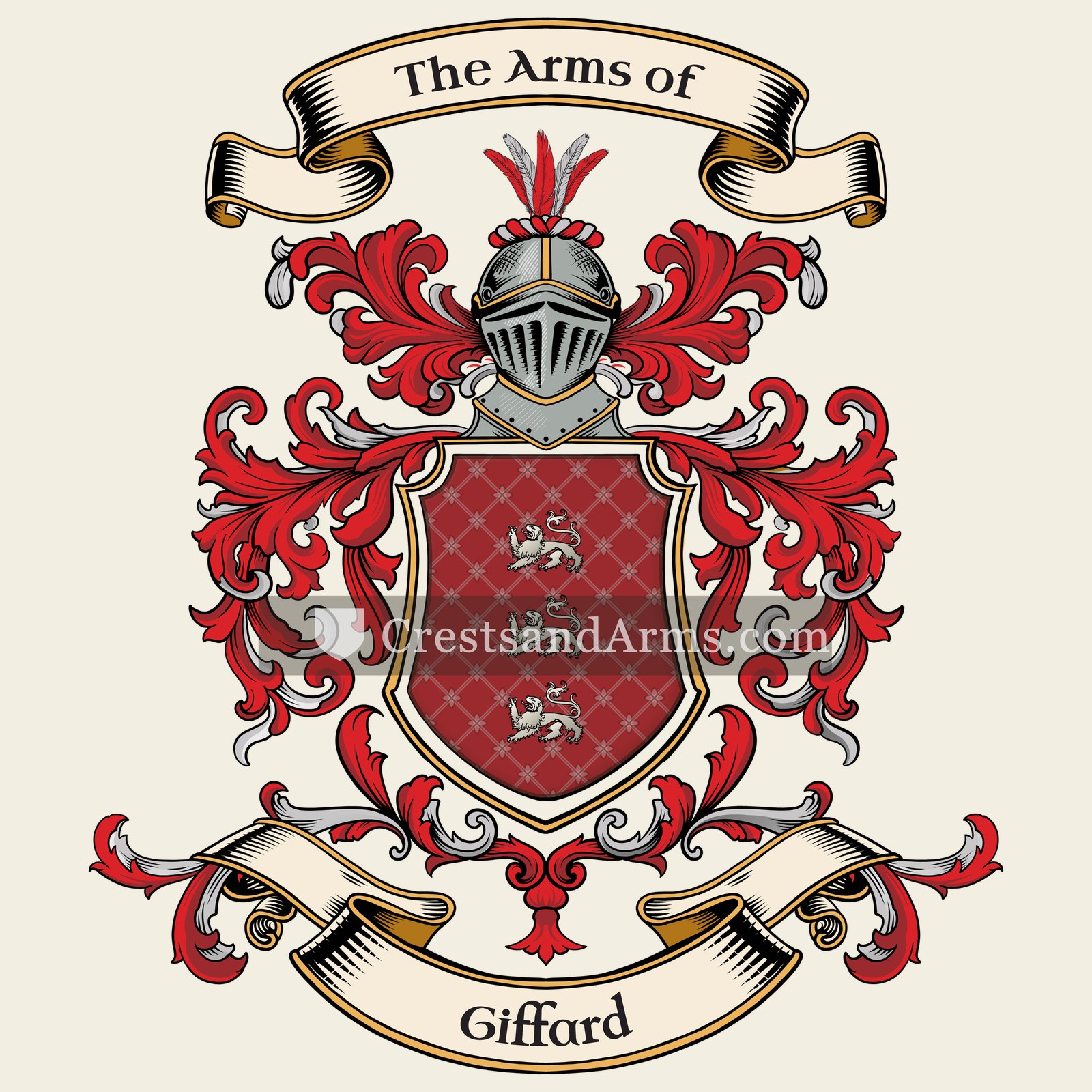
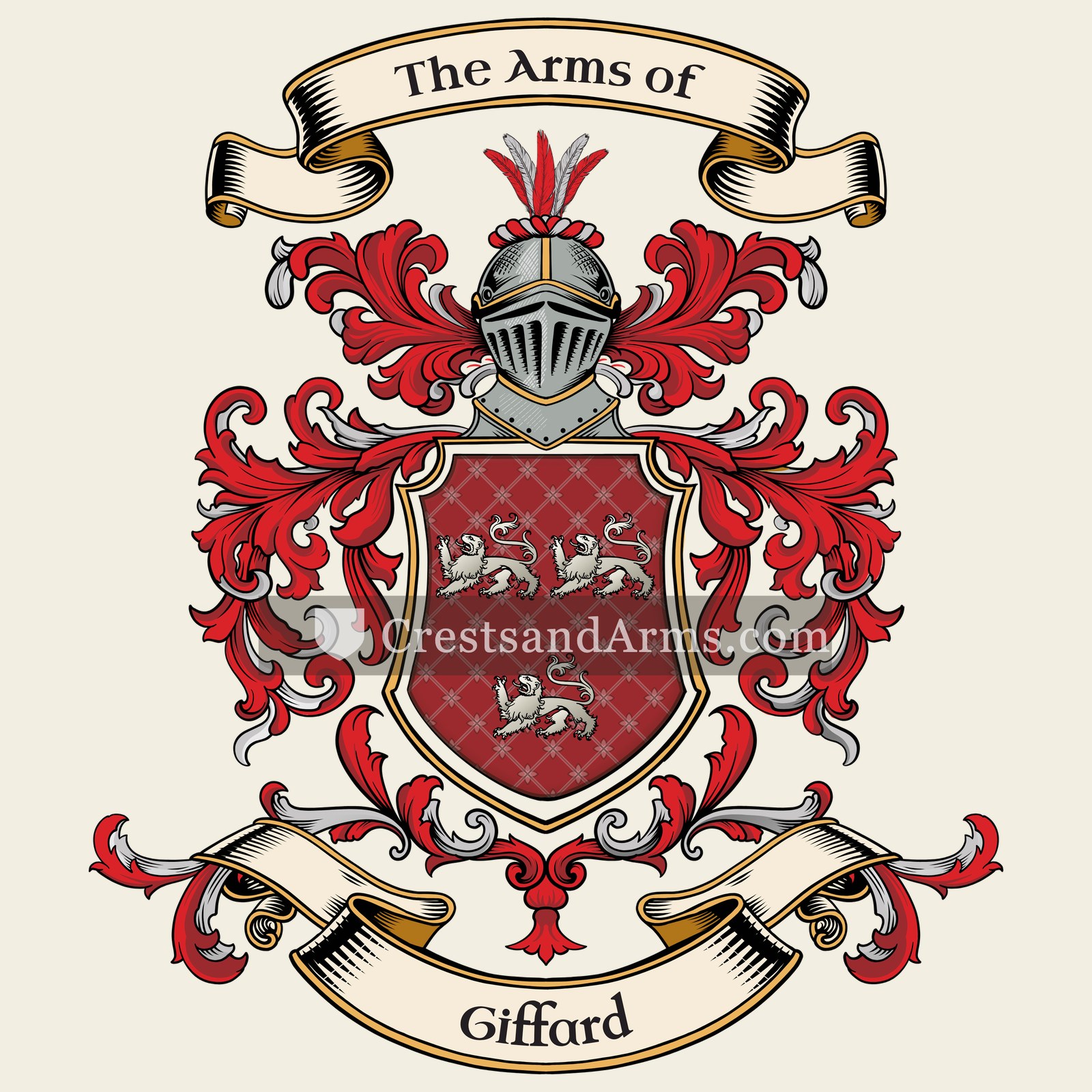
Symbols on this shield
lionCourage, strength and royalty
Colours
Red (Gules)Means: Military strength
Silver (Argent)Means: Peace and sincerity
Historical info
Source
Sir Bernard Burke, The General Armory of England, Scotland, Ireland and Wales, London: Harrison & Sons, 1884
Blazon (the actual original written record)
“Gu. three lions pass. in pale ar”
BuckinghamBuckingham, c. 1164
Digital archive packCoat of arms PNG, gold border print PDF, vector SVG and the certificate of authenticity. Sent to your email in minutes.
Map of England showing where the Giffard arms are recorded
The Giffard arms were recorded in Buckingham, c. 1164.
Buckinghamshire was quiet farming country on the road out of London. Court officials and lawyers bought manors there within easy reach of the capital, and a manor was the usual reason to take arms.
This is where the arms were entered in the register. Families often moved to other parts of the country, so the same name can turn up in more than one region.
The body that granted and recorded arms in England in this period.
Henry II of England
Sovereign of the period
Henry II of England
1154–1189
Reigning in Britain when the Giffard arms are first recorded.
How Arms Worked in England
English heraldry allowed arms to be shared by all legitimate descendants of the original owner. These symbols were treated as personal property that moved through the generations to all children. While the eldest son kept the original design, other family members could use the same shield without needing to change it or register their own unique versions.
Granting authority
The College of Arms in London has regulated the use of coats of arms throughout England and Wales since 1484.
How they got arms
Families typically obtained their coats of arms through a formal grant from the Crown or by proving their ancient right to them.
Where arms were recorded
All official coats of arms are recorded in the registers kept at the College of Arms, which date back to the fifteenth century.
The family's standing
Recorded among the armigerous families of Buckingham.
Origin & History of the Giffard Family in England
The history of the Giffard family in England is deeply rooted in the period following the Norman Conquest. The name itself is of Old French origin and likely began as a nickname describing a person with chubby cheeks. By the middle of the twelfth century, the family had established a significant presence in Buckinghamshire. Records from the year 1164 confirm that members of the Giffard family held land and exercised authority within this region. They were part of a group of influential families who helped manage local affairs and served the interests of the Crown. Over time, their influence spread across various English counties, allowing them to integrate into the social and political fabric of medieval society. Their early activities in Buckingham serve as a clear starting point for understanding how this family transitioned from their continental origins to becoming a recognized part of the English landed class.
Giffard Meaning & Related Branches
Root word
Gebhard
Derived from Germanic elements meaning gift and brave or strong.
This name
GiffardAn Anglo-Norman nickname meaning generous or liberal, often used to describe a bold person.
also spelled
Giffart
Gyffard
Jifard
Gifard
Gifford
Related arms
Giffartvariant spelling
Giffordvariant spelling
Bertramrecorded with Giffard, same area
Lebretonrecorded with Giffard, same area
Documented Sources
J. B. Rietstap, Armorial Général, Gouda: G. B. van Goor Zonen, 1884–87
Reaney, P.H., A Dictionary of English Surnames, 1958
Lower, Mark Antony, Patronymica Britannica: A Dictionary of the Family Names of the United Kingdom, 1860
The National Archives, Probate records of the Prerogative Court of Canterbury, 1700
Kent History and Library Centre, Parish registers of Kent, 1700
Digital archive packCoat of arms PNG, gold border print PDF, vector SVG and the certificate of authenticity. Sent to your email in minutes.


 lionCourage, strength and royalty
 lionCourage, strength and royalty