Map of Germany showing where the Giger arms are recorded
The Giger arms were recorded in Germany, c. 1765.
Arms such as these were typically recorded in Bavaria.
Bavaria was a country of old landed families and walled market towns. Estates passed down the same line for centuries, and both the landowners and the leading townsmen kept arms, which is why so many Bavarian names sit in the registers.
This is where the arms were entered in the register. Families often moved to other parts of the country, so the same name can turn up in more than one region.
The body that granted and recorded arms in Germany in this period.
Francis I, Holy Roman Emperor
Sovereign of the period
Francis I, Holy Roman Emperor
1745–1765
Reigning in Germany when the Giger arms are first recorded.
How Arms Worked in Germany
In the Holy Roman Empire, coats of arms were often granted to individuals by the Emperor or his representatives. These arms were then passed down through the generations to all legitimate descendants of the original holder. Younger branches of a family usually kept the same shield design without needing to change it, as the arms belonged to the entire lineage.
Granting authority
The Holy Roman Emperor held the sole power to grant new coats of arms throughout his vast imperial territories.
How they got arms
Families typically obtained their coats of arms through a formal imperial grant or by proving their noble status to the authorities.
Where arms were recorded
These grants were officially recorded in the Imperial Chancery registers, which began keeping formal records of such honors during the Middle Ages.
The family's standing
Recorded among the armigerous families of Germany.
Origin & History of the Giger Family in Germany
The family name Giger originated in the southern regions of German-speaking Europe, where it functioned as a descriptive occupational or personal identifier. Linguists believe the name is rooted in the Middle High German word gige, which refers to a fiddle or a similar stringed instrument. This suggests that the earliest ancestors to carry the name may have been professional musicians, wandering minstrels, or perhaps skilled instrument makers. By the mid-eighteenth century, the family had established a firm presence in Bavaria, a region known for its strong traditions in music and craftsmanship. Records from 1765 confirm that members of the Giger family were integrated into the local social and economic life of the Bavarian countryside during this period. As these individuals lived and worked in their communities, the name transitioned from a simple description of a trade into a permanent hereditary surname passed down through generations.
Coat of Arms & Family Crest Details
Symbols on this shield
lionCourage, strength and royalty
Colours
Black (Sable)Means: Constancy
Gold (Or)Means: Generosity
Historical info
Source
J. B. Rietstap, Armorial Général, Gouda: G. B. van Goor Zonen, 1884–87
Blazon (the actual original written record)
“Coupé de sa. sur or; à un lion de l'un en l'autre. Cq. cour. C.: un lion iss. d'or, tenant une épée; entre un vol de sa.”
Austriac. 1772
Digital archive packCoat of arms PNG, gold border print PDF, vector SVG and the certificate of authenticity. Sent to your email in minutes.
Map of Austria showing where the Giger arms are recorded
The Giger arms were recorded in Austria, c. 1772.
Arms such as these were typically recorded in Tyrol.
Tyrol was mountain country in western Austria, where the valleys were held by families who had been there a very long time. Old tenure counted for more than money, and old families carried arms.
This is where the arms were entered in the register. Families often moved to other parts of the country, so the same name can turn up in more than one region.
Region
Tyrol
First recorded
1772
Granting Authority for the Giger Arms
Imperial and Royal chancery
Sodacan · CC BY-SA 3.0
The body that granted and recorded arms in Austria in this period.
Joseph II, Holy Roman Emperor
Sovereign of the period
Joseph II, Holy Roman Emperor
1765–1790
Reigning in Germany when the Giger arms are first recorded.
How Arms Worked in Austria
Austrian coats of arms were often linked directly to noble titles granted by the Emperor. These symbols belonged to the entire family line rather than just one individual. When a family grew, new branches kept the original design without needing to change it. This system allowed all members of a noble house to share the same identity across many generations.
Granting authority
The Imperial and Royal chancery managed all heraldic matters and controlled the official granting of arms throughout the Austrian lands.
How they got arms
Families typically received their arms through a formal imperial decree that often accompanied the elevation of a person to noble status.
Where arms were recorded
Official records of these grants were kept in the Imperial Register of Nobility which began its formal documentation process in 1453.
The family's standing
Recorded among the armigerous families of Austria.
Origin & History of the Giger Family in Austria
The surname Giger has deep roots in the mountainous landscape of the Austrian Tyrol, where families bearing this name were well-established by the late 18th century. Etymologically, the name is often linked to the Middle High German word "gige," which refers to a fiddle or a stringed instrument. This suggests that the earliest ancestors to carry the name may have been musicians or entertainers who traveled through the Alpine valleys. By 1772, records confirm that the Giger family was firmly integrated into the local social fabric of the Tyrol region. Life in this area during that time was defined by harsh winters and a strong reliance on agriculture and trade. As members of a rural community, the early Gigers likely lived as independent farmers or skilled craftsmen who adapted to the challenging terrain of the Eastern Alps. Their presence in official documents from this era highlights a family that was stable, hardworking, and deeply connected to the traditions of the Austrian highlands.
Coat of Arms & Family Crest Details
Symbols on this shield
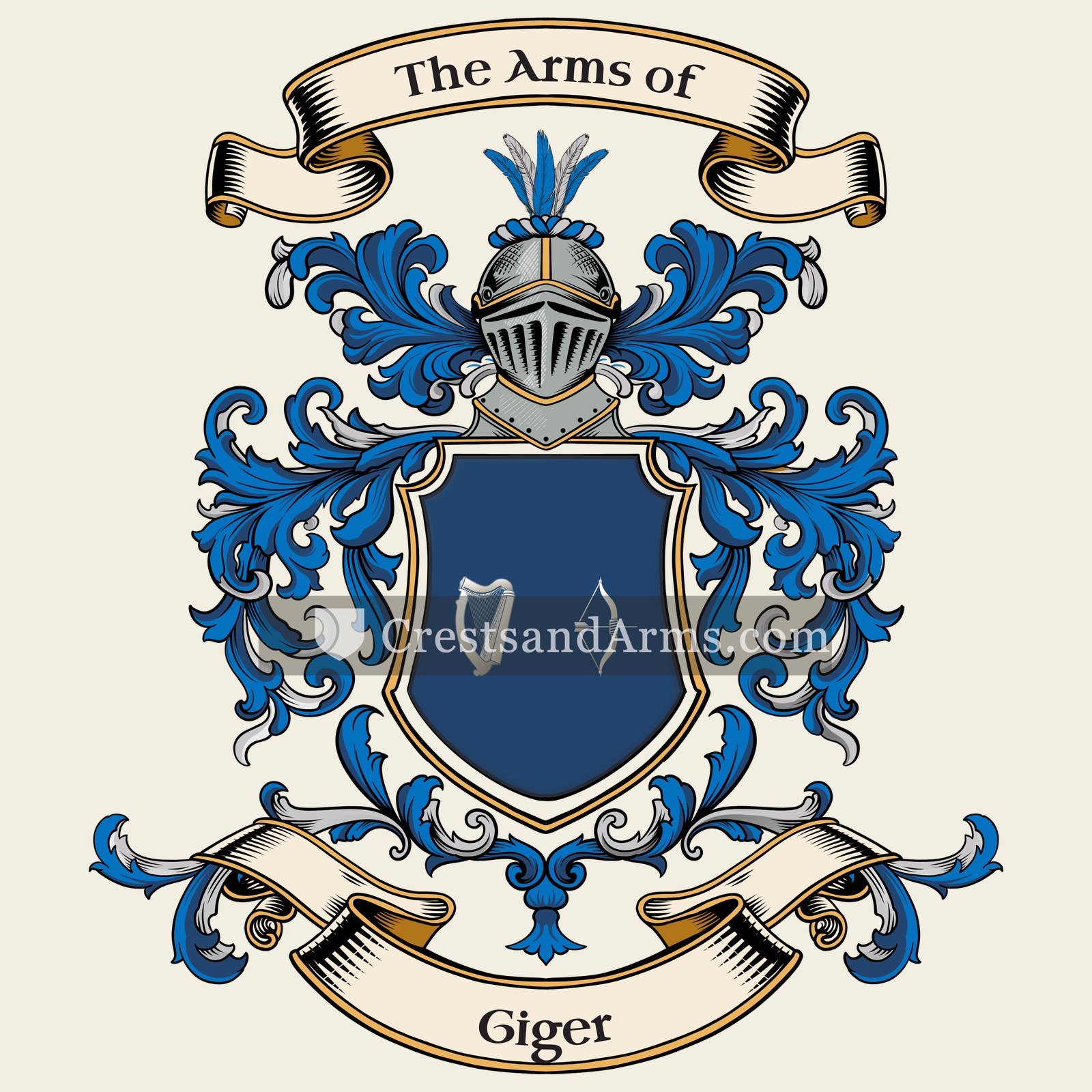
harpWell-tuned governance and love of music
bowReadiness, and the strength held in reserve
Colours
Blue (Azure)Means: Loyalty and truth
Historical info
Source
J. B. Rietstap, Armorial Général, Gouda: G. B. van Goor Zonen, 1884–87
Blazon (the actual original written record)
“D'azur à un violon, posé en bande, le manche en haut, et un archet, br. en fasce, le tout au nat. C.: une corneille de sa. L. d'arg. et d'azur.”
SwitzerlandBâle, c. 1745
Digital archive packCoat of arms PNG, gold border print PDF, vector SVG and the certificate of authenticity. Sent to your email in minutes.
Map of Switzerland showing where the Giger arms are recorded
The Giger arms were recorded in Bâle, c. 1745.
This is where the arms were entered in the register. Families often moved to other parts of the country, so the same name can turn up in more than one region.
The body that granted and recorded arms in Switzerland in this period.
How Arms Worked in Switzerland
In Switzerland, coats of arms were not restricted to the nobility and were often adopted by common citizens and families. These symbols were passed down through generations to show family identity. When branches of a family grew, they often changed small details of the design to distinguish their own line from the original group.
Granting authority
Cantonal and civic authorities managed the use of coats of arms within their specific regions and local jurisdictions.
How they got arms
Families typically assumed their own coats of arms based on local custom rather than receiving them from a central monarch.
Where arms were recorded
Arms were recorded in various cantonal and civic registers starting from the fourteenth century throughout the Swiss region.
The family's standing
Recorded among the armigerous families of Switzerland.
Origin & History of the Giger Family in Switzerland
The Giger family name has deep roots in the Swiss landscape, evolving from a descriptive term used to identify individuals in medieval alpine communities. In the German-speaking regions of Switzerland, the name is historically linked to the word "Gige," which referred to a traditional stringed instrument similar to a fiddle. This suggests that early ancestors may have been musicians or entertainers who traveled between villages to perform at local gatherings. By the mid-eighteenth century, the family established a notable presence in the city of Basel, where records confirm their residence by 1745. During this period, Basel served as a major center for trade and intellectual exchange, allowing families like the Gigers to integrate into the urban economy as skilled craftsmen and merchants. Their transition from rural life to the bustling environment of Basel reflects the broader social shifts occurring in Switzerland as families sought new opportunities in growing city centers.
Giger Meaning & Related Branches
Root word
Gige
A Middle High German term for a fiddle or stringed instrument.
This name
GigerAn occupational surname for a professional fiddler or a maker of stringed instruments.
also spelled
Gyger
Giger
Documented Sources
J. B. Rietstap, Armorial Général, Gouda: G. B. van Goor Zonen, 1884–87
Bahlow, Hans, Deutsches Namenlexikon: Familien- und Vornamen nach Ursprung und Sinn erklärt, 1967
Heintze, Albert, Die deutschen Familiennamen: geschichtlich, geographisch, sprachlich, 1903


 eagleNobility, strength and a keen mind
 eagleNobility, strength and a keen mind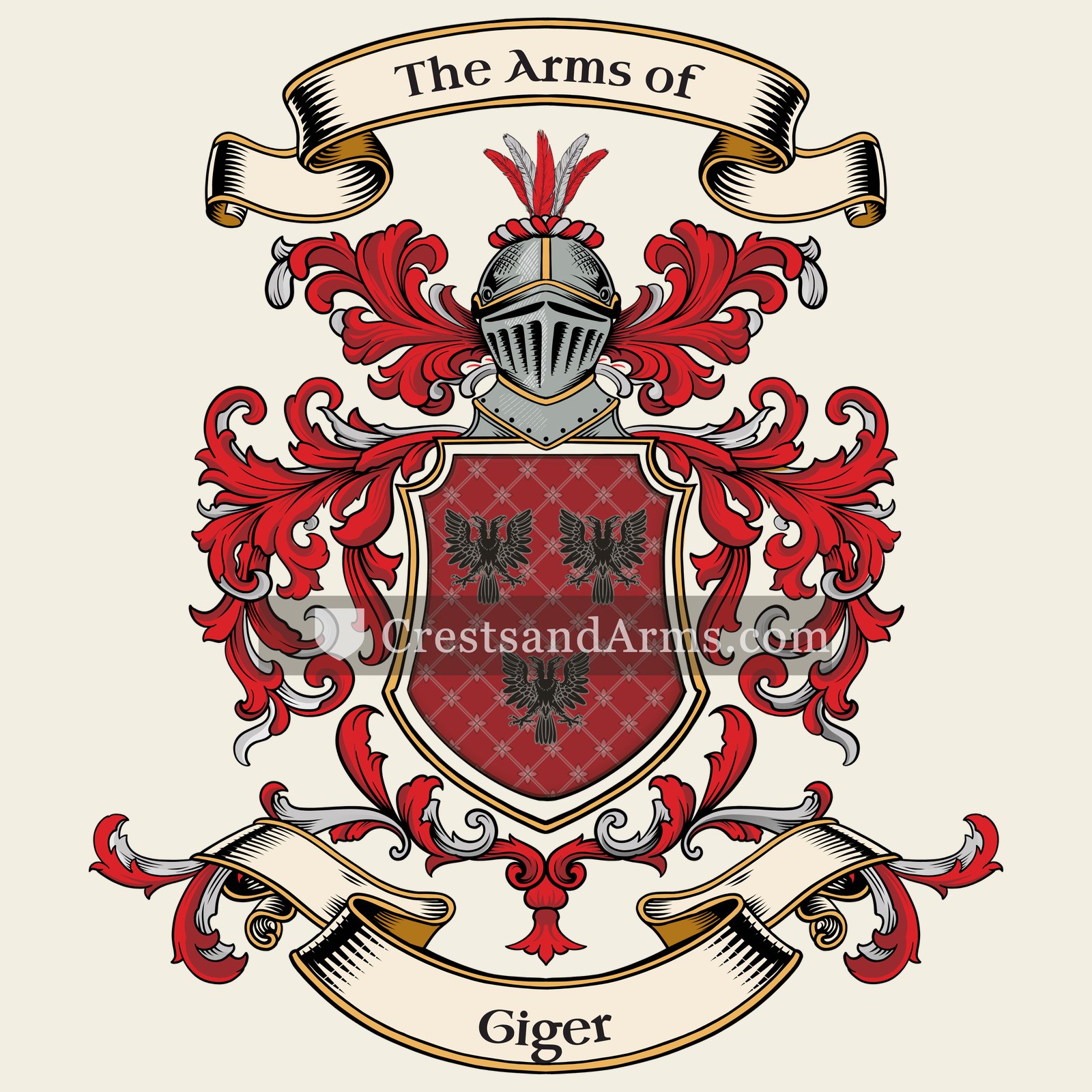


 lionCourage, strength and royalty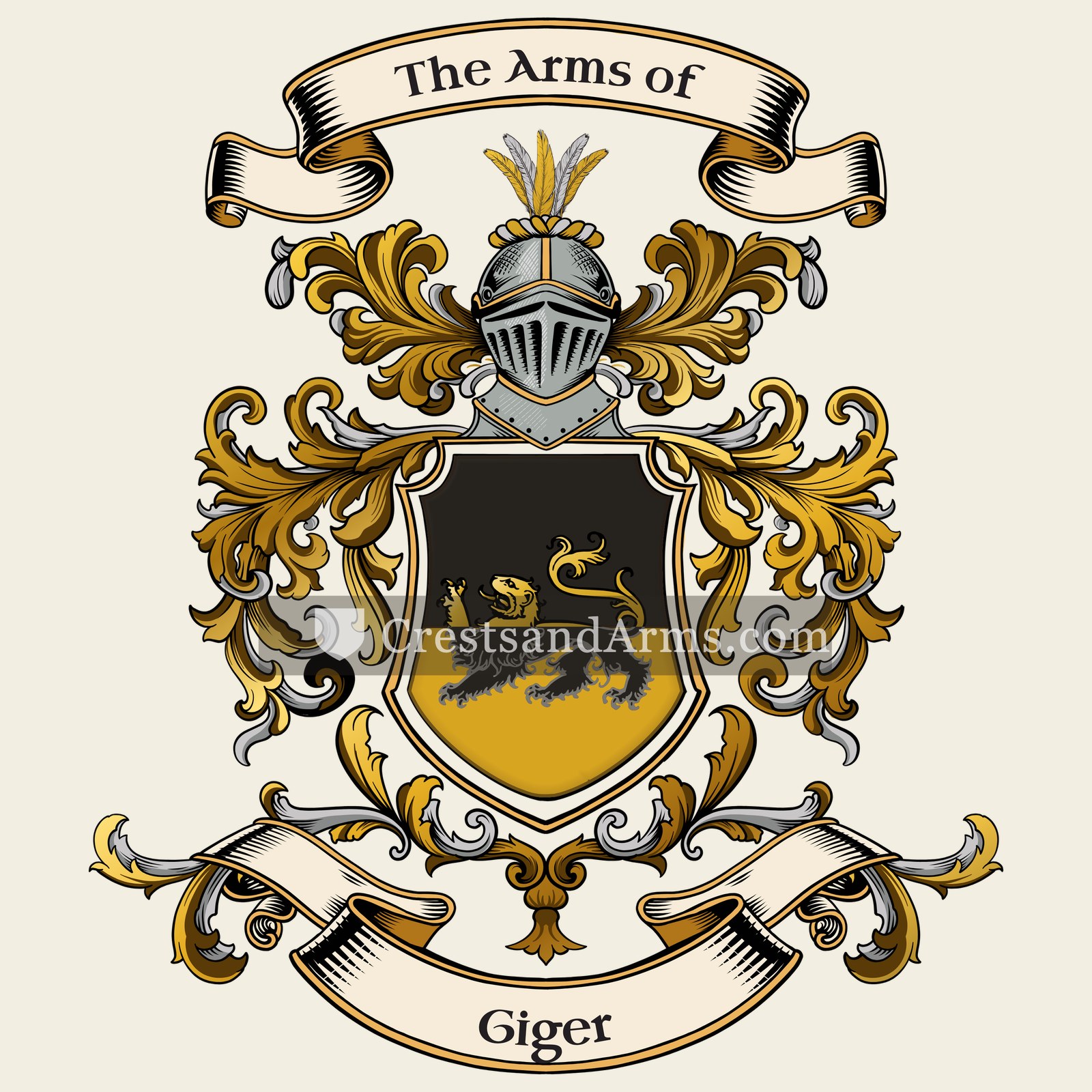


 harpWell-tuned governance and love of music
 bowReadiness, and the strength held in reserve