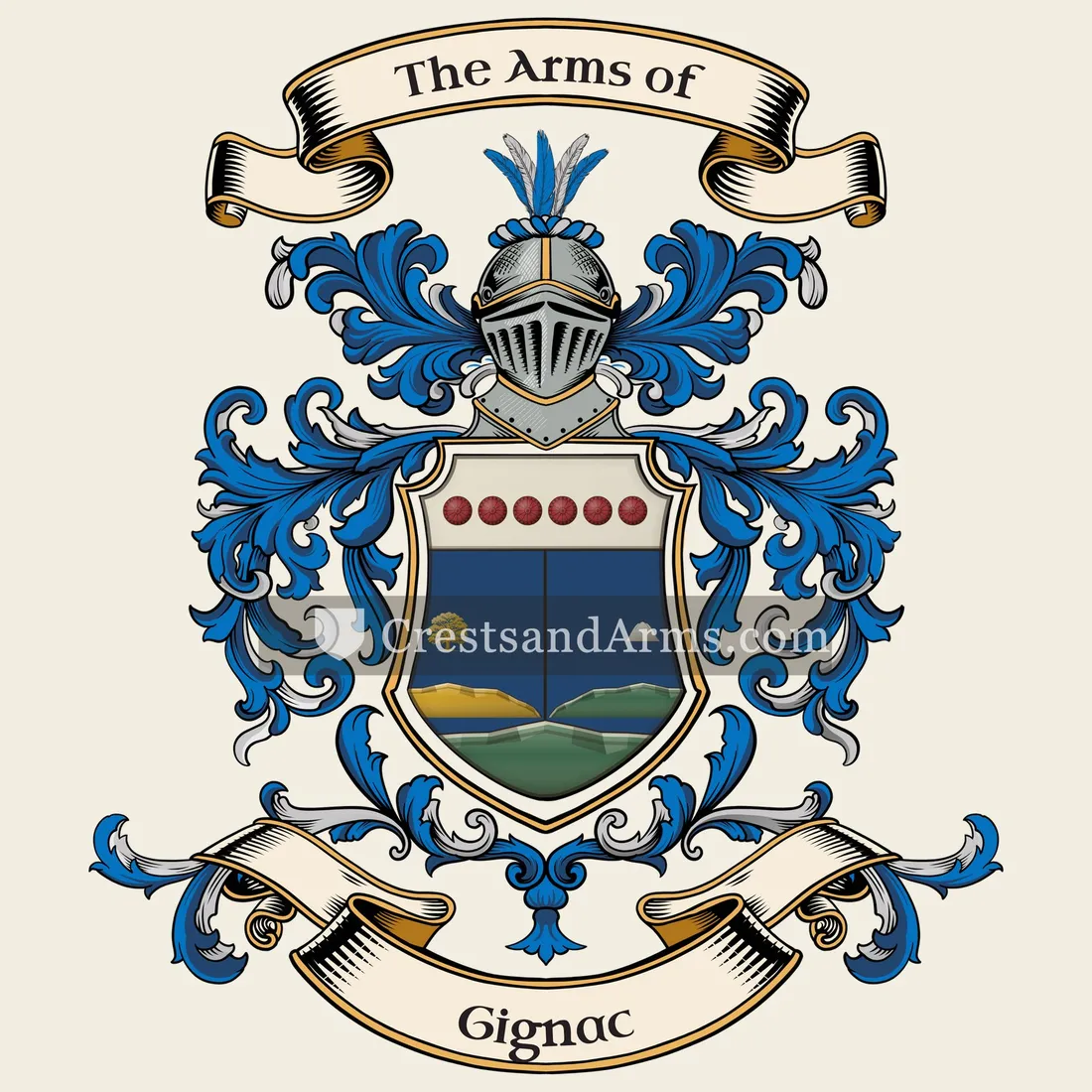
A record of documented arms, meaning and origin, researched for the Gignac family of France.
Reg. 6875 · French, G–I
Meaning of the Gignac family crest colors & symbols
Symbols on this shield
mountThe ground held, and steadfastness upon it
chiefAuthority, wisdom and dominion
roundelA coin, and one who has been to the crusades
treeLife, endurance and deep roots
Colours
Blue (Azure)Means: Loyalty and truth
Silver (Argent)Means: Peace and sincerity
Green (Vert)Means: Hope
Gold (Or)Means: Generosity
Red (Gules)Means: Military strength
Historical info
Source
J. B. Rietstap, Armorial Général, Gouda: G. B. van Goor Zonen, 1884–87
Blazon (the actual original written record)
“Parti: au 1 d'azur à un arbre d'or, terrassé du même; au 2 d'azur à un rocher de six coupeaux d'arg. Au chef de l'écu d'arg., br. sur le parti et ch. de six tourt. de gu.”
OrleanaisOrleanais, c. 1663
Digital archive packCoat of arms PNG, gold border print PDF, vector SVG and the certificate of authenticity. Sent to your email in minutes.
Map of France showing where the Gignac arms are recorded
The Gignac arms were recorded in Orleanais, c. 1663.
Orleanais lay on the Loire around Orleans, close enough to Paris for court money to reach it. Officials and lawyers who did well bought estates there, and an estate brought a coat of arms with it.
This is where the arms were entered in the register. Families often moved to other parts of the country, so the same name can turn up in more than one region.
The body that granted and recorded arms in France in this period.
Louis XIV of France
Sovereign of the period
Louis XIV of France
1643–1715
Reigning in France when the Gignac arms are first recorded.
How Arms Worked in France
In France, a coat of arms was a mark of honor that passed down through the male line to all legitimate descendants. Families often used the same shield without changes to show their shared heritage. If a branch wanted to stand out, they could add a small mark to their shield to show their specific place in the family tree.
Granting authority
The Juge d'armes de France acted as the official authority that regulated and verified coats of arms across the country.
How they got arms
Families typically inherited their arms from ancestors, though they could also receive them through royal grants or by proving their noble status.
Where arms were recorded
Coats of arms were officially recorded in the Armorial Général de France, which began its main collection in the year 1696.
The family's standing
Recorded among the armigerous families of Orleanais.
Origin & History of the Gignac Family in France
The Gignac family name finds its historical roots in the Orléanais region of north-central France. By the year 1663, records confirm that members of this family were established in this fertile area along the Loire River. During the seventeenth century, many people from this part of France began to look toward the New World for new opportunities. The name itself is thought to be locative, meaning it likely identified people based on the specific village or land they occupied before moving to other regions. As these early ancestors transitioned from their life in Orléanais to the challenges of colonial life, they carried their family identity with them, helping to preserve a connection to their French heritage that has lasted for centuries.
Gignac Meaning & Related Branches
Root word
Gigniacus
A Gallo-Roman estate belonging to a person named Gignius.
This name
GignacDerived from a topographic location or ancestral landholding originating in the Limousin region of France.
also spelled
Guignas
Guignasse
Guignacee
Geenyas
Documented Sources
J. B. Rietstap, Armorial Général, Gouda: G. B. van Goor Zonen, 1884–87
Jetté, René, Dictionnaire généalogique des familles du Québec, 1983
Library and Archives Canada, Fonds du Ministère des Colonies (Série C11A: Correspondance générale relative à la Nouvelle-France), 1663
Digital archive packCoat of arms PNG, gold border print PDF, vector SVG and the certificate of authenticity. Sent to your email in minutes.


 mountThe ground held, and steadfastness upon it
 chiefAuthority, wisdom and dominion
 roundelA coin, and one who has been to the crusades
 treeLife, endurance and deep roots
 mountThe ground held, and steadfastness upon it
 chiefAuthority, wisdom and dominion
 roundelA coin, and one who has been to the crusades
 treeLife, endurance and deep roots