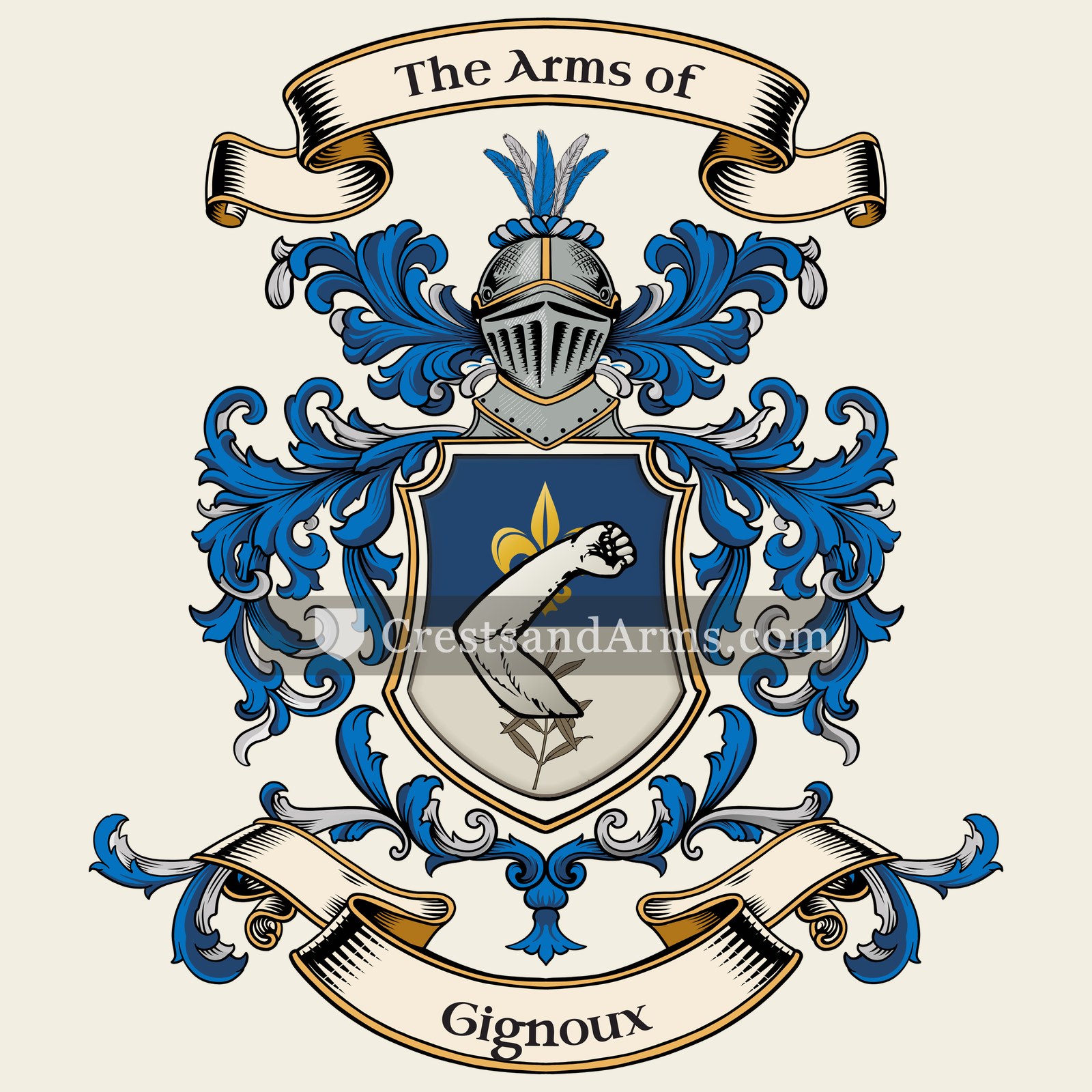
A record of documented arms, meaning and origin, researched for the Gignoux family of Germany.
Reg. 6592 · German, G–I
Coat of Arms & Family Crest Details
Symbols on this shield
armA person of action, industrious and laborious
fleur de lisPurity, light, and the sixth son
branchPeace, and new growth
Colours
Blue (Azure)Means: Loyalty and truth
Silver (Argent)Means: Peace and sincerity
Gold (Or)Means: Generosity
Historical info
Source
J. B. Rietstap, Armorial Général, Gouda: G. B. van Goor Zonen, 1884–87
Blazon (the actual original written record)
“Coupé: au 1 parti: a. d'azur à une fleur-de-lis d'or; b. d'arg. à une branche de pommier en barre, feuillée et fruitée au nat.; au 2 d'or à un senestrochère, coupé à l'épaule et ensanglanté, paré d'arg., tenant une lampe antique de sa., allumée de gu. C.: un pommier de sin., fruité de quatre pièces d'or. L.: d'or et d'azur.”
Germanyc. 1792
Digital archive packCoat of arms PNG, gold border print PDF, vector SVG and the certificate of authenticity. Sent to your email in minutes.
Map of Germany showing where the Gignoux arms are recorded
The Gignoux arms were recorded in Germany, c. 1792.
Arms such as these were typically recorded in Bavaria.
Bavaria was a country of old landed families and walled market towns. Estates passed down the same line for centuries, and both the landowners and the leading townsmen kept arms, which is why so many Bavarian names sit in the registers.
This is where the arms were entered in the register. Families often moved to other parts of the country, so the same name can turn up in more than one region.
The body that granted and recorded arms in Germany in this period.
Leopold II, Holy Roman Emperor
Sovereign of the period
Leopold II, Holy Roman Emperor
1790–1792
Reigning in Germany when the Gignoux arms are first recorded.
How Arms Worked in Germany
In the Holy Roman Empire, coats of arms were often granted to individuals by the Emperor or his representatives. These arms were then passed down through the generations to all legitimate descendants of the original holder. Younger branches of a family usually kept the same shield design without needing to change it, as the arms belonged to the entire lineage.
Granting authority
The Holy Roman Emperor held the sole power to grant new coats of arms throughout his vast imperial territories.
How they got arms
Families typically obtained their coats of arms through a formal imperial grant or by proving their noble status to the authorities.
Where arms were recorded
These grants were officially recorded in the Imperial Chancery registers, which began keeping formal records of such honors during the Middle Ages.
The family's standing
Recorded among the armigerous families of Germany.
Origin & History of the Gignoux Family in Germany
The Gignoux family name carries a rich history that likely traces its roots to the French-speaking regions of Europe before members eventually migrated eastward. By the late 18th century, the family had firmly established a presence in Bavaria, where records confirm their residence by 1792. During this era, families with this name were often associated with skilled craftsmanship or trade, which allowed them to integrate into the social and economic structures of the German states. As they settled into their new surroundings, they adapted to the local culture while maintaining the distinct identity associated with their surname. This transition from their ancestral origins to the Bavarian landscape highlights a period of significant movement and adaptation for the family during a time of great political change in Europe.
Gignoux Meaning & Related Branches
Root word
Gigno
Latin verb meaning to beget, produce, or give birth to.
This name
GignouxA locative or occupational surname likely denoting one who is productive or born of a specific place.
also spelled
Gignou
Zheenoo
Documented Sources
J. B. Rietstap, Armorial Général, Gouda: G. B. van Goor Zonen, 1884–87
Bayerisches Hauptstaatsarchiv, General-Landes-Direktion, Akten der Regierung von Oberbayern
Kohl, Wilhelm, Die Einwanderung französischer Familien in die süddeutschen Staaten, 1985
Stadtarchiv München, Bürgerrechtsverzeichnisse und Einwohnermelderegister, 1792
Digital archive packCoat of arms PNG, gold border print PDF, vector SVG and the certificate of authenticity. Sent to your email in minutes.


 armA person of action, industrious and laborious
 fleur de lisPurity, light, and the sixth son
 branchPeace, and new growth
 armA person of action, industrious and laborious
 fleur de lisPurity, light, and the sixth son
 branchPeace, and new growth